
Matrices and methods for storage and stabilization of biological samples comprising viral RNA
a biological sample and matrix technology, applied in the field of viral rna, can solve the problems of false negative diagnosis, too high analysis volume, and too expensive systems, and achieve the effects of high volume, high throughput, and time-consuming and/or laborious
Patent Information
- Authority / Receiving Office
- US · United States
- Patent Type
- Applications(United States)
- Current Assignee / Owner
- Publication Date
- 2020-06-18
- Estimated Expiration
- Not applicable · inactive patent
Smart Images
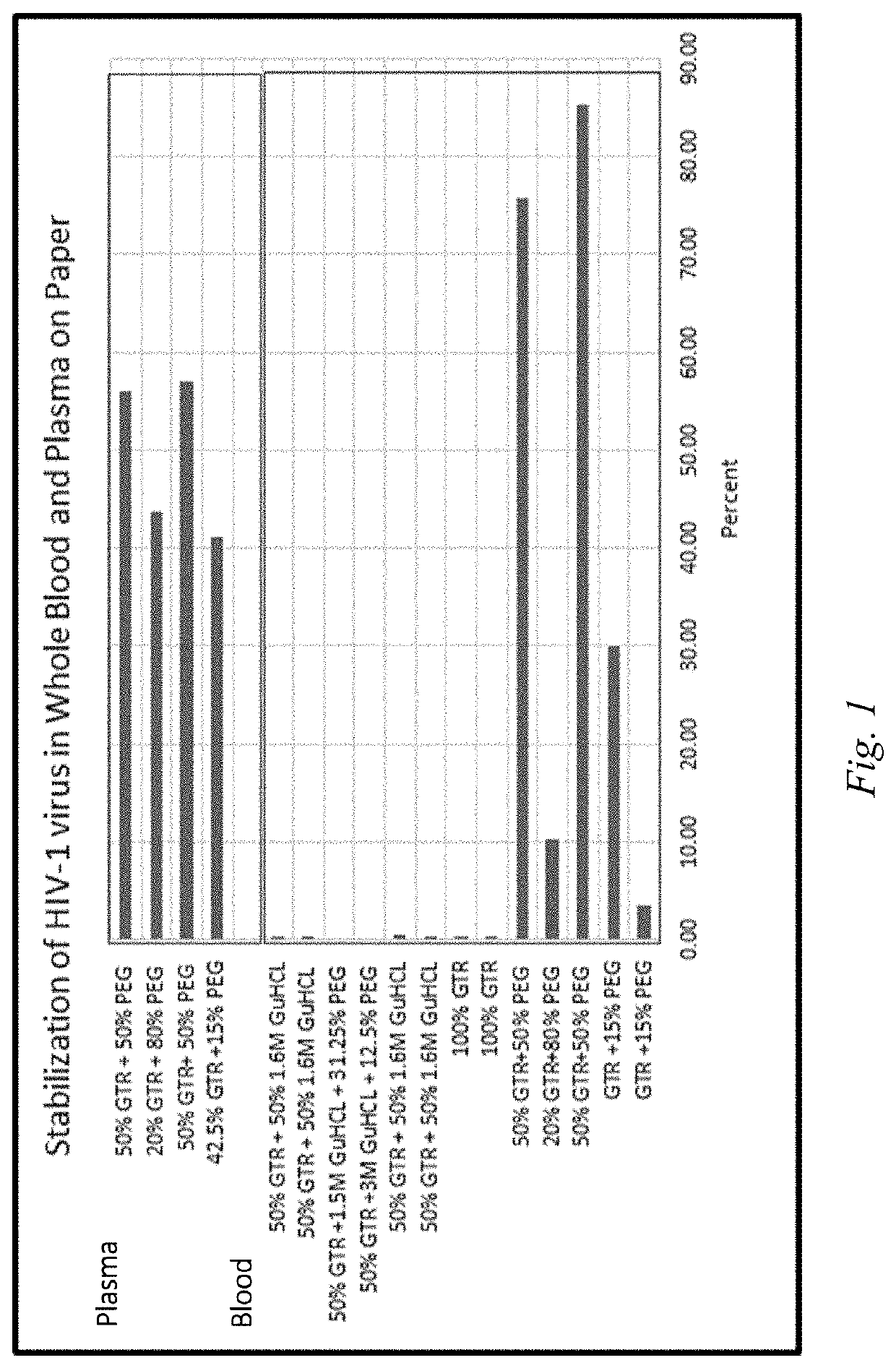
Figure 1 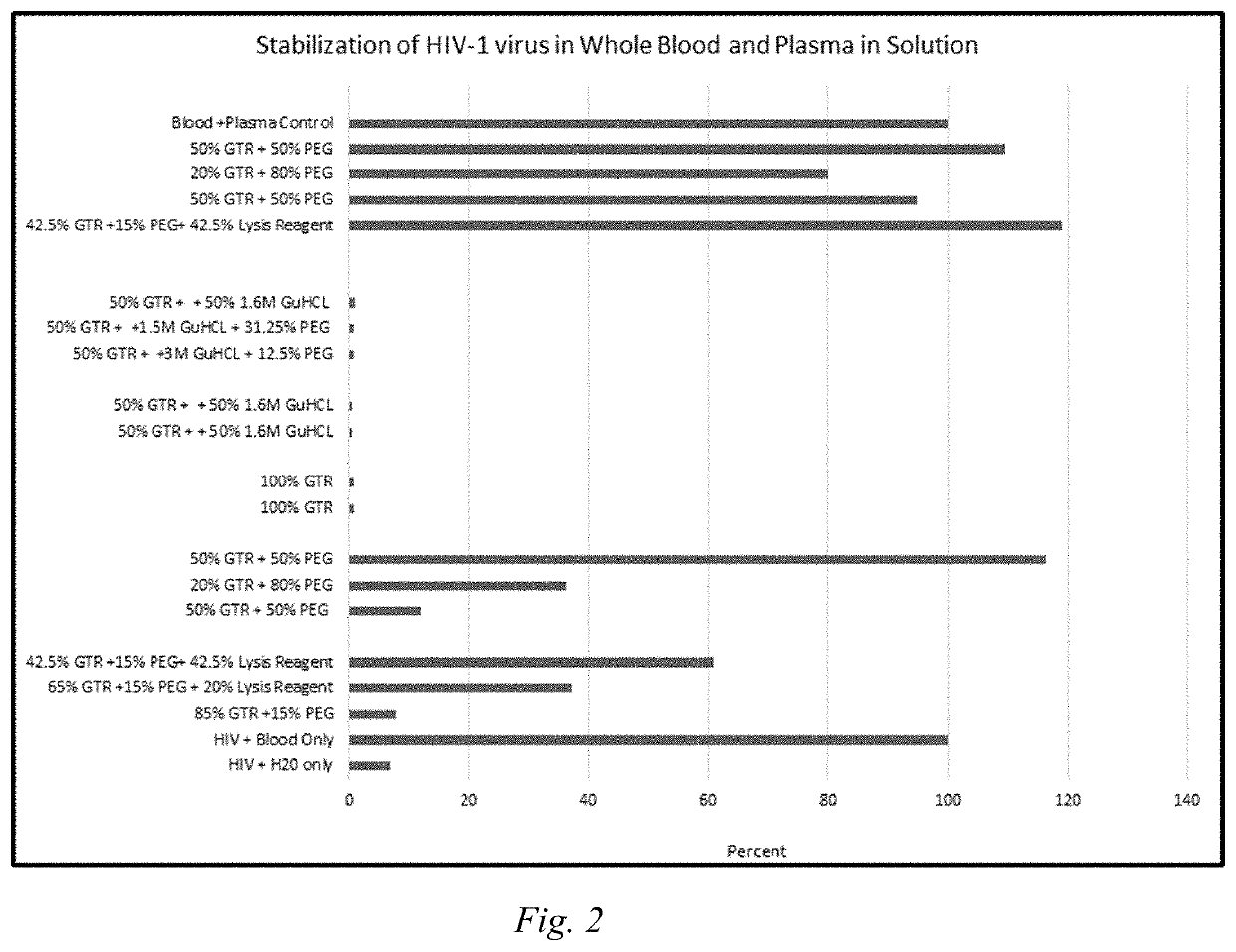
Figure 2 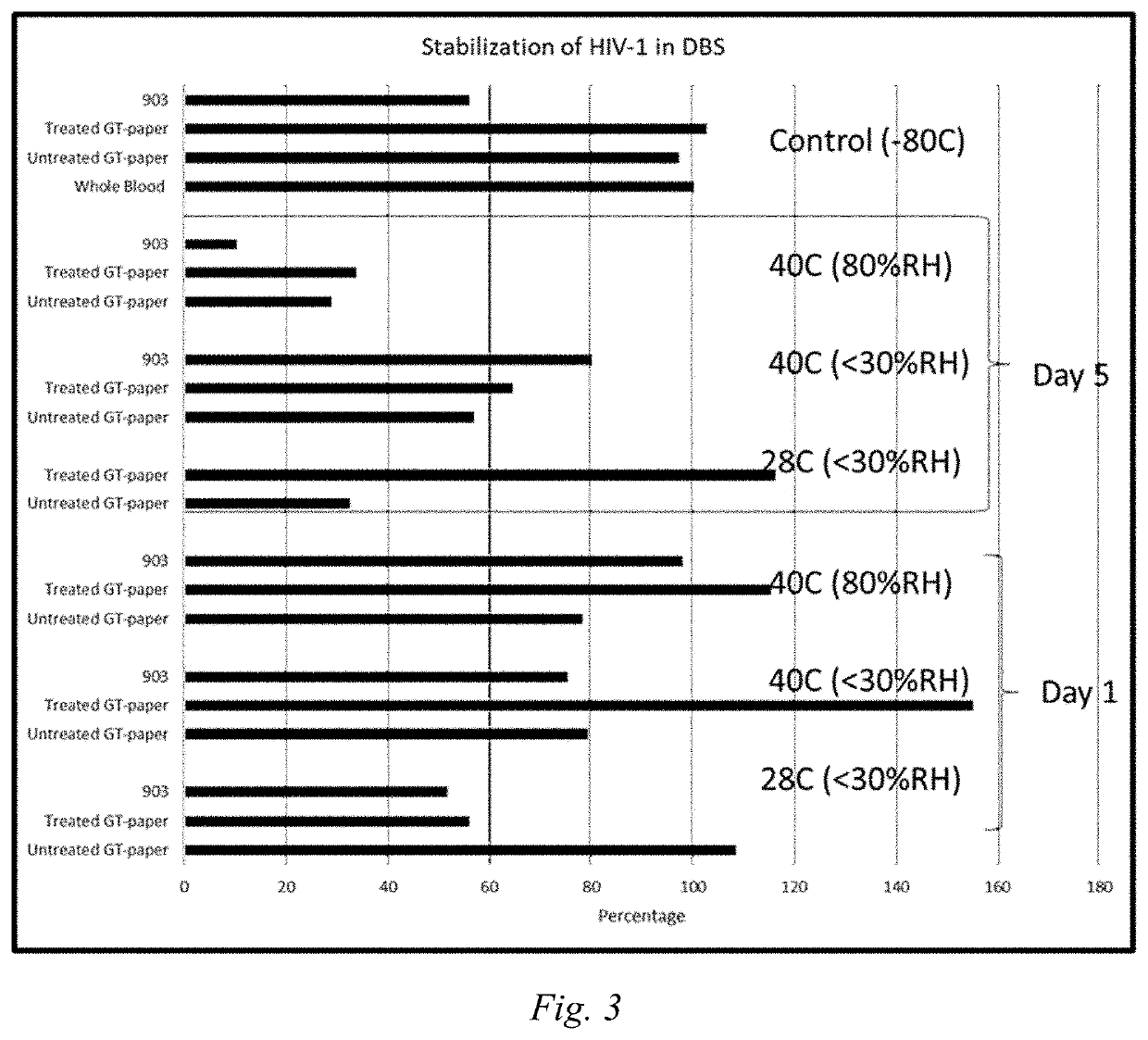
Figure 3
Abstract
Description
GOVERNMENT SPONSORSHIP
[0001] This invention was made with government support under Grant Contract Number 12244564 awarded by the NIAID division of the NIH. The government has certain rights in the invention.FIELD OF THE INVENTION
[0002] The invention relates generally to matrices and methods for stabilizing and storing biological samples containing nucleic acids, particularly RNA and especially viral RNA, wherein the stabilization and storage occurs before additional processing, isolation, and analytical steps have taken place.BACKGROUND OF THE INVENTION
[0003] Many industries require effective methods and systems of stabilizing and storing fully intact nucleic acid sequences obtained from raw samples, such as genomic DNA and RNA obtained from whole blood and plasma. For the pharmaceutical, medical, law enforcement, military, and other molecular research industries, it is highly desirable to store and have access to many biological samples containing nucleic acids. Stabilization and stor...
Examples
example 1
[0091]The compositions of the present application were evaluated for their ability to stabilize HIV-1 virus present in both whole blood and plasma on paper. The whole blood and plasma were provided in a solid state, in the form of dried plasma spots (DPS) and dried blood spots (DBS). To further evaluate the effect of PEG as a cell separation reagent, various weight percentages of PEG-600 were evaluated. In particular, PEG-600 was evaluated at weight percentages of 15%, 50%, and 80% in the stabilization of DPS. For DBS, PEG was evaluated at 12.5%, 15%, 31.25%, 50% and 80% PEG.
[0092]The effect of PEG in the formulations of the present application were compared to a control comprising the other components of composition according to the application but excluding PEG, and to a comparative formula using Guanidium chloride (GuHCl), a denaturing chaotropic agent, in place of PEG. These formulations can be shown in Table 1 below, wherein Formulation 1 represents the formulation according to...
example 2
[0095]The experimental procedures of Example 1 were repeated, except that the stabilization of HIV-1 virus was evaluated for whole blood and plasma in solution. In addition to the formulations and compositions in Table 1, further controls were added. The additional controls in this case were a solution of HIV-1 virus and blood only, the HIV-1 virus and water only, and finally the HIV-1 virus and plasma only. These controls contained 210,000 copies / mL of the HIV virus, spiked in 30 uL whole blood, plasma, or water. These controls were stored at −80° C., mimicking currently existing storage procedures. Like Example 1, the preservation and storage efficacy are expressed in terms of percent recovery. The results of this evaluation are shown in FIG. 2.
[0096]FIG. 2 shows that for samples stored in solution, the presence of PEG is important for the successful storage and recovery of the HIV-1 virus in solution.
example 3
[0097]The test procedures of Example 1 were repeated, except that the samples evaluated were 903, paper treated according to formulation 1 of table 1, untreated paper, and whole blood. These samples where then applied to paper and dried as DBS samples according to Example 1. The DBS samples were dried at 72 C for 2 hours followed by storage for 1 day and 5 days at either 40 C with 80% relative humidity, 40 C with <30% relative humidity or at ambient temperature of 28 C with <30% relative humidity. Representative control DBS samples on 903 paper, untreated GT-paper and GT-paper treated with formulation 1 and control liquid whole blood samples were stored at −80 C. At the end of the 1 day and 5 day incubation periods, the experimental and control DBS samples were rehydrated with nuclease free water to the original volume of the sample applied to the DBS and analyzed with the COBAS® TaqMan® HIV-1 Test. The results of this evaluation are shown in FIG. 3.
[0098]FIG. 3 shows that the treat...