
Battery simulator having compensation impedance
Patent Information
- Authority / Receiving Office
- US · United States
- Current Assignee / Owner
- Publication Date
- 2022-06-23
Smart Images
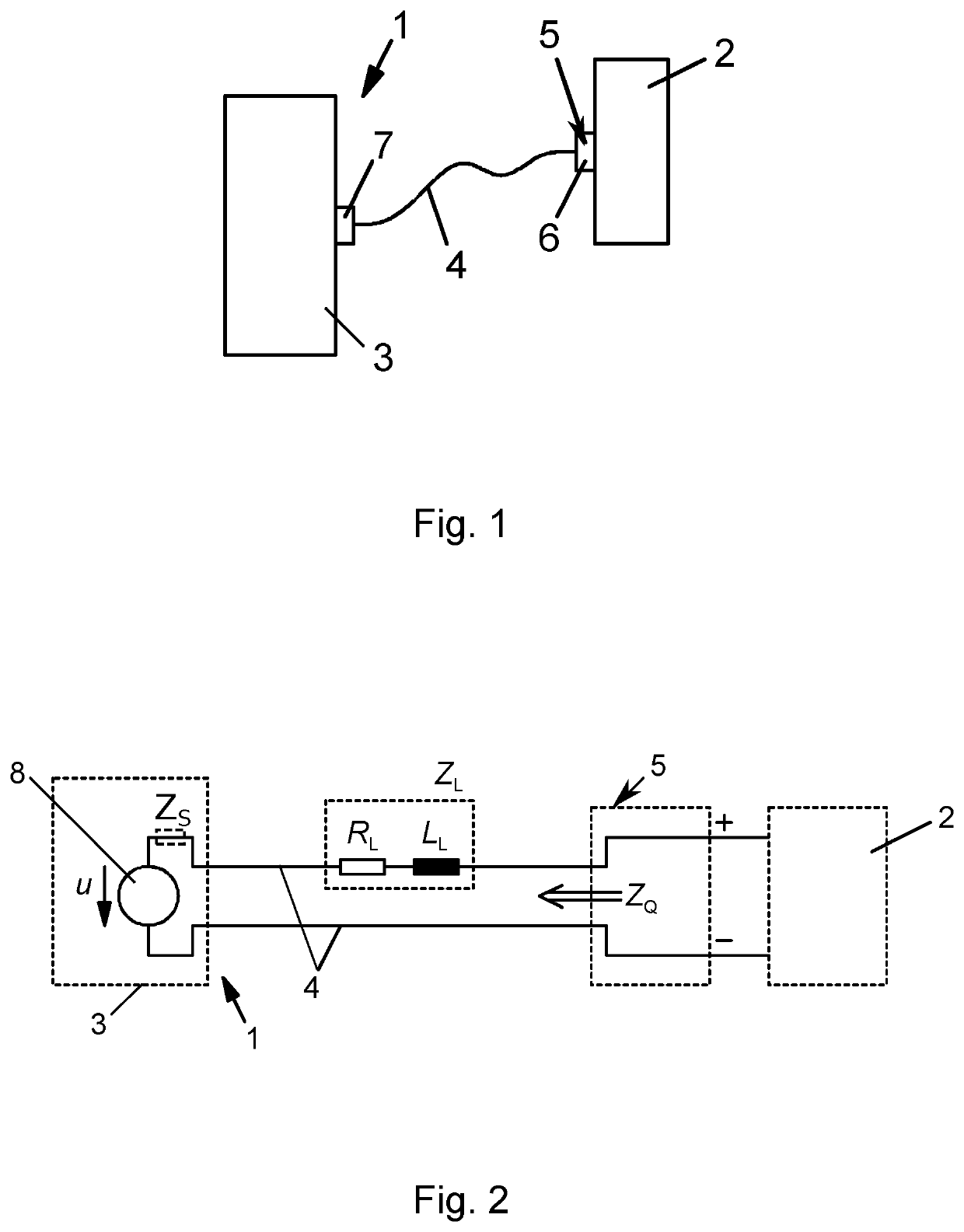
Figure 1 
Figure 2
Abstract
Description
TECHNICAL FIELD
[0001] The invention relates to a device for the testing, in particular the high-frequency testing, of a test item, for example of an electrical machine or a converter, having:
[0002] a simulation unit for the simulation of an electrical energy storage with the aid of a simulation model, and
[0003] an electrical connecting line, by way of which the test item can be connected to the simulation unit.BACKGROUND AND SUMMARY
[0004] The invention furthermore relates to a method for the testing, in particular the high-frequency testing, of a test item, for example of an electrical machine or a converter, in which the test item is connected to a simulation unit by way of an electrical connecting line, wherein the simulation unit simulates an electrical energy storage with the aid of a simulation model.
[0005] The voltage of an energy storage, such as a battery or an accumulator, is not constant, but depends on the profile of the present and past current flow, on the state of charge, t...
Examples
Embodiment Construction
[0035]FIG. 1 shows a simplified representation of the device 1 in accordance with the invention, to which is connected a test item 2 in the form of an electric drive unit. The device 1 has a simulation unit 3 for the simulation of an electrical energy storage, for example a battery or an accumulator, and an electrical connecting line 4, at the end of which is located a connecting unit 5, with a plug and / or coupling unit 6. However, screw terminals can also be provided on the connecting unit 5. The plug and / or coupling unit 6 is connected to the test item 2, and establishes an electrical connection between the test item 2 and the simulation unit 3.
[0036]The simulation unit 3 can be formed by a computer or a microprocessor, and can provide a current and a voltage in accordance with a simulation model by way of an output 7. Current and voltage are transferred to the test item 2 by way of the connecting line 4. The simulation unit 3 thus essentially corresponds to a feedforward controll...