
Speech recognition circuit using parallel processors
a technology of parallel processors and speech recognition, applied in speech recognition, speech analysis, instruments, etc., can solve the problems of large amount of communication and synchronization between threads, high computational intensity of search, and the biggest challenge of the search process, so as to increase the accuracy, not increase the memory requirements
Patent Information
- Authority / Receiving Office
- US · United States
- Patent Type
- Patents(United States)
- Current Assignee / Owner
- Publication Date
- 2014-07-01
- Estimated Expiration
- Not applicable · inactive patent
Smart Images
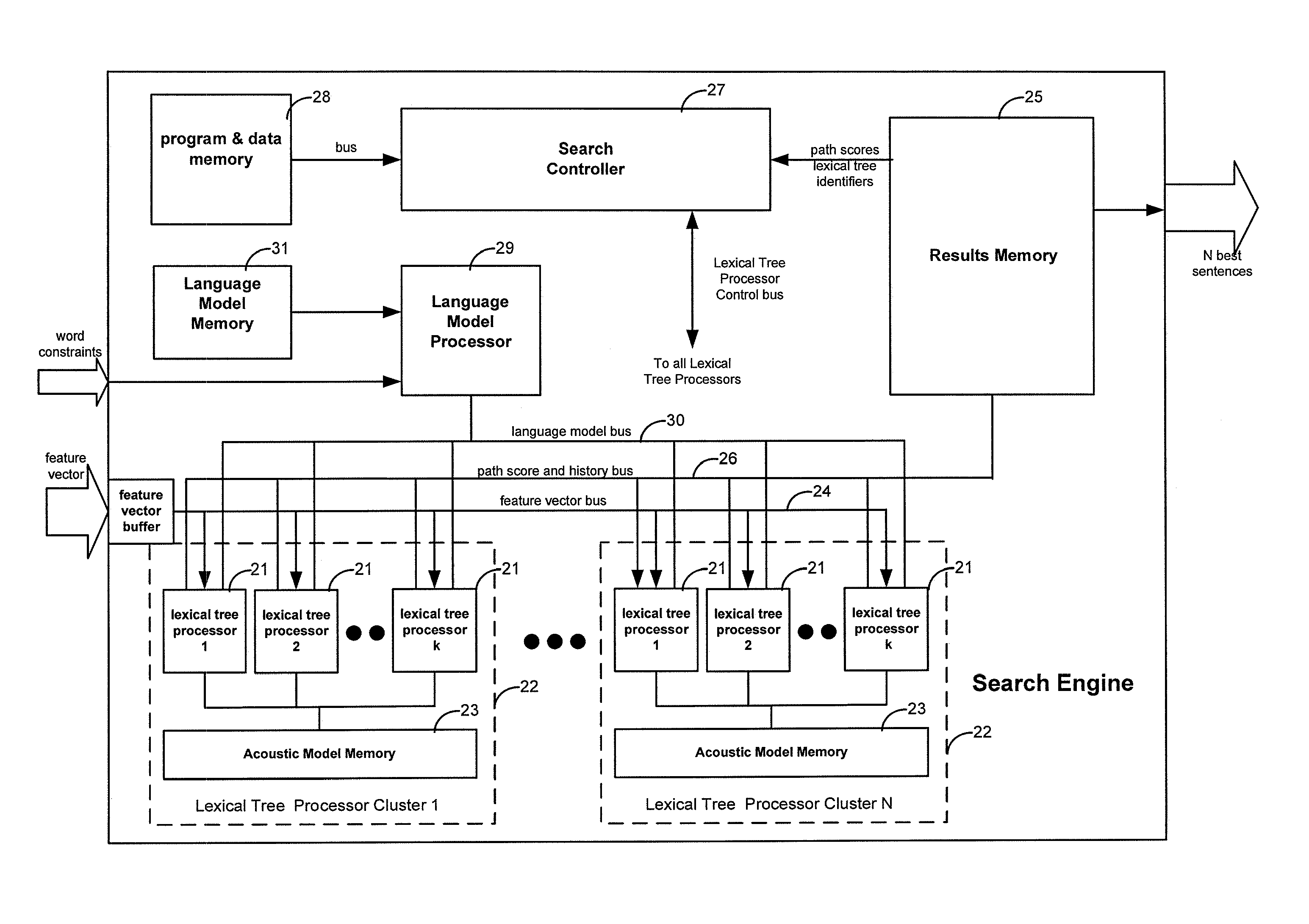
Figure 1 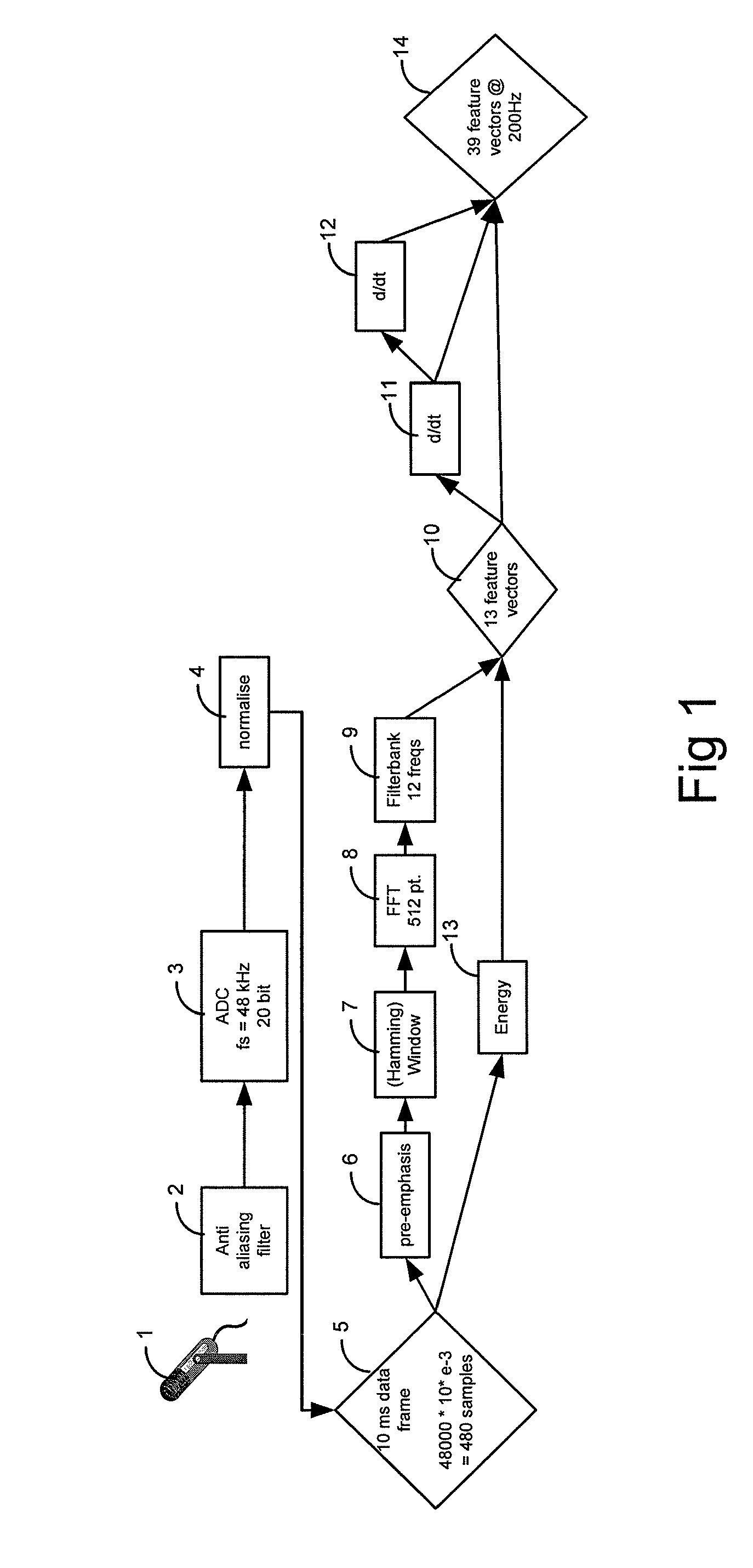
Figure 2 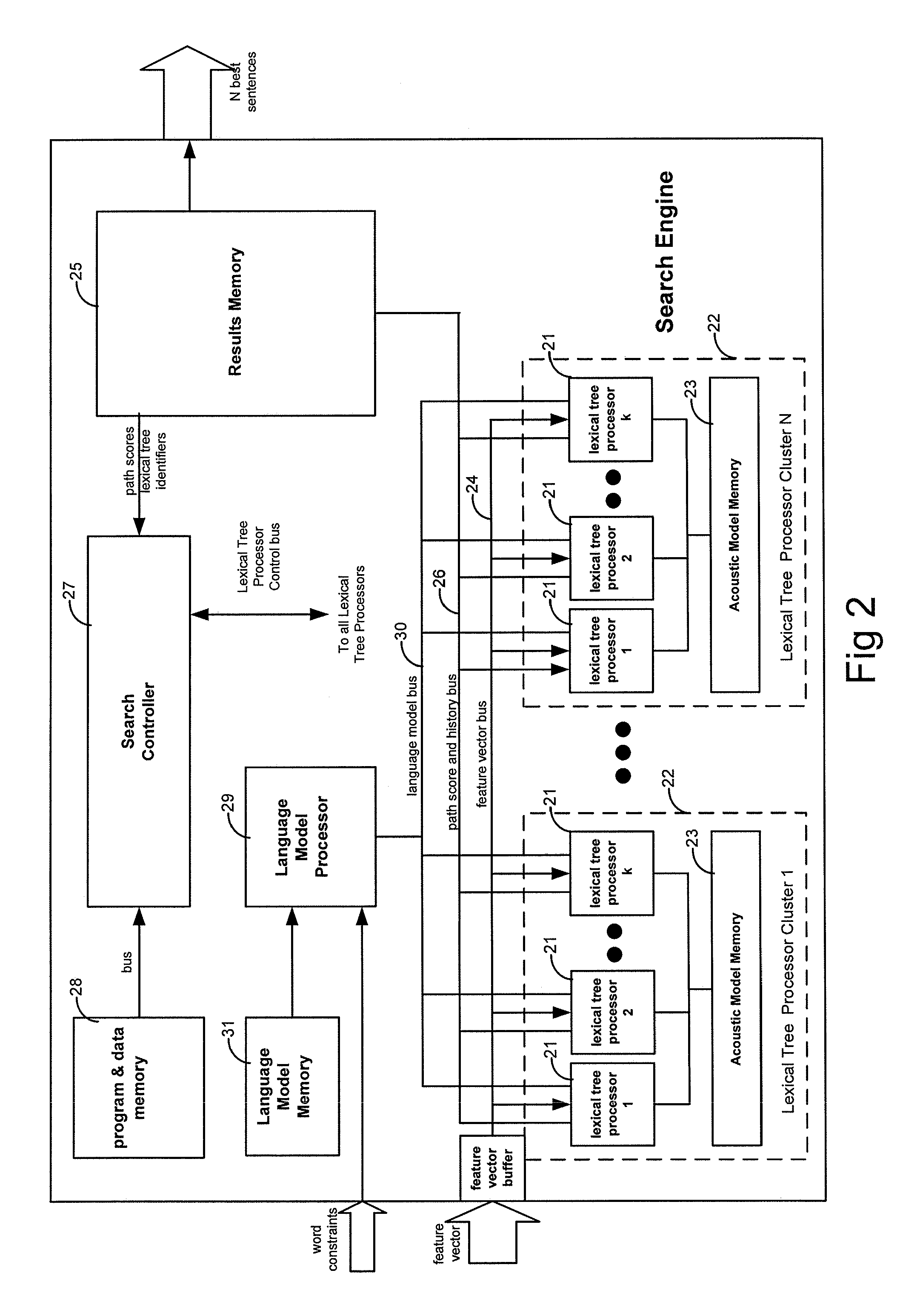
Figure 3
Abstract
Description
[0001] This is a continuation of application Ser. No. 12 / 554,607, filed on Sep. 4, 2009, now U.S. Pat. No. 8,036,890, which is a continuation of application Ser. No. 10 / 503,463, filed on May 24, 2005, now U.S. Pat. No. 7,587,319, which is a 371 of International Application No. PCT / GB2003 / 000459, filed on Feb. 4, 2003, which claims priority to GB Application No. 0202546.8, filed Feb. 4, 2002.BACKGROUND OF THE INVENTION
[0002] 1. Field of the Invention
[0003] The present invention generally relates to a speech recognition circuit which uses parallel processors for processing the input speech data in parallel.
[0004] 2. Description of the Related Art
[0005] Conventional large vocabulary speech recognition can be divided into two processes: front end processing to generate processed speech parameters such as feature vectors, followed by a search process which attempts to find the most likely set of words spoken from a given vocabulary (lexicon).
[0006] The front end processing generally represents...
Examples
Embodiment Construction
[0032]FIG. 1 illustrates a typical circuit for the parameterization of input speech data. In this embodiment the parameters generated are speech vectors.
[0033]A microphone 1 records speech in an analogue form and this is input through an anti-aliasing filter 2 to an analogue-to-digital converter 3 which samples the speech at 48 kHz at 20 bits per sample. The digitized output signal is normalized (4) to generated a 10 millisecond data frame every 5 milliseconds with 5 milliseconds overlap (5). A pre-emphasis operation 6 is applied to the data followed by a hamming window 7. The data is then fast Fourier transformed (FFT) using a 512 point fast Fourier transform (8) before being filtered by filter bank 9 into 12 frequencies. The energy in the data frame 5 is also recorded (13) as an additional feature and together with the 12 frequency outputs of the filter bank 9, 13 feature vectors (10) are thus produced and these are output as part of the 39 feature vectors 14. First and second der...