
Hierarchical and adaptive multi-carrier digital modulation and demodulation
a multi-carrier, digital modulation technology, applied in multi-frequency code systems, sustainable buildings, high-level techniques, etc., can solve the problems of inability to predict standardized mechanisms, insufficient robustness of digital subscriber lines (dsls) to resist transient noise, and inability to accurately estimate the effect of the number of users
Patent Information
- Authority / Receiving Office
- US · United States
- Patent Type
- Patents(United States)
- Current Assignee / Owner
- Publication Date
- 2016-09-06
Smart Images
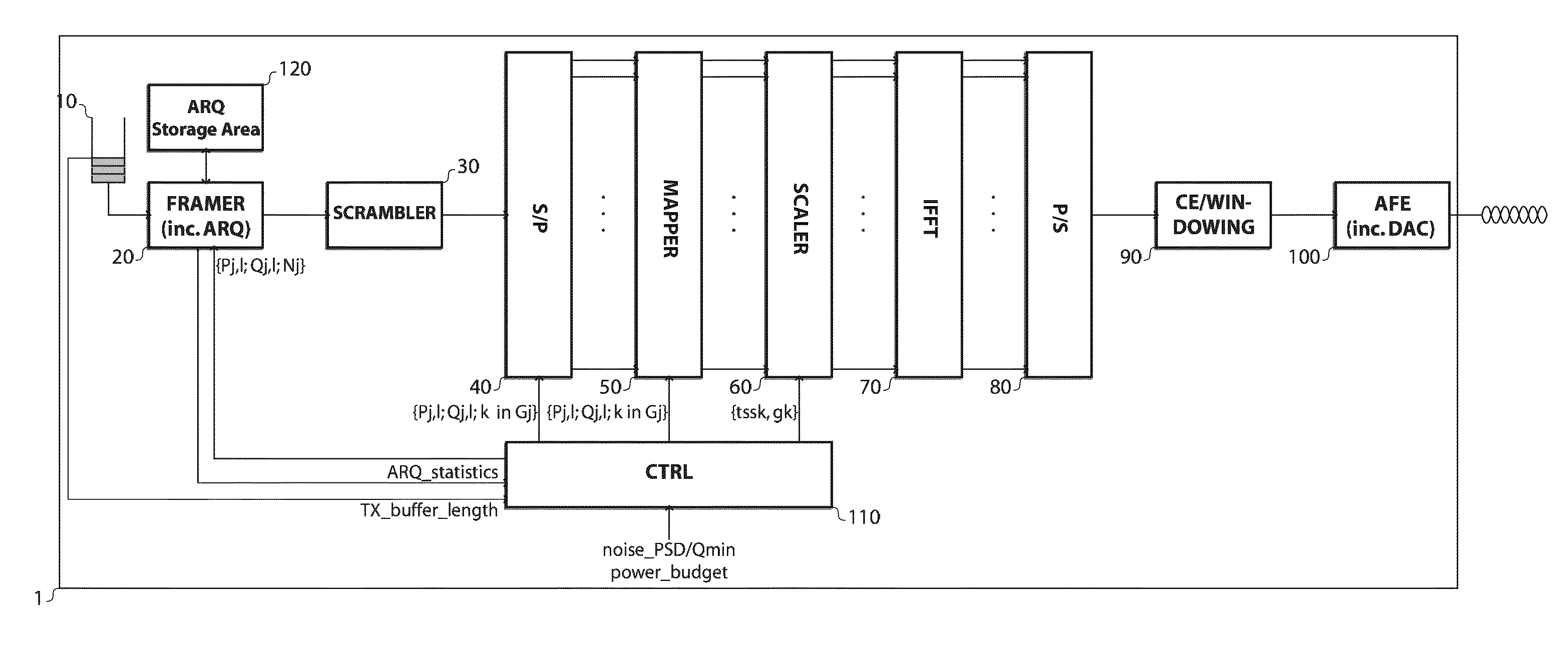
Figure 1 
Figure 2 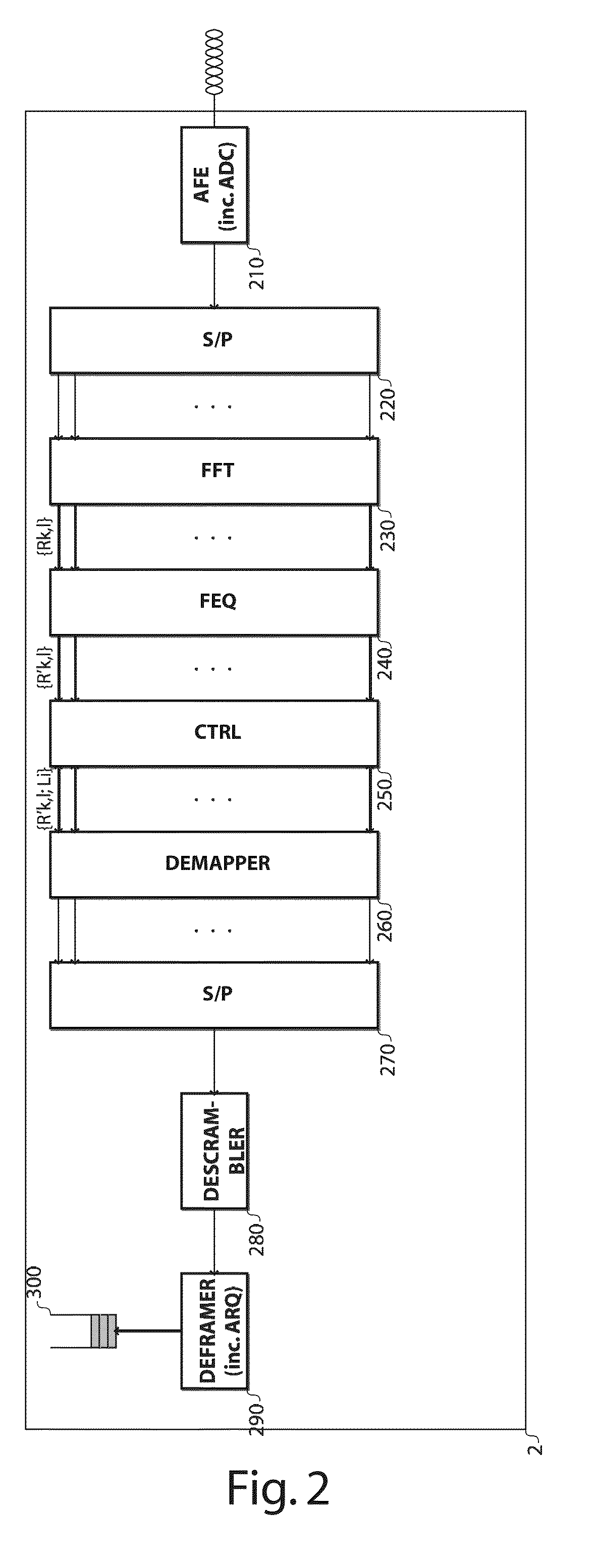
Figure 3
Abstract
Description
[0001] This application is a national phase under 35 U.S.C. §371 of PCT International Application No. PCT / EP2012 / 069955 which has an International filing date of Oct. 9, 2012, which claims priority to European patent application number EP11306381.2 filed Oct. 25, 2011; the entire contents of each of which are hereby incorporated by reference.TECHNICAL FIELD OF THE INVENTION
[0002] The present invention relates to digital modulation and demodulation of multi-carrier signals.TECHNICAL BACKGROUND OF THE INVENTION
[0003] After their first introduction in the early 1990s, wireline broadband networks, which includes fiber, coaxial cable and twisted pair, have evolved substantially. Despite the inherent attenuation of copper which limits the capacity, transmission over this medium remains attractive as it is abundantly present throughout the world, due to legacy Plain Old Telephony Service (POTS) deployment. Hence, broadband over copper offers substantial deployment cost savings as compared to ...
Examples
Embodiment Construction
[0067]The following terminology will be consistently used throughout the description:[0068]I denotes the maximum number of hierarchical modulation layers, or alternatively the maximum number of constellation vectors, that can potentially be used by the transmitter and the receiver;[0069]i denotes a modulation layer index, or alternatively a constellation vector index, ranging from 0 to I−1;[0070]Li denotes a particular modulation layer characterized by a particular predefined transmit power;[0071]J denotes the total number of carrier groups;[0072]j denotes a carrier group index ranging from 0 to J−1;[0073]Gj denotes the carrier group with index j;[0074]Nj denotes the number of carriers within the carrier group Gj;[0075]K denotes the total number of carriers;[0076]k denotes a carrier or frequency index ranging from 1 to K;[0077]l denotes a transmit or receive multi-carrier data symbol index,[0078]Vi,k,l denotes the transmit constellation vector at frequency index k for modulation lay...