System bandwidth self-adaptive adjusting method in long term evolution system

A long-term evolution system and self-adaptive adjustment technology, applied in the field of mobile communication, can solve problems such as user interference in neighboring cells

CN101754282AActive Publication Date: 2010-06-23ZTE CORP
0 Cites 15 Cited by

Patent Information

Authority / Receiving Office
CN · China
Current Assignee / Owner
Publication Date
2010-06-23

Smart Images

  • Figure 1
    Figure 1
  • Figure 2
    Figure 2
  • Figure 3
    Figure 3
Patent Text Reader

Abstract

The invention discloses a system bandwidth self-adaptive adjusting method in a long term evolution system, which comprises the following steps of: a, counting resource conditions practically used by the system; b, periodically triggering comparison with the resource occupying threshold set by the system according to the resource conditions practically used by the system, and judging system bandwidth occupied by the resource; and c, changing the system bandwidth. In the premise of meeting business demand of users in a cell, the system bandwidth self-adaptive adjusting method in the long term evolution system of the invention can increase and decrease bandwidth according to increase and decrease of quantity of system online users correspondingly so as to meet different business quality requirements on users, reduce multiplexing odds of adjacent cell frequencies, decrease interference to users in the adjacent cells, and is particularly suitable for use in communication systems with variable bandwidth and same frequency interference.
Need to check novelty before this filing date? Find Prior Art

Description

Technical field

[0001] The present invention relates to the field of mobile communication, and in particular to a method for adaptive adjustment of uplink and downlink system bandwidth in a Long Term Evolution system (Long Term Evolution, LTE for short), and is particularly suitable for a communication system with variable system bandwidth and co-channel interference. Background technique

[0002] The LTE system has attracted more and more attention from operators due to its advantages such as low latency, high transmission efficiency, and effective improvement of the quality of service for cell edge users. The 3GPP (3rd Generation Partnership Project) organization defines the frame of the LTE system as 10ms, which is divided into 10 subframes, and each subframe is divided into 2 time slots. Whether it is uplink or downlink, the transmission signal of each time slot passes through N RB N sc RB Subcarriers and N symb A grid of symbols to describe. among them 6≤N RB ≤110, the ...

Examples

Embodiment Construction

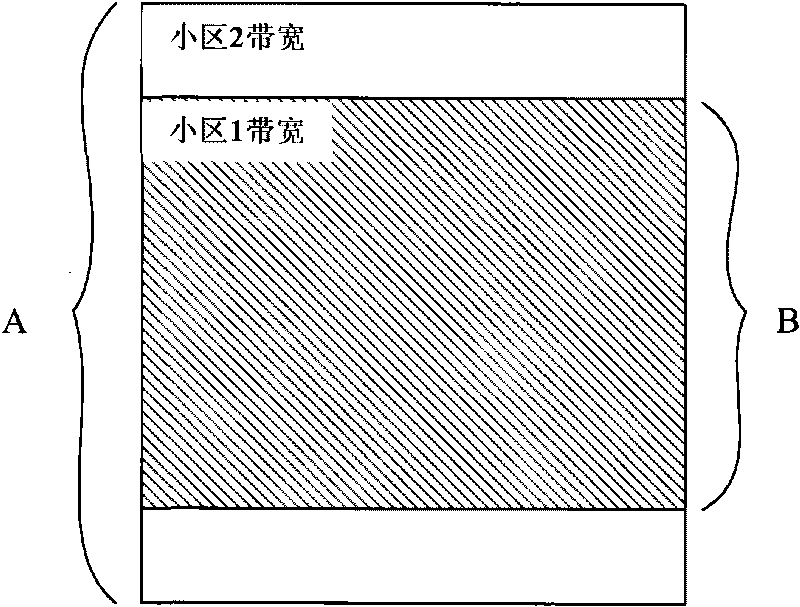
[0028] The core idea of ​​the method for adaptive adjustment of system bandwidth in the long-term evolution system of the present invention is to measure whether the current system bandwidth is appropriate by counting the number of online users or the actual usage of RBs and adjust the bandwidth accordingly. This method can make the system bandwidth change flexibly and help reduce the overlapping area of ​​the same frequency in the neighboring cells, thereby reducing the interference to the users using the same frequency resources in the neighboring cells. The implementation of the technical solution will be further described in detail below in conjunction with the drawings.

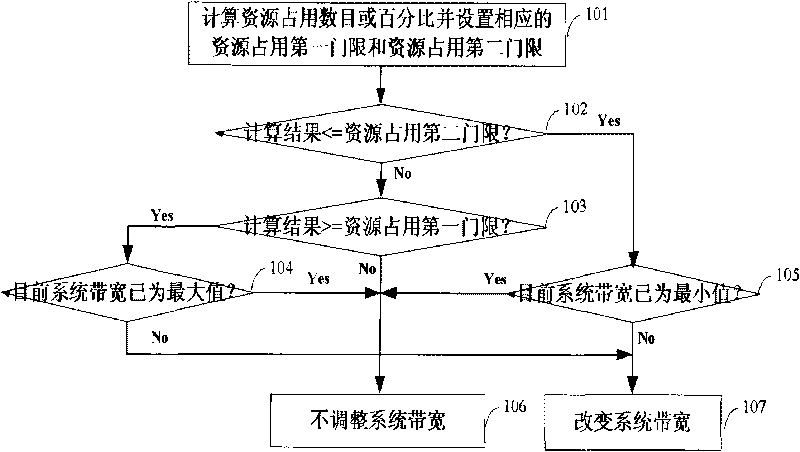
[0029] Such as figure 1 As shown, the method for adaptive adjustment of system bandwidth in the long-term evolution system of the present invention includes the following steps:

[0030] Step 101: Count the number Num_ue or percentage of users currently active; or report the number of RBs Num_rb currently us...