Sync signal mapping method and device for relay link

A technology of synchronization signal and mapping method, which is applied in the directions of synchronization device, multiplexing communication, pilot signal distribution, etc., and can solve the problem of out-of-synchronization between the sending and receiving parties.

CN101958743AInactive Publication Date: 2011-01-26海宁市盐官工业投资有限公司
4 Cites 21 Cited by

Patent Information

Authority / Receiving Office
CN · China
Current Assignee / Owner
Publication Date
2011-01-26
Estimated Expiration
Not applicable · inactive patent

Smart Images

  • Figure 1
    Figure 1
  • Figure 2
    Figure 2
  • Figure 3
    Figure 3
Patent Text Reader

Abstract

The invention provides a sync signal mapping method and a sync signal mapping device for a relay link. In the invention, a synchronizing sequence is generated, the mapping positions of sync signal in a frequency direction and a time direction are determined, and thus a specific sync signal mapping manner of a back haul link from a base station to a relay node is realized. The sync signal mapping method and device are well applied to the back haul link from the base station to the relay node, and the sync signal mapping manner is simple; therefore, backward compatibility (compatible with an LTE system) is ensured, and the problem that the relay node cannot correctly receive the primary sync signal (PSS) and the supplementary sync signal (SSS) transmitted from the base station is solved. In the method, a low cost is adopted and a normal completion of tracking by the relay node is ensured.
Need to check novelty before this filing date? Find Prior Art

Description

Technical field

[0001] The present invention relates to synchronization signal mapping technology, in particular to a synchronization signal mapping method and device of a relay link. Background technique

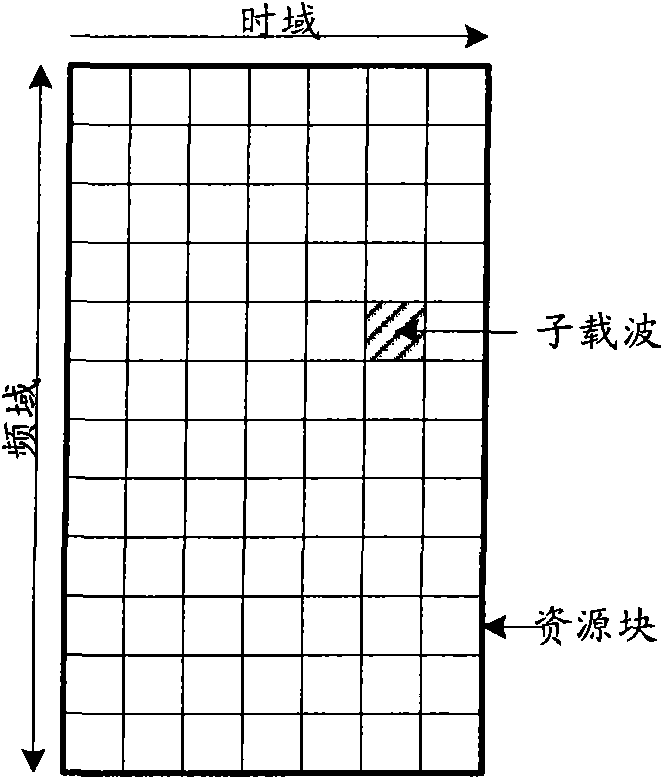
[0002] The Long Term Evolution (LTE) system, the Long Term Evolution Advanced (LTE-A) system, and the International Mobile Telecommunication Advanced (IMT-Advanced) system all use orthogonal frequency A system based on Orthogonal Frequency Division Multiplexing (OFDM) technology is mainly a time-frequency two-dimensional data form in an OFDM system. figure 1 Is a schematic diagram of the relationship between resource blocks and subcarriers, such as figure 1 As shown, all the small squares represent a resource block, and the slash and shade represent sub-carriers.

[0003] In the LTE system and the LTE-A system, the resource block (RB, Resource Block) is defined as the OFDM symbol in 1 consecutive slot in the time domain, and 12 or 24 consecutive subcarriers in the frequency doma...

Examples

Embodiment Construction

[0075] Figure 4 It is a flowchart of the synchronization signal mapping method of the relay link of the present invention, such as Figure 4 As shown, including the following steps:

[0076] Step 400: Generate a synchronization sequence of the backhaul link between the base station and the relay node.

[0077] In this step, the method for generating the synchronization sequence of the link from the base station to the relay node is the same as or different from the method for generating the main synchronization sequence of the link from the base station to the terminal. Specifically:

[0078] When the synchronization sequence generation method of the base station to the relay node link is the same as the main synchronization sequence generation method of the base station to the terminal link, the specific implementation is: the synchronization signal is composed of the frequency domain Zadoff-Chu sequence, the root sequence of the Zadoff-Chu sequence Index u and correspond. among...