
Method and device for adding physical port to or exiting aggregation port
A technology of physical ports and aggregated ports, which is applied in the field of communication, can solve the problem that GID resources cannot be used reasonably, and achieve the effect of saving CPU and storage space
- Summary
- Abstract
- Description
- Claims
- Application Information
AI Technical Summary
Problems solved by technology
Method used
Image

Examples
Embodiment 1
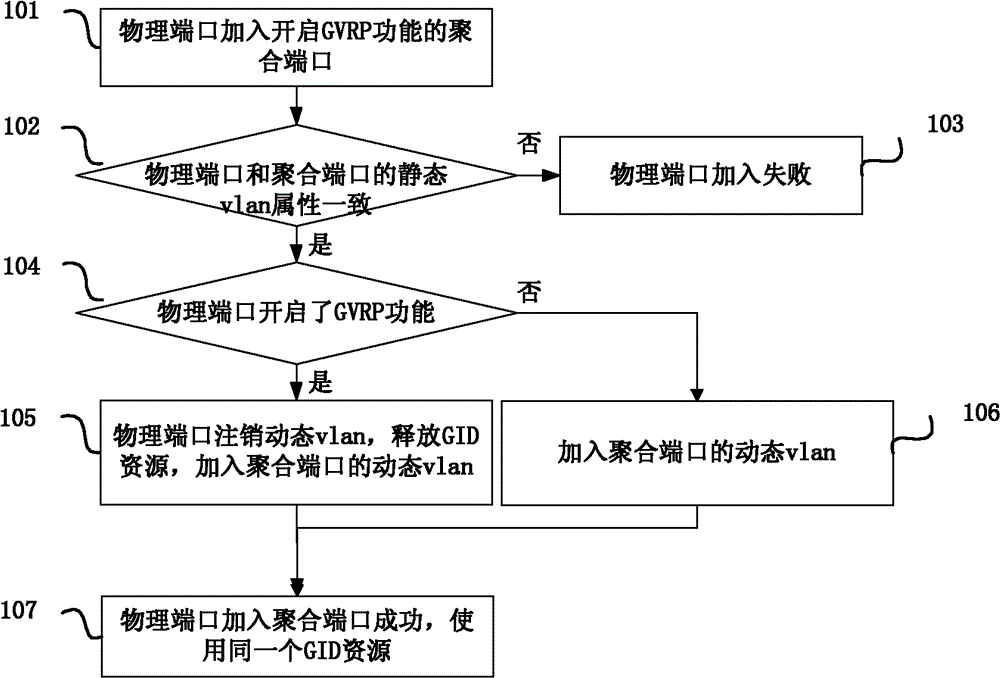
[0028] This embodiment mainly describes the process of adding a physical port to an aggregation port with the GVRP function enabled, such as figure 1 shown, including the following steps:
[0029] Step S101, executing an instruction of adding a physical port to an aggregation port.
[0030] Step S102, judging whether the static vlan attribute of the physical port is consistent with the aggregation port, if consistent, execute step 104; if not, execute step 103.
[0031] In step S103, adding the physical port to the aggregation port fails, and the original attributes of the physical port and the aggregation port remain unchanged.
[0032] Step S104, determine whether the physical port has enabled the GVRP function, if enabled, execute step S105; if not enabled, execute step 106.
[0033] Step S105, the physical port cancels its dynamic vlan, releases the GID resource, and joins the dynamic vlan where the aggregation port is located.
[0034] Step S106, adding the physical po...
Embodiment 2
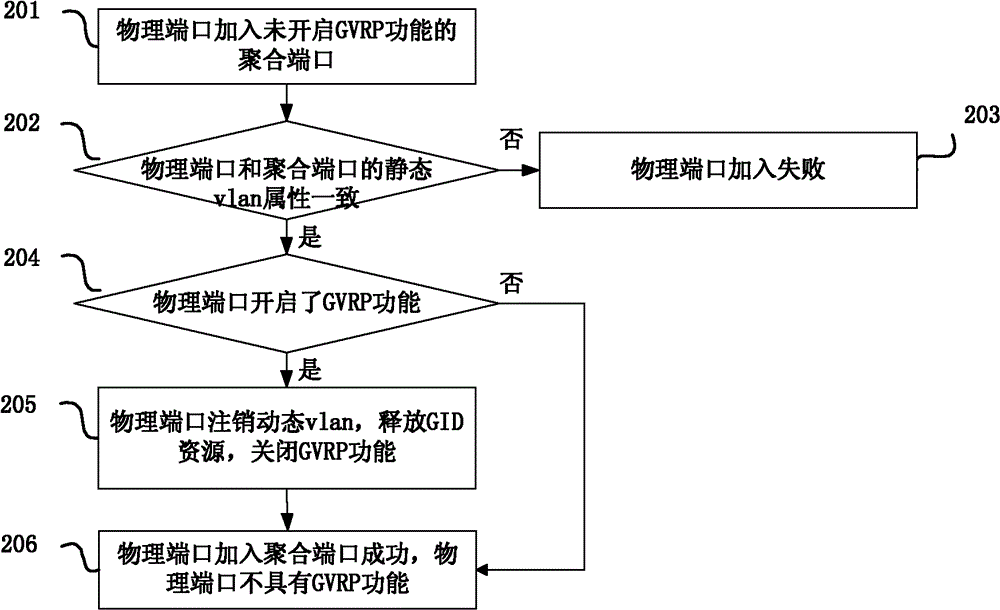
[0038] This embodiment mainly describes the process of adding a physical port to an aggregation port whose GVRP function is not enabled, such as figure 2 As shown in the figure, adding a physical port to an aggregation port whose GVRP function is not enabled includes the following steps:
[0039] In step S201, an instruction of adding a physical port to an aggregated port is executed.
[0040] Step S202, judging whether the static vlan attribute of the physical port is consistent with the aggregation port. If consistent, go to step 204 for processing; if not, go to step S203 for processing.
[0041] In step S203, adding the physical port to the aggregation port fails, and the original attributes of the physical port and the aggregation port remain unchanged.
[0042] Step S204, judging whether the physical port has enabled the GVRP function. If it is enabled, go to step S205; if not, go to step S206.
[0043] Step S205, the physical port cancels the dynamic vlan, releases...
Embodiment 3
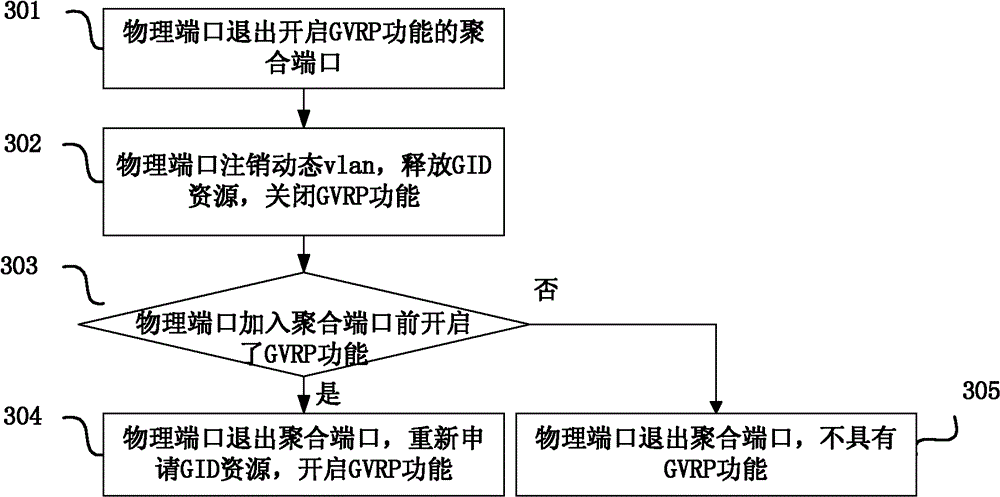
[0047] This embodiment mainly describes the flow of a physical port withdrawing from an aggregation port with the GVRP function enabled, such as image 3 As shown in the figure, the process of exiting the aggregation port with the GVRP function enabled on the physical port includes the following steps:
[0048] Step S301, execute the instruction that the physical port exits the aggregation port with the GVRP function enabled;
[0049] Step S302, the physical port cancels the dynamic vlan, releases the GID resource, and closes the GVRP function;
[0050] Step S303, judging whether the GVRP function is enabled before the physical port joins the aggregation port. If enabled, go to step S304; if not turned on, go to step S305;
[0051] Step S304, the physical port withdraws from the aggregation port, re-applies for GID resources, and enables the GVRP function;
[0052] Step S305, the physical port exits the aggregation port and does not have the GVRP function.
PUM
 Login to View More
 Abstract
Description
Claims
Application Information
 Login to View More