
A β-adrenergic receptor agonist multi-residue detection immunosensor and its detection method
A receptor agonist, epinephrine technology, applied in the field of food safety detection and analytical chemistry, can solve the problems of complicated operation, high cost and loss of chromatographic detection, and achieve the effect of high sensitivity and low linear range.
- Summary
- Abstract
- Description
- Claims
- Application Information
AI Technical Summary
Problems solved by technology
Method used
Image

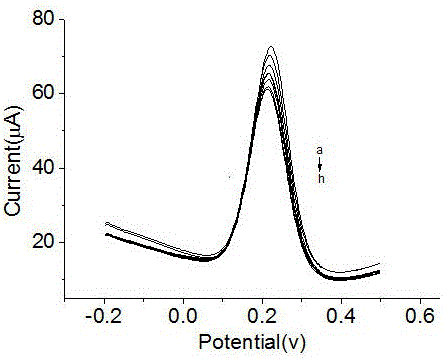
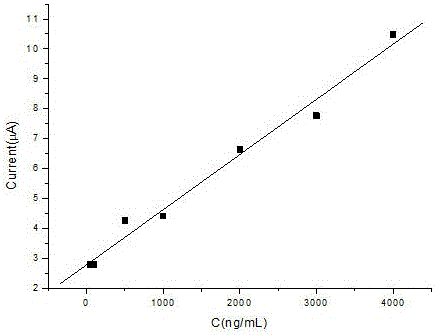
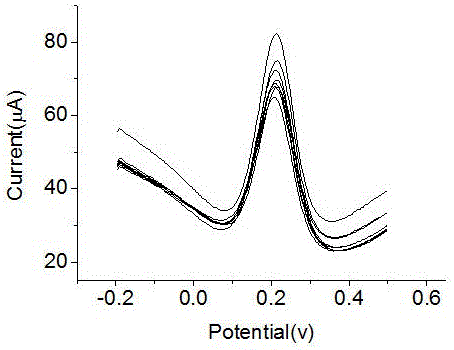
Examples
Embodiment 1
[0036] Example 1 Preparation of multi-cluster antigen (SAL-RAC-BSA conjugate)
[0037] 1) Coupling the SAL hapten on BSA by the mixed anhydride method, and then purifying:
[0038] Dissolve 0.2 mmol salbutamol sulfate in 5-10 ml absolute ethanol, add 0.2 mmol glutaric anhydride, react at room temperature for 3-5 h, and centrifuge. Dissolve the solid in the lower layer in 5-10 ml of N,N-dimethylformamide, add 0.2 mmol of tri-n-butylamine and 0.2 mmol of isobutyl chloroformate, and continue the reaction for 1-3 h. The above reaction solution was slowly added to 5-10 ml of phosphate buffer solution containing 5-10 mg / ml BSA, and reacted overnight at room temperature. The above reaction solution is dialyzed 3 to 6 times with phosphate buffer solution, and freeze-dried to obtain the freeze-dried powder of the SAL-BSA conjugate. According to the UV-Vis absorption spectra of SAL, BSA and SAL-BSA conjugates ( figure 1 ) to calculate the available coupling ratio, BSA:SAL = 1:8.5;
...
Embodiment 2
[0041] Example 2 Preparation of broad-spectrum specific antibody (anti-SAL-RAC-BSA antibody)
[0042] Healthy white rabbits weighing about 2 kg were immunized with the SAL-RAC-BSA conjugate synthesized in Example 1 as an immunogen. For the first immunization, 0.25 mg of immunogen was mixed with an equal amount of Freund's complete adjuvant, fully emulsified, and injected subcutaneously at multiple points on the back. Two weeks later, the same dose of immunogen and the same amount of Freund's incomplete adjuvant were used for emulsification and booster immunization, and booster immunization was performed every two weeks, for a total of three times. Ten days after the last immunization, blood was collected from the jugular vein of the white rabbits, placed at 4°C for 30 minutes, and then purified by ammonium sulfate multi-stage precipitation to obtain the anti-SAL-RAC-BSA polyclonal antibody.
Embodiment 3
[0043] Example 3 Electrochemical immunosensor and its preparation
[0044] A glassy carbon electrode with a diameter of 3 mm was sequentially filled with Al with a diameter of 0.3 μm and 0.05 μm 2 o 3 Grinding with polishing powder, followed by ultrasonic cleaning with absolute ethanol-distilled water and distilled water for 5 min, and then rinsed with distilled water. 4 μl of graphene / chitosan dispersion was drop-coated on the electrode, and then 2 μl of 0.2 mg / ml albuterol-ractopamine-bovine serum albumin solution was drop-coated on the surface of the electrode and dried at room temperature. Finally, the electrodes were soaked in 5% BSA solution and incubated in a 37°C oven for 30 min to block the remaining active sites.
PUM
 Login to View More
 Abstract
Description
Claims
Application Information
 Login to View More