
DNS end-to-end analysis method capable of ensuring safety and privacy
A parsing method, DNS query technology, applied in transmission systems, electrical components, etc., can solve problems such as security and privacy leakage, achieve high efficiency, improve TCP performance and transmission performance, and achieve simple results
- Summary
- Abstract
- Description
- Claims
- Application Information
AI Technical Summary
Problems solved by technology
Method used
Image


Examples
Embodiment Construction
[0021] The embodiments will be described in detail below in conjunction with the accompanying drawings.
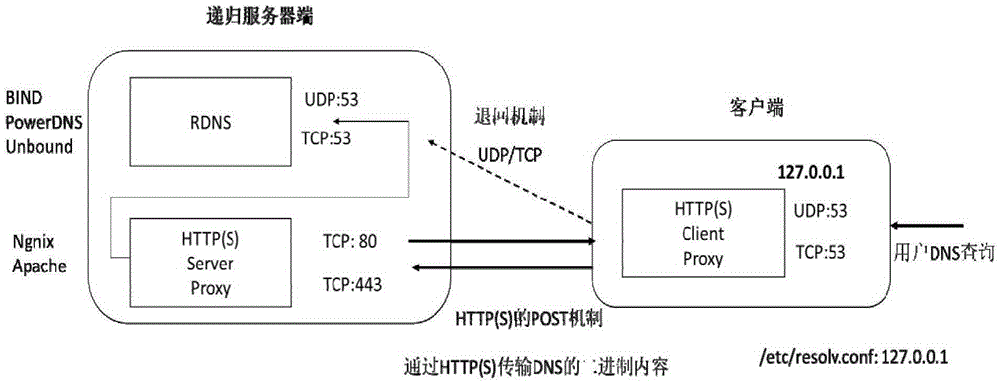
[0022] Such as figure 2 As shown, the present invention proposes to ensure security and privacy through the HTTP(S) protocol from the user to the recursive server; and to ensure data security through DNSSEC from the recursive server to the authoritative name server. Take a type A query of the domain name www.example.com as an example to illustrate the workflow of the DNS end-to-end resolution solution.
[0023] The client sends a query request of type A whose domain name is www.example.com to the address of 127.X.X.X. After the local client agent receives the DNS message, it establishes an HTTP or HTTPS connection with the agent of the recursive server. After the connection is established, the DNS message can be sent to the recursive server proxy in the form of binary code through HTTP(S) PUSH. If it is sent through the HTTP protocol, the port of the authoritative serv...
PUM
 Login to View More
 Abstract
Description
Claims
Application Information
 Login to View More