This helps you quickly interpret patents by identifying the three key elements:
Problems solved by technology
Method used
Benefits of technology
Problems solved by technology
[0008] However, there is currently no presentation on interference assessment and coordination in priority spectrum sharing scenarios
Method used
the structure of the environmentally friendly knitted fabric provided by the present invention; figure 2 Flow chart of the yarn wrapping machine for environmentally friendly knitted fabrics and storage devices; image 3 Is the parameter map of the yarn covering machine
View more
Image
Smart Image Click on the blue labels to locate them in the text.
Viewing Examples
Smart Image
Click on the blue label to locate the original text in one second.
Reading with bidirectional positioning of images and text.
Smart Image
Examples
Experimental program
Comparison scheme
Effect test
no. 1 example
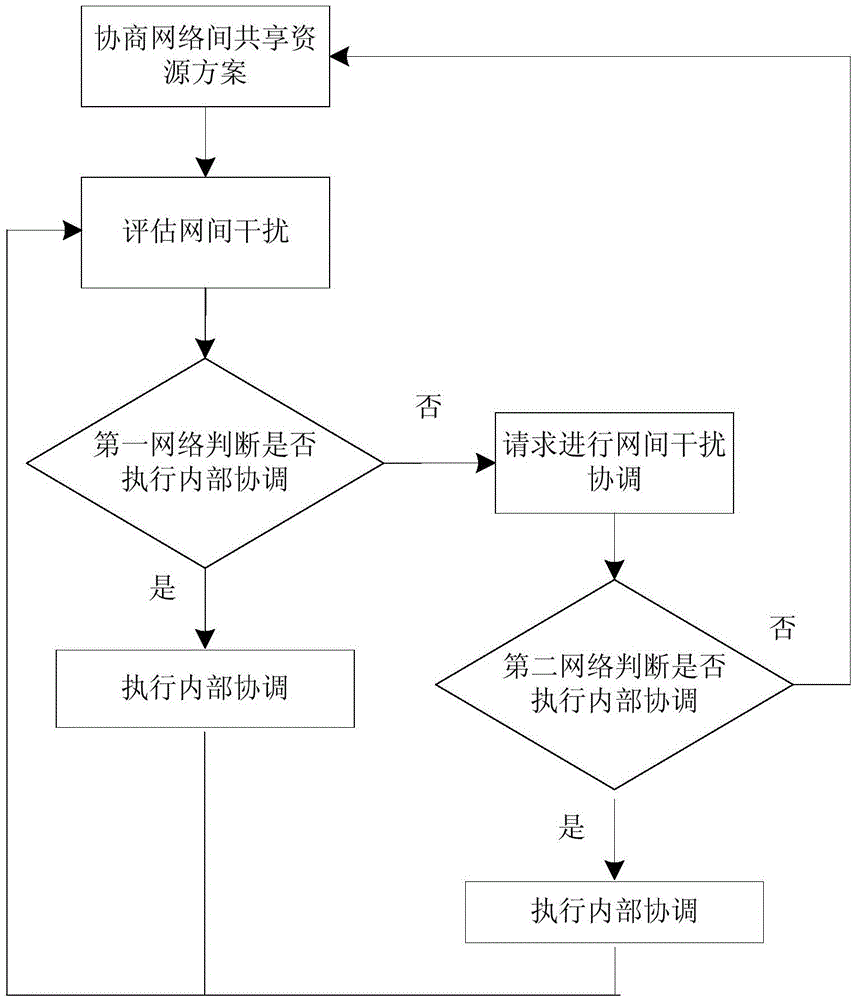
[0037] like figure 1 As shown, the overall solution of the first embodiment includes the following steps:
[0038] Negotiate resource sharing schemes between networks;
[0039] Evaluate network interference;
[0040] The first network judges whether to perform internal coordination, if it judges to perform internal coordination, then the first network performs internal coordination, and returns to the step of evaluating inter-network interference; if it judges not to perform internal coordination, then requests inter-network interference coordination, and proceeds to the next step ;
[0041] The second network judges whether to perform internal coordination, and if internal coordination is performed, the second network performs internal coordination and returns to the step of evaluating inter-network interference; if not performing internal coordination, returns to the step of negotiating a resource sharing scheme between networks.
[0042] To simplify the description, this...
no. 2 example
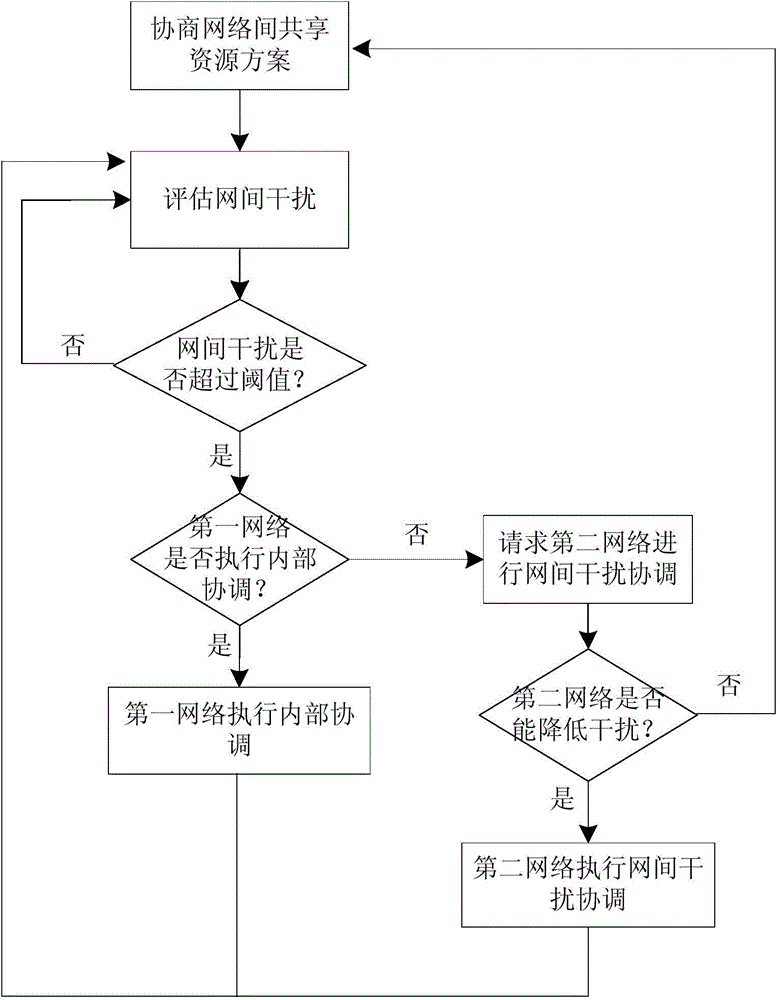
[0128] To briefly introduce the second embodiment of the present invention, only the differences from the first embodiment are described here.
[0129] Image 6 The network-level inter-network interference of each carrier in the shared spectrumpool of the second embodiment is shown. with the first embodiment Figure 4 Different, the network-level inter-network interference value in the first embodiment is non-quantified, and the network-level inter-network interference value in the second embodiment is quantized, which is divided into high interference, medium interference and low interference, and its signaling The format is as follows. Wherein, the "signaling content" of the second embodiment is different from that of the first embodiment, which is the description of the interference level (it is a quantized value).
[0130]
no. 2 example 3
[0131] Specifically, the second embodiment has three modes:
[0132]
[0133] The second embodiment is the same as the first embodiment, as Figure 4 As shown, for each carrier in the shared spectrumpool, according to the cell-level inter-network interference reported by all the cells assigned to the carrier, the operator management node calculates the average value of the inter-network interference, and obtains the corresponding The average value of inter-network interference received.
[0134] like Image 6 As shown, based on the average cell-level inter-network interference received by the network on each carrier, N operator interference thresholds are selected to quantify the average interference, which corresponds to the average inter-network interference received by the network on each carrier The level has N+1 levels, and the quantified result is used as an indication of network-level interference between networks.
[0135]
[0136] Same as the alternative in th...
the structure of the environmentally friendly knitted fabric provided by the present invention; figure 2 Flow chart of the yarn wrapping machine for environmentally friendly knitted fabrics and storage devices; image 3 Is the parameter map of the yarn covering machine
Login to View More
PUM
Login to View More
Abstract
The invention discloses an inter-operator interference coordination method for use in a co-primary spectrum sharing scene. The method comprises the following steps that: a first network negotiates an inter-operator sharing frequency band with a second network, wherein the sharing frequency band is also in a sharing spectrum pool; the first network assesses inter-operator interference; the first network judges whether to execute internal coordination or not, and if so, the first network executes the internal coordination and returns to the step that the first network assesses the inter-operator interference; if not, the first network makes a request for inter-operator interference coordination to the second network, and enters a next step; the second network judges whether to execute the internal coordination or not, and if so, the second network executes the internal coordination, and returns the step that the first network assesses the inter-operator interference; and if not, the second network returns to the step that the first network negotiates the inter-operator sharing frequency band with the second network. Through adoption of the inter-operator interference coordination method, the network interference coordination in the co-primary spectrum sharing scene can be realized fairly and reasonably.
Description
technical field [0001] The invention relates to an interference coordination method among networks, in particular to an interference coordination method used between networks with the same priority, and belongs to the technical field of wireless communication. Background technique [0002] Co-primary Spectrum Sharing (Co-primary Spectrum Sharing) is a new spectrum access mode, and different operators can realize dynamic and flexible spectrum sharing with the same priority. It requires two or more wireless frequency band license holders to reach an agreement on how to jointly use part of their authorized frequency bands through negotiation. The entire spectrum sharing model is governed by national frequency band management agencies. Therefore, people are assuming a new model: the frequency band management agency no longer allocates a certain spectrum resource to a certain operator in an exclusive manner, but allocates it to multiple potential operators (users) at the same ti...
Claims
the structure of the environmentally friendly knitted fabric provided by the present invention; figure 2 Flow chart of the yarn wrapping machine for environmentally friendly knitted fabrics and storage devices; image 3 Is the parameter map of the yarn covering machine
Login to View More
Application Information
Patent Timeline
Application Date:The date an application was filed.
Publication Date:The date a patent or application was officially published.
First Publication Date:The earliest publication date of a patent with the same application number.
Issue Date:Publication date of the patent grant document.
PCT Entry Date:The Entry date of PCT National Phase.
Estimated Expiry Date:The statutory expiry date of a patent right according to the Patent Law, and it is the longest term of protection that the patent right can achieve without the termination of the patent right due to other reasons(Term extension factor has been taken into account ).
Invalid Date:Actual expiry date is based on effective date or publication date of legal transaction data of invalid patent.


 Login to View More
  Login to View More