Mechanical arm error analysis method

An error analysis, robotic arm technology, applied in manipulators, claw arms, special data processing applications, etc., can solve the problems of low positioning accuracy and low working accuracy of robotic arms.

CN107038275AActive Publication Date: 2017-08-11SHENYANG INST OF AUTOMATION - CHINESE ACAD OF SCI
6 Cites 11 Cited by

Patent Information

Authority / Receiving Office
CN · China
Current Assignee / Owner
Publication Date
2017-08-11

Smart Images

  • Figure 1
    Figure 1
  • Figure 2
    Figure 2
  • Figure 3
    Figure 3
Patent Text Reader

Abstract

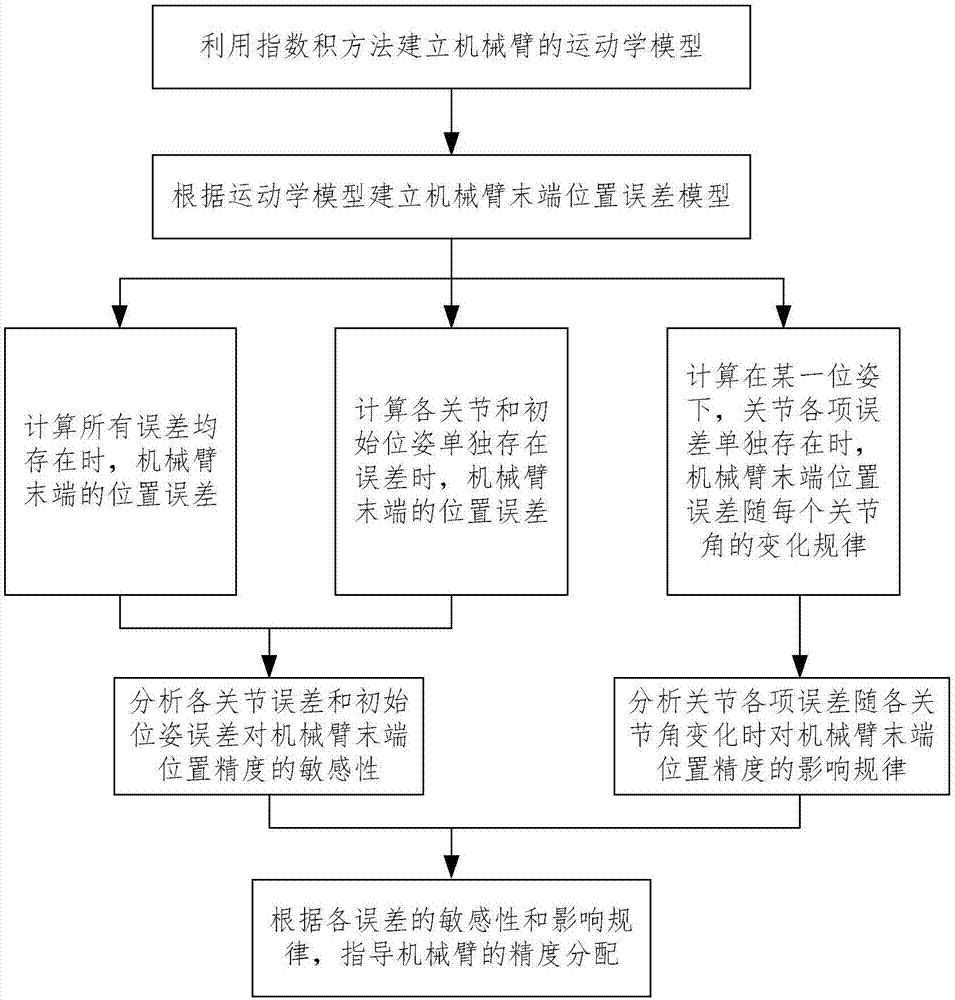
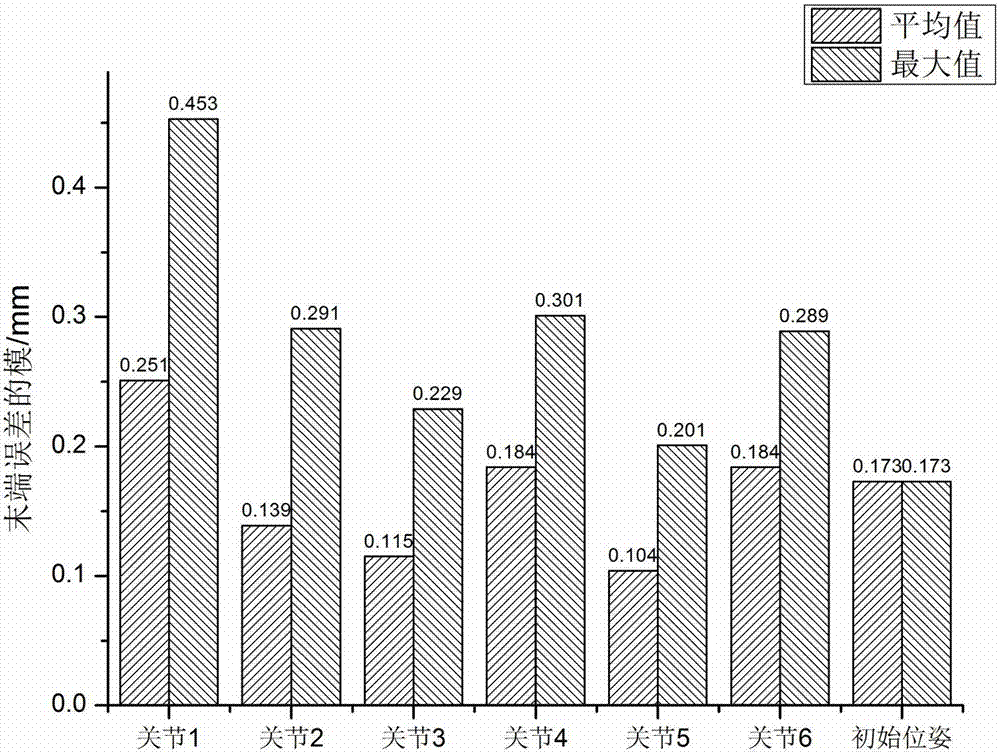
The invention relates to a mechanical arm error analysis method. On the basis of a mechanical arm motion model, the sensitivity and influence law of all kinematic parameter errors on the precision of a tail-end position of a mechanism arm are analyzed, and a basis is provided for precision distribution during design, machining and assembling of the mechanical arm. The method comprises the analysis steps that (1) an exponential product method is utilized to establish a kinematic model of the mechanical arm; (2) a mechanical arm tail-end position error model is established according to the kinematic model; (3) the sensitivity of all joint errors and initial pose errors on the precision of the tail-end position of the mechanism arm is analyzed; (4) the influence law of changes of all the joint errors along with all joint angles on the precision of the tail-end position of the mechanism arm is analyzed; and (5) precision distribution of the mechanism arm is guided according to the sensitivity and the influence law of all the errors. The mechanical arm error analysis method has the advantages of precise calculation, convenient operation, comprehensive analysis, etc.
Need to check novelty before this filing date? Find Prior Art

Description

technical field

[0001] The invention relates to error analysis of a mechanical arm, in particular to the analysis of the sensitivity and influence law of each error affecting the position accuracy of the end of the mechanical arm. Background technique

[0002] With the expansion of the application field of the robotic arm, people's requirements for the performance of the robotic arm are increasing day by day, and the robotic arm is developing towards intelligence and high precision. Accuracy is one of the important properties to evaluate the performance of the robotic arm. After many years of development, it has been able to achieve high repeat positioning accuracy, but its absolute positioning accuracy is still very low. Due to the design, manufacture and assembly errors of the manipulator, the influence of the control system and working environment factors, there are differences between the kinematics model in the manipulator controller and the actual model of the manipula...

Examples

Embodiment Construction

[0083] The present invention will be further described in detail below in conjunction with the accompanying drawings and embodiments.

[0084] Such as figure 1 Shown, in specific application examples, the detailed steps of the present invention are:

[0085] (1) Using the exponential product method to establish the kinematics model of the manipulator

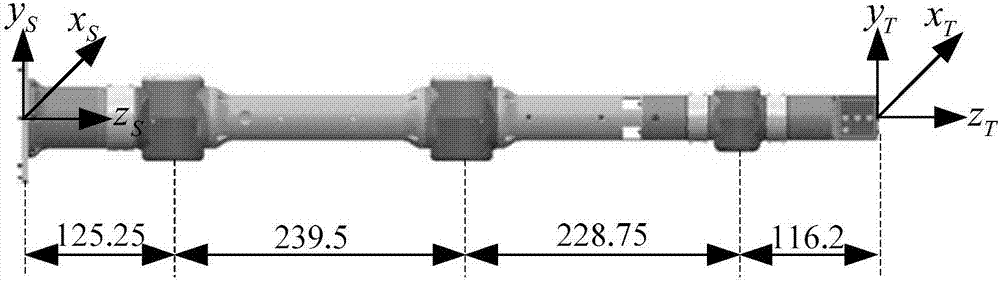
[0086] select figure 2 The 6-DOF manipulator is shown as an example, which includes the initial configuration of the manipulator, link parameters, base coordinate system and tool coordinate system. The motion ranges of the six joints of the robotic arm are -180°~180°, -90°~90°, -90°~90°, -180°~180°, -90°~90°, -180°~ 180°. According to the definition of motion screw, according to the direction of each joint axis and the position where it passes through a point, the motion screw of each joint of the manipulator can be obtained as shown in Table 1:

[0087] Table 1 The motion screw of each joint of the manipulator

[0088] ...