
A terminal capability acquisition method in a dual connection system
A technology of terminal capability and acquisition method, applied in the field of communication, can solve problems such as judgment, and achieve the effect of reducing handover interruption delay, simple and effective implementation, and increasing handover delay
- Summary
- Abstract
- Description
- Claims
- Application Information
AI Technical Summary
Problems solved by technology
Method used
Image

Examples
Embodiment 1
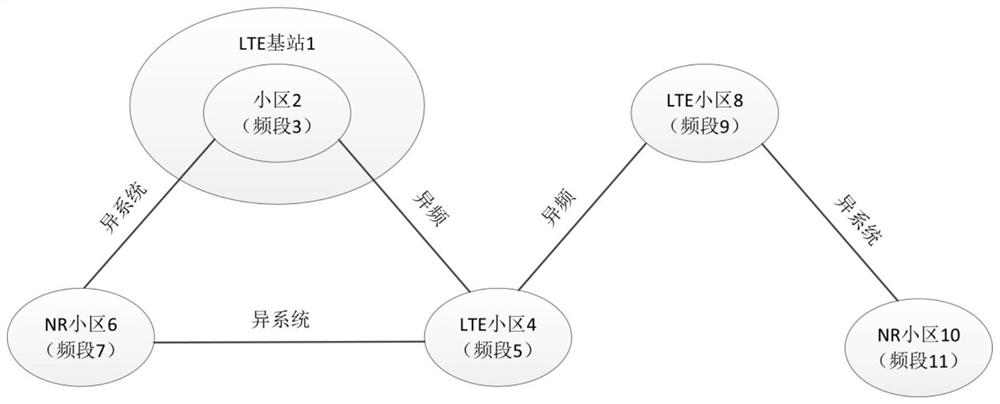
[0025] Network architecture description: Base station 1 supports dual connectivity as the main LTE base station. The service frequency of serving cell 2 belongs to frequency band 3, and there is a different-frequency adjacent cell 4. The service frequency of this adjacent cell belongs to frequency band 5; The NR neighbor cell 6 of the standby secondary cell of the different system has a service frequency of frequency band 7; cell 4 has a different frequency neighbor cell 8, its service frequency belongs to frequency band 9, and has the same NR neighbor cell 6 as cell 2; 8. There is NR zone 10 as a backup secondary cell for different systems, and its service frequency belongs to frequency band 11; terminal A supports all EN-DC dual connectivity combinations of LTE frequency bands 3, 5, and 9 and NR frequency bands 7 and 11. The architecture diagram of this embodiment is shown in the attached image 3 .
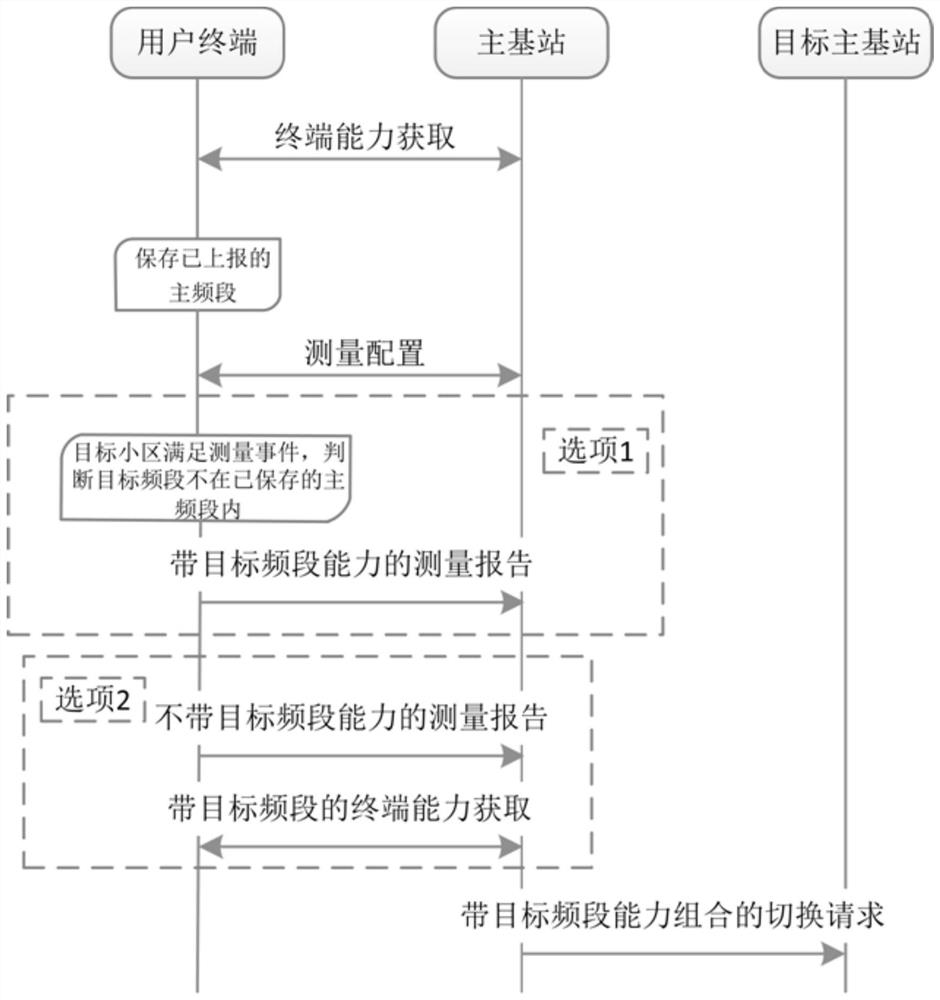
[0026] The flowchart of this embodiment is attached Figure 4 , the proc...
Embodiment 2
[0036] Network architecture description: Base station 1 supports dual connectivity as the main LTE base station. The service frequency of serving cell 2 belongs to frequency band 3, and there is a different-frequency adjacent cell 4. The service frequency of this adjacent cell belongs to frequency band 5; The NR neighbor cell 6 of the standby secondary cell of the different system has a service frequency of frequency band 7; cell 4 has a different frequency neighbor cell 8, its service frequency belongs to frequency band 9, and has the same NR neighbor cell 6 as cell 2; In 4, the secondary NR frequency bands 12 and 13 corresponding to the inter-frequency adjacent cell 8 are configured or obtained; cell 8 has NR areas 10 and 11 as inter-system backup secondary cells, and their service frequencies belong to frequency bands 12 and 13 respectively; terminal A All EN-DC dual connectivity combinations for LTE bands 3, 5, 9 and NR bands 7, 12, 13 are supported.
[0037] The flow proc...
PUM
 Login to View More
 Abstract
Description
Claims
Application Information
 Login to View More