A composite subgrade structure of reinforced heat-thaw piles/reinforced crushed stone piles in degraded permafrost regions

A technology of composite roadbed and permafrost foundation, applied in infrastructure engineering, roads, roads, etc., can solve problems such as insufficient bearing capacity of foundation, road thaw damage, and inability to effectively control, to improve bearing capacity, reduce roadbed settlement, The effect of increasing stiffness

CN111893832BActive Publication Date: 2022-03-15HARBIN INST OF TECH
5 Cites 0 Cited by

Patent Information

Authority / Receiving Office
CN · China
Patent Type
Patents(China)
Current Assignee / Owner
Publication Date
2022-03-15

Smart Images

  • Figure 1
    Figure 1
  • Figure 2
    Figure 2
  • Figure 3
    Figure 3
Patent Text Reader

Abstract

The invention relates to a composite subgrade structure of reinforced heat-thaw piles / reinforced gravel piles in degraded permafrost regions, and relates to a subgrade structure in degraded permafrost regions. The present invention aims to solve the road thawing damage caused by the inability to effectively control the degradation of permafrost in permafrost areas, and the fact that the water cannot be quickly discharged after the permafrost melts, making the foundation a soft foundation, and the lack of bearing capacity of the foundation leads to unevenness in the road The technical problem of subsidence. A plurality of reinforced heat-melt piles and a plurality of reinforced crushed stone piles are vertically arranged in the permafrost foundation, the upper non-frozen soil foundation and the lower non-frozen soil foundation. The new subgrade structure in the degraded high-temperature permafrost region according to the present invention uses two different types of piles, the reinforced heat-melt pile and the reinforced gravel pile, to form a new type of binary pile composite subgrade, which combines thermal The heat release effect of melting piles on frozen soil and the excellent drainage capacity of gravel piles can realize the pre-thawing of frozen soil and the drainage and consolidation of thawing soil at the same time.
Need to check novelty before this filing date? Find Prior Art

Description

technical field

[0001] The invention relates to a subgrade structure in degraded permafrost regions. Background technique

[0002] The area of ​​permafrost is widely distributed. In my country, only the Greater and Lesser Khingan Mountains and the northern part of the Songnen Plain are covered with 390,000 square kilometers of permafrost. However, due to the combined effects of global warming and frequent human engineering activities, the permafrost environment in Northeast China is losing its original thermal balance. Taking the island-shaped permafrost region in Northeast my country as an example, the melting of permafrost caused uneven settlement of infrastructure such as roads, which seriously affected the durability and stability of the superstructure.

[0003] At present, the treatment of severely degraded permafrost foundations mainly follows the principles of "protection" and "destruction". However, due to the obvious degradation of permafrost, especially high-temp...

Examples

specific Embodiment approach 1

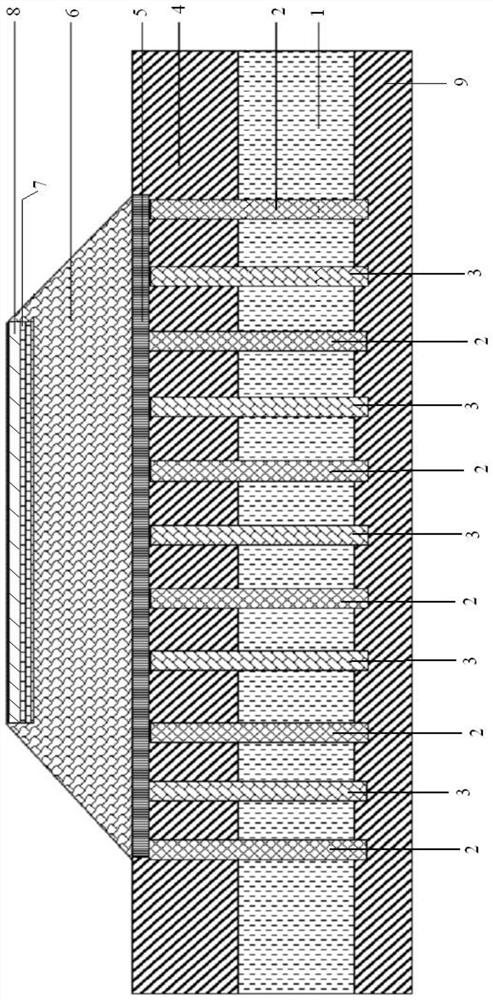
[0021] Specific implementation mode 1: This implementation mode is a composite subgrade structure of reinforced heat-thaw piles / reinforced crushed stone piles in degraded permafrost areas, such as Figure 1-Figure 7 As shown, it is specifically composed of permafrost foundation 1, reinforced thermal melting pile 2, reinforced gravel pile 3, upper unfrozen foundation 4, drainage sand cushion 5, embankment 6, pavement base layer 7, pavement surface layer 8 It is composed of the unfrozen ground foundation 9 in the lower layer;

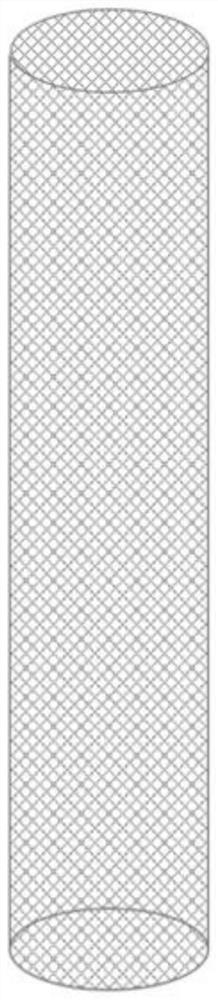
[0022] The reinforced hot-melt pile 2 is composed of gravel soil, quicklime, cement and geogrid; quicklime, cement and water are mixed and then cemented with gravel soil to form a pile body, and the geogrid encloses a hollow structure Wrapped around the pile body to form a reinforced heat-melt pile 2, combined with the lateral restraint provided by the geogrid, it has good strength and rigidity; the quicklime component in the reinforced heat-melt pile 2 c...

specific Embodiment approach 2

[0028] Embodiment 2: This embodiment differs from Embodiment 1 in that sensors are arranged around the reinforced heat-melt pile 2 to monitor changes in temperature, humidity, displacement and pore water pressure. Others are the same as the first embodiment.

specific Embodiment approach 3

[0029] Embodiment 3: This embodiment differs from Embodiment 1 or Embodiment 2 in that: the geogrid in the reinforced heat-melt pile 2 is a steel-plastic geogrid. Others are the same as those in Embodiment 1 or 2.