Trusted identity model based on block chain smart contract

A technology of smart contracts and identity models, applied in the fields of instruments, electronic digital data processing, digital data protection, etc., can solve the problems of hiding the real identity and risks of actual users, achieve safe and efficient cross-domain authentication, ensure security, and improve computing. performance effect

CN113239382AActive Publication Date: 2021-08-10NANJING UNIV OF POSTS & TELECOMM
5 Cites 3 Cited by

Patent Information

Authority / Receiving Office
CN · China
Patent Type
Applications(China)
Current Assignee / Owner
Publication Date
2021-08-10

Smart Images

  • Figure 1
    Figure 1
  • Figure 2
    Figure 2
  • Figure 3
    Figure 3
Patent Text Reader

Abstract

The invention discloses a trusted identity model based on a block chain smart contract, wherein the model comprises the following steps: releasing a trusted identity smart contract, and registering an identity by a CA node to obtain a block chain digital certificate; registering the identity by a user to the CA node to obtain the block chain digital certificate; completing, by the service providermm, user identity authentication to the CA node through the user block chain digital certificate. According to the invention, the PKI system is introduced into the block chain, the block chain digital certificate and the CA-related smart contract are designed, the trusted identity based on the smart contract is realized, the identity is ensured to be trusted, the transaction is safe, and the law compliance is satisfied.
Need to check novelty before this filing date? Find Prior Art

Description

technical field

[0001] The invention belongs to the technical field of cyberspace security, and in particular relates to a trusted identity model based on blockchain smart contracts. Background technique

[0002] Blockchain technology has the characteristics of decentralization, common maintenance, non-tampering, traceability, and trust-building. These features help to solve trust issues among different institutions, different systems, and different regions. As a computer transaction protocol, smart contracts have attracted much attention in recent years with the popularity of blockchain technology. It has the characteristics of decentralization, self-verification, and automatic execution of contract terms, and can use automatic execution codes to improve the level of automated transactions. Smart contracts are based on the distributed ledger characteristics of the blockchain, and have disruptive technical advantages in the financial field. Blockchain technology can ensur...

Examples

Embodiment Construction

[0036] Below in conjunction with accompanying drawing and specific embodiment, further illustrate the present invention, should be understood that these examples are only for illustrating the present invention and are not intended to limit the scope of the present invention, after having read the present invention, those skilled in the art will understand various aspects of the present invention All modifications of the valence form fall within the scope defined by the appended claims of the present application.

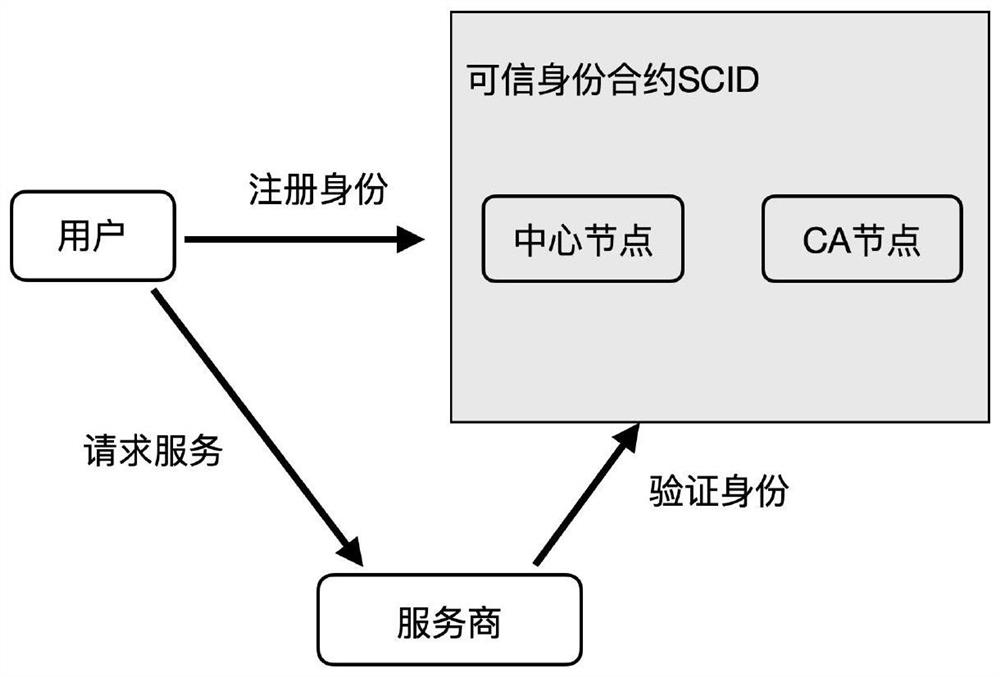
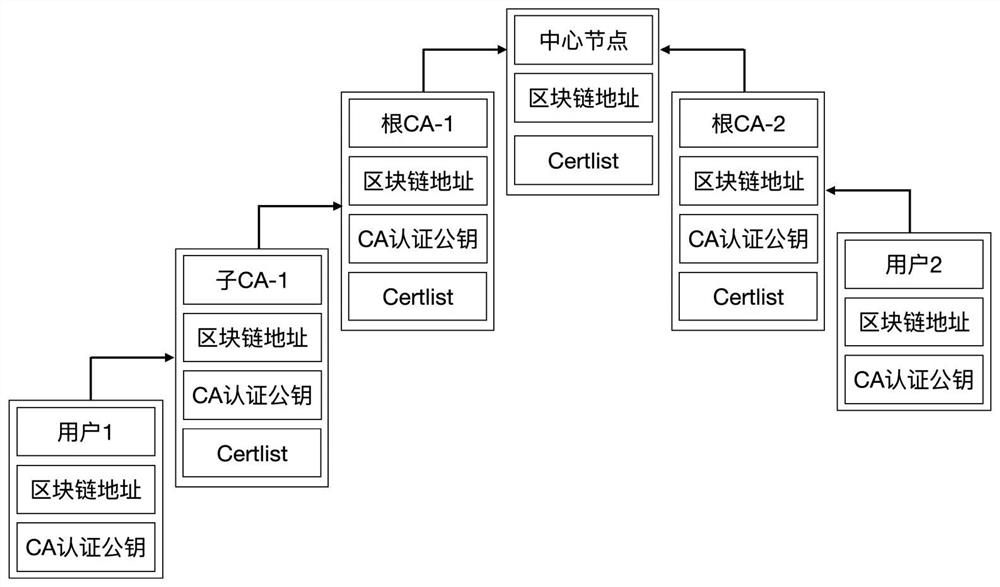
[0037] A trusted identity model based on blockchain smart contracts, such as figure 1 As shown, the participating roles include central nodes, CA nodes, users, service providers, and trusted identity smart contracts. After the CA node registers the identity through the central node, the user realizes the trusted identity registration through the CA node. When a user requests a service from the service provider, the service provider can call the trusted identity cont...