[0006]In the case where the vehicle is being steered, the steering assist system constructed as described above avoids the assist force from being abruptly generated by the first assist portion when the engine operates after the assist force by the second assist portion becomes zero. Thus, the steering system prevents or reduces a change in the assist force with respect to the steering operation by the driver. That is, the steering assist system enables proper switching from the assist force by the second assist portion to the assist force by the first assist portion.
[0014]This form aims at addressing the problem described above. According to this form, when there occurs a failure in which the second assist portion does not work during running of the vehicle in the EV mode, the steering assist system executes the assist switching from the assist by the second assist portion to the assist by the first assist portion. In the assist switching, the assist force by the first assist portion is gradually increased in the case where the steering operation is being performed. According to this form, the assist force is gradually made larger when the assist force that has once become lost again generated, thus enabling the driver to easily maintain an appropriate steering amount.
[0016]Although the magnitude of the set assist force in this form is not limited, the set assist force may have the same magnitude as the assist force generated before the second portion fails to operate, for instance. Owing to this set assist force, the assist force by the first assist portion is gradually increased after the occurrence of the failure of the second assist portion up to the assist force whose magnitude is equal to that of the assist force that has been generated by the second assist portion before the occurrence of the failure, thus preventing a change in the operation feeling felt by the driver in the steering operation before and after the occurrence of the failure of the second assist portion. It is desirable that the assist force by the first assist portion be gradually increased such that the assist force reaches the set assist force within about 0.5-5 seconds.
[0021]This form enjoys the advantage that the operation feeling felt by the driver in the steering operation does not change before and after the occurrence of the failure of the second assist portion.
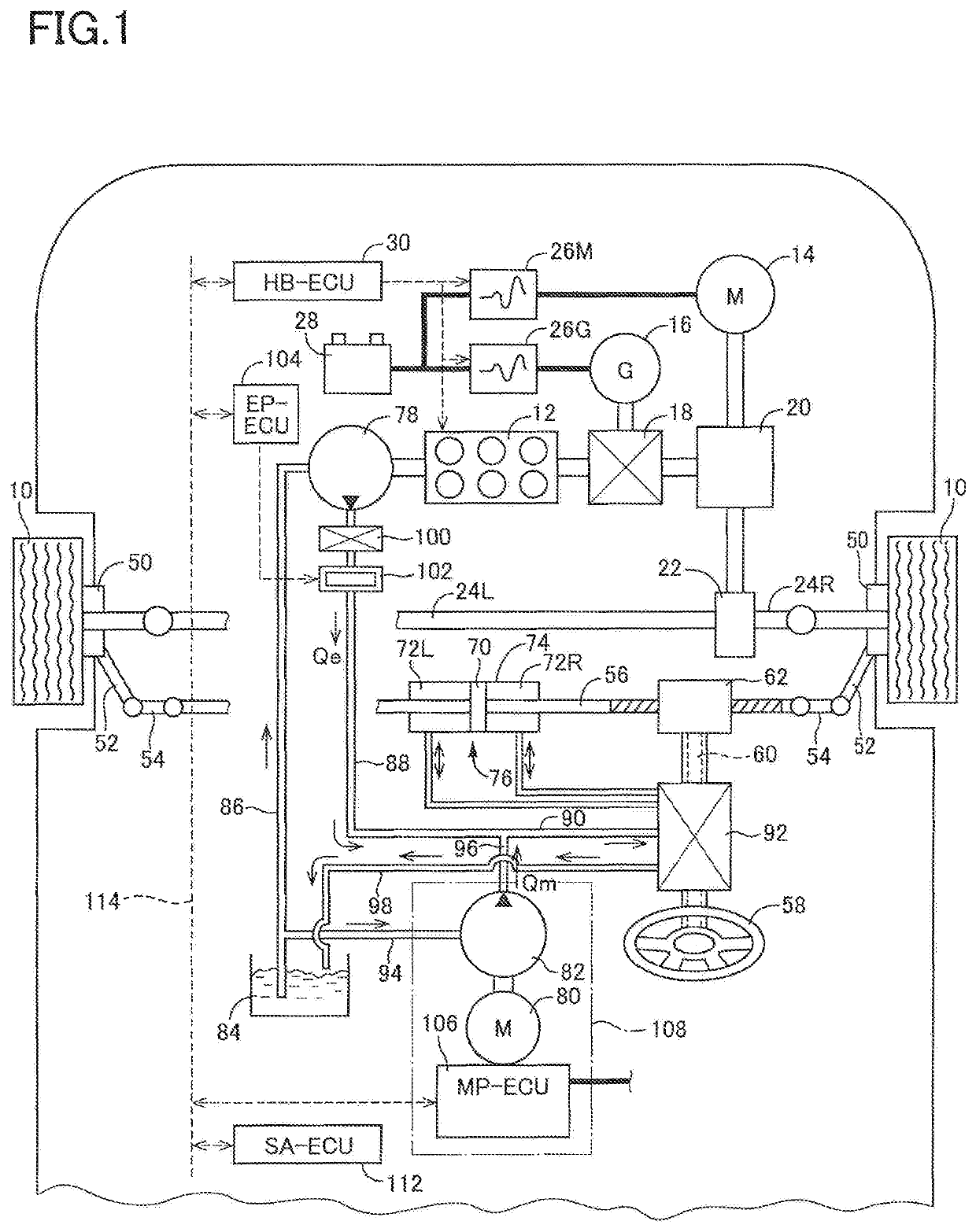
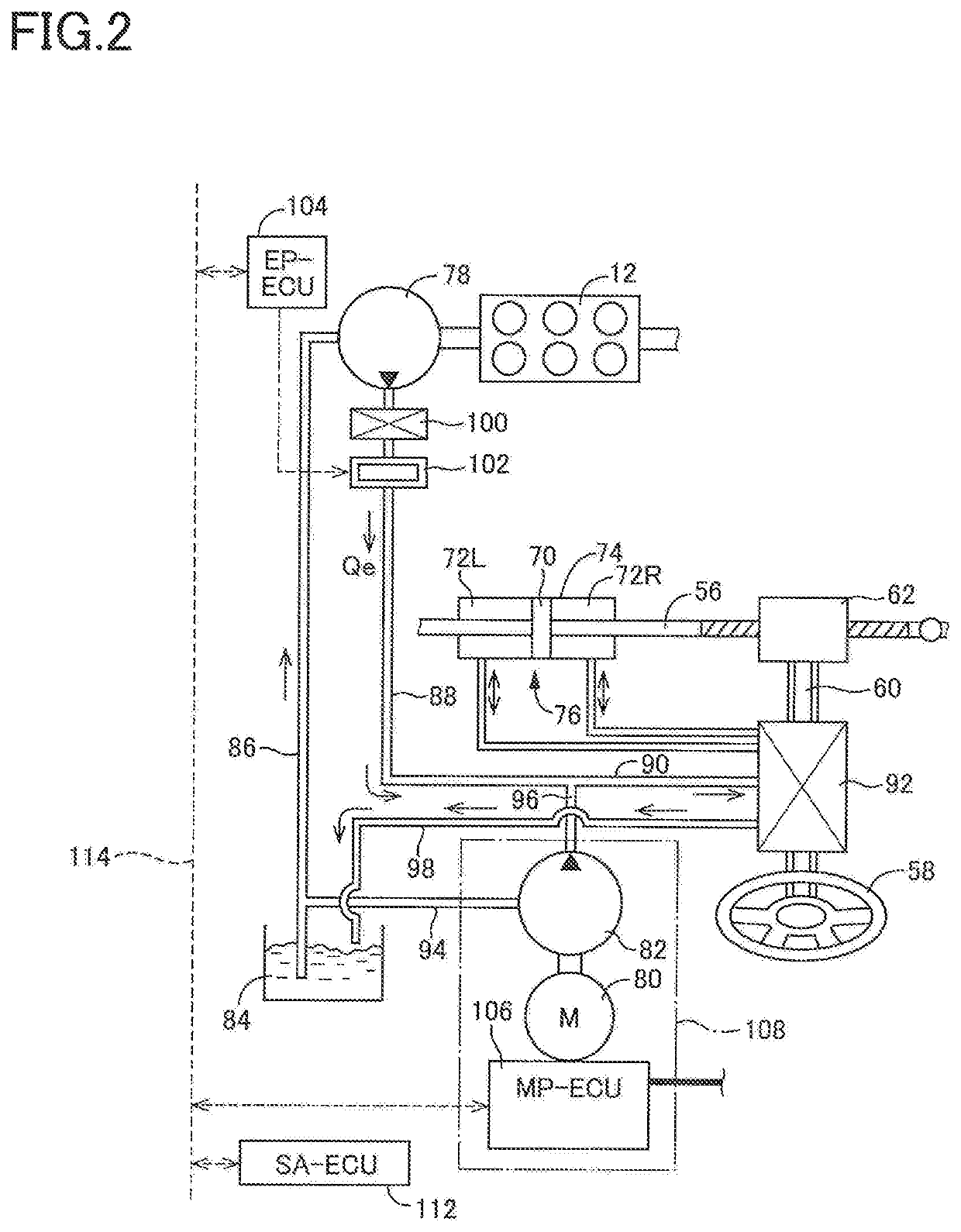
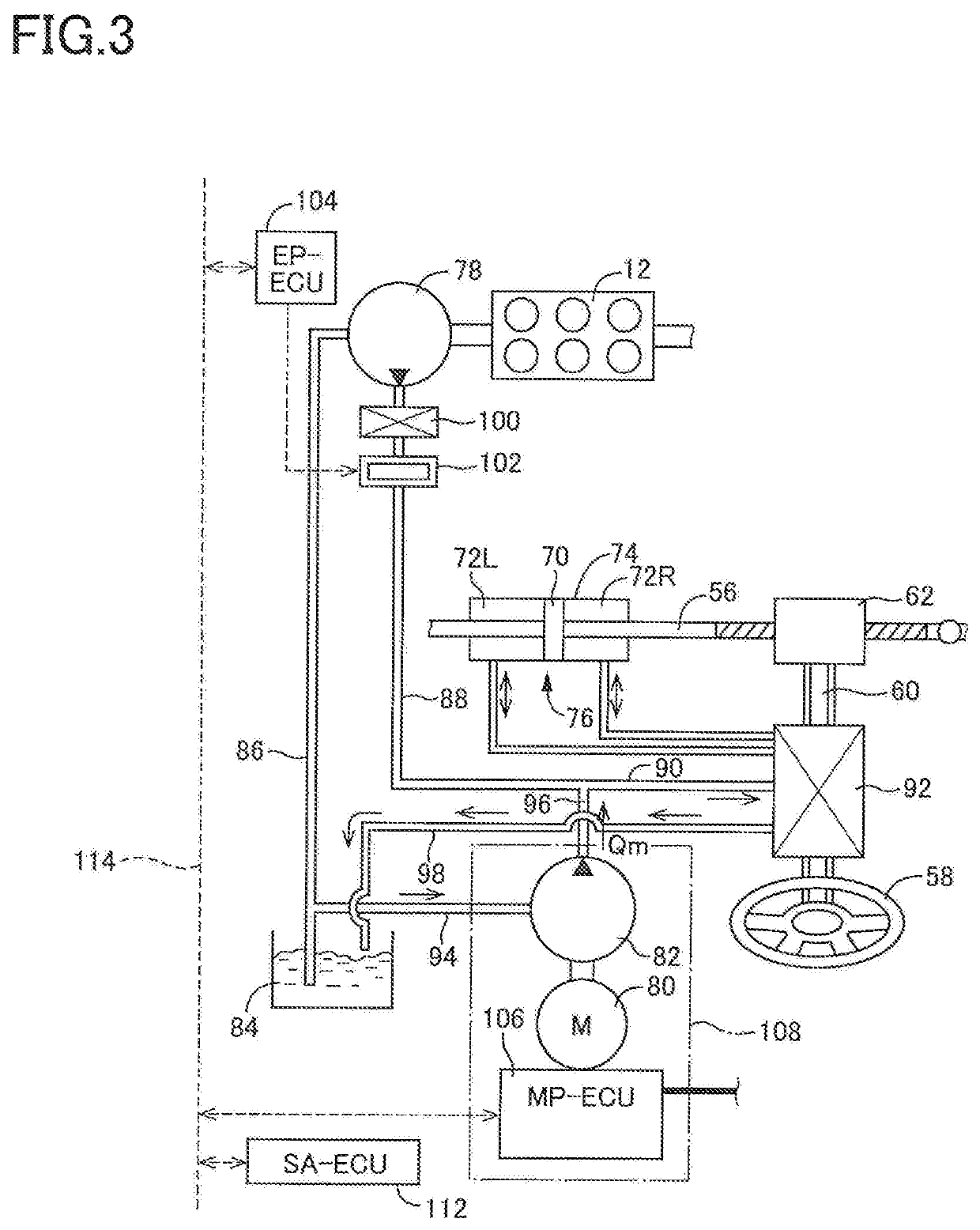
[0033]The engine-pump ejection flow rate controller according to this form may employ an electromagnetic valve mechanism having a known ordinary structure as illustrated in FIG. 2 of the Japanese Patent Application Publication No. 2014-19290, for instance. The engine-pump ejection flow rate controller is configured to control an electric current supplied to a solenoid so as to permit the working fluid to pass therethrough at a flow rate in accordance with the controlled electric current. Owing to provision of the engine-pump ejection flow rate controller, this form offers an advantage of preventing a rapid change in the flow rate of the working fluid ejected to the assist device when the running mode of the vehicle is switched from the EV mode to a mode in which the vehicle runs by driving of the engine (hereinafter referred to as “engine mode” where appropriate) or to a mode in which the vehicle runs by driving of both of the drive motor and the engine (hereinafter referred to as “hybrid mode” where appropriate). Further, in the engine mode and the hybrid mode, the engine-pump ejection flow rate controller may control the engine pump to eject the working fluid at the engine-pump ejection flow rate lower than the required receiving flow rate, and an insufficient flow rate, which is a shortage in the required receiving flow rate and which cannot be covered by the engine-pump ejection flow rate, may be covered by the motor-pump ejection flow rate. The thus configured assist system ensures sufficient assist capability while achieving downsizing of the engine pump. The motor-pump ejection flow rate controller in this form may be constituted as an electronic controller including a computer and drive circuits for the electric motor.
[0035]In this form, the gradient at which the assist force is gradually increased in the assist switching is made constant. This form enables relatively smooth assist switching in a relatively simple manner.


 Login to View More
  Login to View More