
Process for making chiral 1,4-disubstituted piperazines
Patent Information
- Authority / Receiving Office
- US · United States
- Current Assignee / Owner
- Publication Date
- 2005-10-13
- Estimated Expiration
- Not applicable · inactive patent
Smart Images
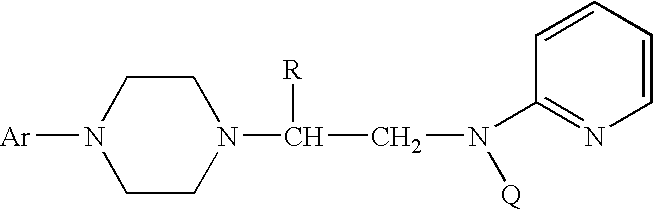
Figure 1 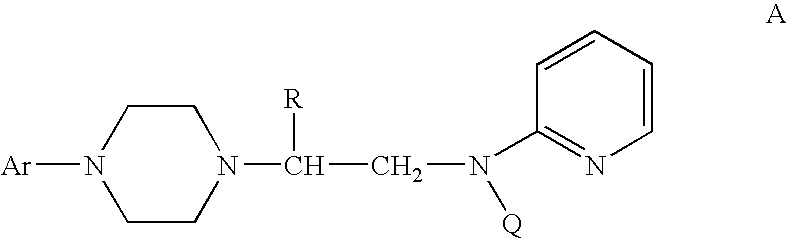
Figure 2 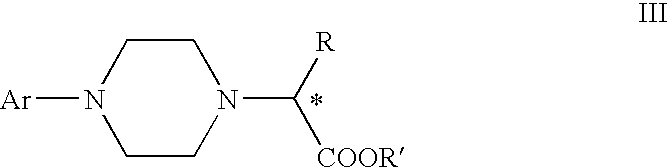
Figure 3
Abstract
Description
[0001] This application is a divisional of co-pending application Ser. No. 10 / 384,837, filed on Mar. 10, 2003, which claims priority from provisional application No. 60 / 363,458, filed on Mar. 12, 2002, the entire disclosure of which is hereby incorporated by reference.BACKGROUND OF THE INVENTION
[0002] Piperazines of formula A wherein R is a lower alkyl, Ar is an unsubstituted or substituted aryl or heteroaryl, and Q is a hydrogen, CO-(lower) alkyl, CO-cycloalkyl, or CO-aryl, are potent 5HT1A receptor binding agents. U.S. Pat. No. 6,127,357 teaches such piperazine derivatives that are useful in the treatment of Central Nervous System (CNS) disorders. Piperazine derivatives of formula A contain an asymmetric carbon so they may exist in two optically active forms. It is now well understood that enantiomers bind to receptors with different potency and selectivity, they may have different metabolic fate and produce different side effects. WO 9703982 teaches that preferred enantiomers ...
Examples
example i
N,N-Bis(2-chloroethyl)-(R)-alanine ethyl ester, trifluoromethanesulfonate
[0041] A suspension of bis(2-chloroethyl)amine hydrochloride (0.392 g; 2.1 mmol) in 5N aqueous sodium hydroxide (3 mL) is extracted with ether (2×10 mL) and the combined extracts are washed with a minimum amount of water and saturated brine. The ethereal solution is dried quickly over magnesium sulfate and filtered. Tetrahydrofuran (2 mL) is added to the filtrate, and ether is carefully removed under reduced pressure on a rotavapor unit without heating. The residue is mixed with a solution of ethyl (S)-2-[(methylsulfonyl)oxy]-propionate (0.5 g; 2 mmol) in tetrahydrofuran (1 mL). After stirring the reaction mixture for 24 hrs at room temperature, there is no visible precipitate. The volatiles are removed under reduced pressure and the remaining viscous oil is dissolved in ether (8 mL), and the slightly turbid solution is filtered after 60 minutes. The filtrate is treated dropwise with n-heptane to induce crysta...
example ii
(R)-4-(2,3-Dihydro-1,4-benzodioxin-5-yl)-α-methyl-1-piperazineacetic acid ethyl ester
[0042] A solution of 2,3-dihydro-1,4-benzodioxin-5-amine (0.327 g; 2.16 mmol) in chlorobenzene (2 mL) is added to a solution of N,N-bis(2-chloroethyl)-(R)-alanine ethyl ester (trifluoromethanesulfonic acid salt; 0.850 g; 2.16 mmol) in the same solvent (2 mL). The stirred reaction mixture is heated at 130° C. for 15 hours, the volatiles are removed on a rotavap, and the semi-solid residue is partitioned between 10% sodium bicarbonate (15 mL) and ether. Organic extracts are washed with brine, dried over magnesium sulfate, and filtered. TLC (chloroform) shows formation of a new product with RF 0.15, (R)-4-(2,3-dihydro-1,4-benzodioxin-5-yl)-α-methyl-1-piperazineacetic acid ethyl ester. Upon addition of 1N ethereal HCl, (R)-4-(2,3-dihydro-1,4-benzodioxin-5-yl)-α-methyl-1-piperazineacetic acid ethyl ester is converted into its hydrochloride salt that is collected by filtration; 0.615 g (80%), mp 168-171°...
example iii
(R)-4-(2,3-Dihydro-1,4-benzodioxin-5-yl)-β-methyl-1 -piperazineethanol
[0043] The hydrochloride salt made by Example II (1.07 g; 3 mmol) is suspended in 5% aqueous sodium bicarbonate (6 mL) and extracted with ether. The organic phase is separated, washed with brine, dried quickly over magnesium sulfate and filtered. The filtrate is added to a stirred suspension of lithium aluminum hydride (0.34 g; 9 eq) and the mixture is heated to a mild reflux for 3 hours. After cooling, it is decomposed with water (1 mL) and 0.5N hydrochloric acid (7 mL). The aqueous layer is separated, basified with 10% sodium bicarbonate and re-extracted with ether. The combined extracts are washed with small amounts of water and brine, dried over magnesium sulfate, filtered and evaporated. The oily product (0.69 g; yield 82%) slowly crystallizes upon standing, and can be recrystallized from n-butanol / n-heptane; mp 92° C.; enantiomeric purity 98%; 1H NMR (300 MHz, CDCl3) δ 1.03 (d, J=7 Hz, 3H), 2.74 (m,2H), 2.9...