Self-adjusting re-sealable spring center closure

a self-adjusting, spring-type technology, applied in the direction of closures using stoppers, liquid handling, caps, etc., can solve the problems of injection molded plastic containers not being recycled, not providing a container that is well suited, and not always easy to remove the lid from the frozen container. , to achieve the effect of convenient removal

a self-adjusting, spring-type technology, applied in the direction of closures using stoppers, liquid handling, caps, etc., can solve the problems of injection molded plastic containers not being recycled, not providing a container that is well suited, and not always easy to remove the lid from the frozen container. , to achieve the effect of convenient removal

US20050269328A1Inactive Publication Date: 2005-12-08GRAHAM PACKAGING CO LP

Image

Smart Image Click on the blue labels to locate them in the text.
Viewing Examples
Smart Image
  • Self-adjusting re-sealable spring center closure
  • Self-adjusting re-sealable spring center closure
  • Self-adjusting re-sealable spring center closure

Examples

Experimental program
Comparison scheme
Effect test

Embodiment Construction

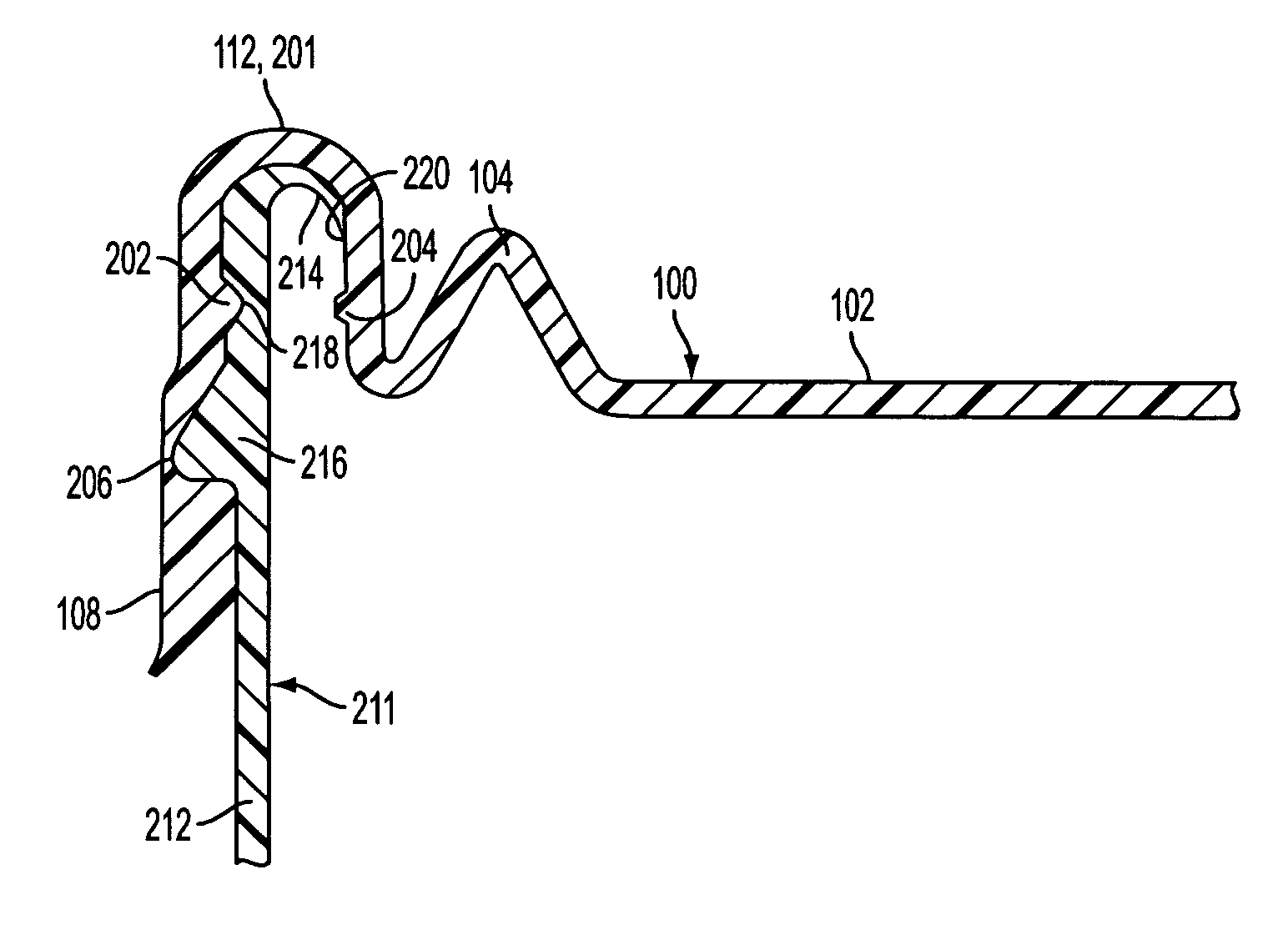
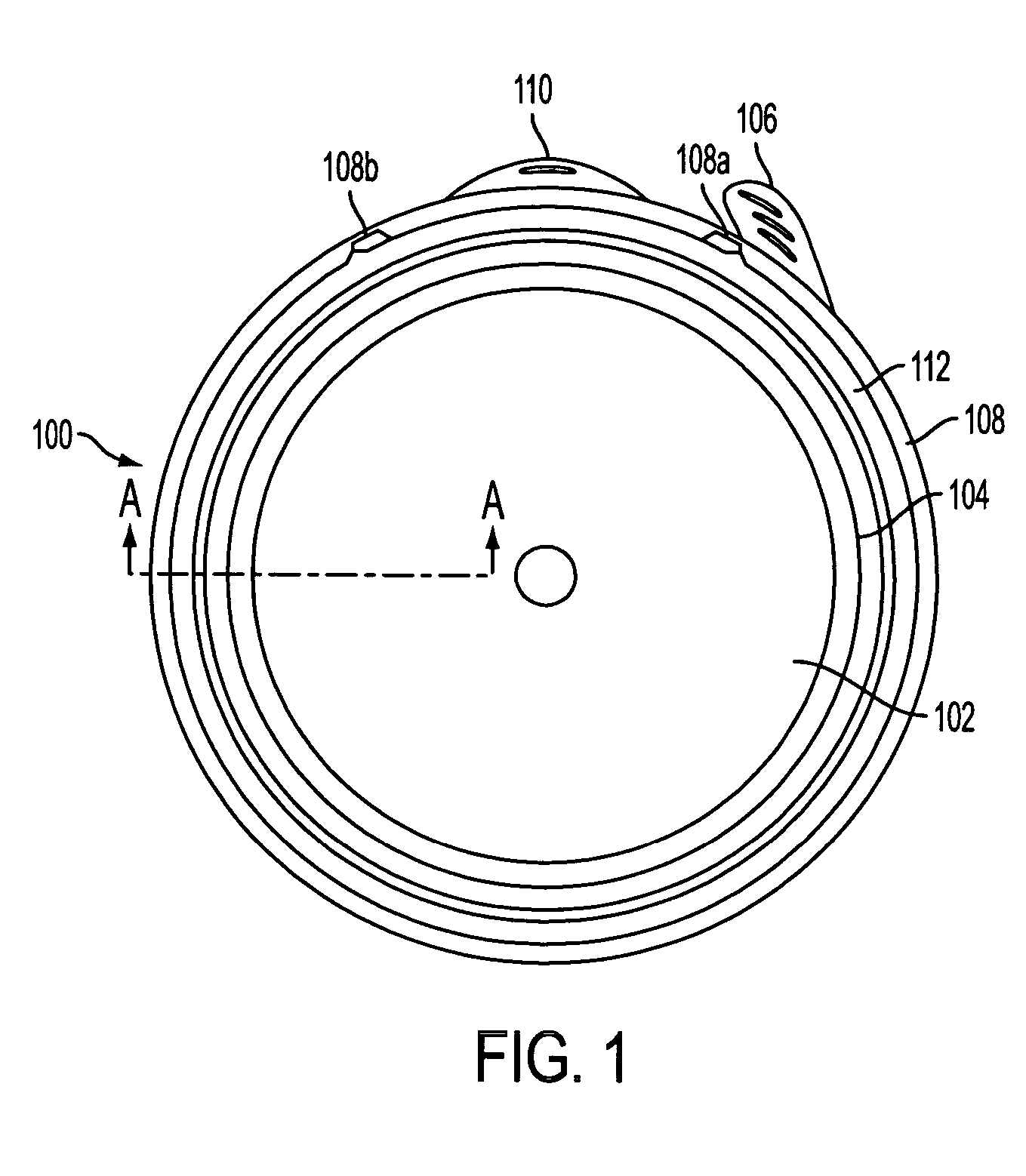
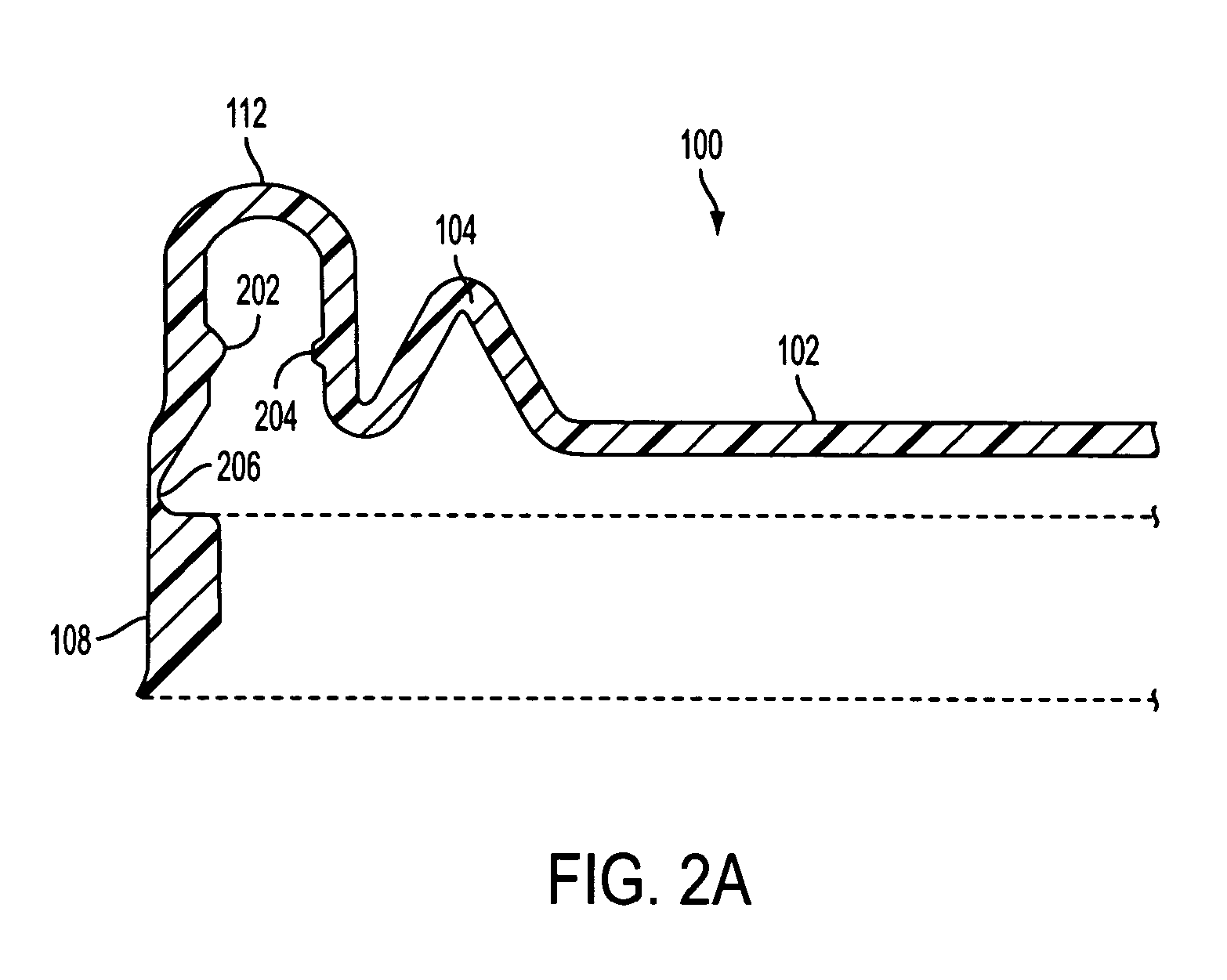
[0031] As can be seen from FIGS. 1 and 2A, a lid 100 according to the present invention is substantially circular and has a substantially planar center region 102. A spring 104 surrounds the center region 102. The spring 104 in the illustrated embodiment is an annular formation that bends in one direction out of the plane defined by the center region 102 and then bends back. The lid 100 also has a pull-tab 106 to remove a tamper-evident seal 108 clockwise from a break point 108a to a breakpoint 108b. In the illustrated embodiment, the seal 108 is a band that extends annularly around the lid 100 and a container that the lid covers. A push-up tab 110 remains on the lid 100 after the tamper-evident seal 108 is removed, allowing the user to push the lid up and remove it from the container. The lid 100 also includes an arcuate flange receiving portion 112 near the perimeter of the lid 100 to receive the flange of a container.

[0032] As can be seen from FIG. 2A, the flange receiving porti...

the structure of the environmentally friendly knitted fabric provided by the present invention; figure 2 Flow chart of the yarn wrapping machine for environmentally friendly knitted fabrics and storage devices; image 3 Is the parameter map of the yarn covering machine
Login to View More

PUM

No PUM Login to View More

Abstract

The application is directed to a leak-resistant closure for a plastic container having a generally planar central portion a peripheral portion, and a spring structure. The peripheral portion defines an annular recess with an inner wall having a secondary sealing formation for engaging a free edge of a container The outer wall of the peripheral portion has a primary sealing formation on an inner surface thereof and faces the annular recess, thereby defining the primary sealing formation. The spring structure biases the peripheral portion radially outward from the central portion, and the spring structure is positioned between the central portion and the peripheral portion.

Description

CROSS REFERENCE TO RELATED APPLICATIONS [0001] This application is a continuation of U.S. patent application Ser. No. 10 / 300,016, filed Nov. 20, 2002.BACKGROUND OF THE INVENTION [0002] 1. Field of the Invention [0003] The present invention relates to a plastic container and lid and, more particularly, to a lightweight easy on and off lid with a reusable liquid seal closure. [0004] 2. Related Art [0005] Many food and beverage products sold to the consuming public are provided in wide mouth jar-like containers. Consumers have indicated that they prefer containers which initially have a tamper-evident seal, and which can be resealed after opening for partial consumption of the contents. It is imperative that any such container have a seal which is leak-resistant from the time the lid is applied until end use by the consumer. [0006] While seal integrity is important, the lid should allow for easy removal by the consumer. Therefore, a commercially-desirable container should have a reliab...

Claims

the structure of the environmentally friendly knitted fabric provided by the present invention; figure 2 Flow chart of the yarn wrapping machine for environmentally friendly knitted fabrics and storage devices; image 3 Is the parameter map of the yarn covering machine
Login to View More

Application Information

Patent Timeline
08 Dec 2005
Publication
US20050269328A1
IPC
B65D43/02
CPC
B65D2543/00796; B65D2543/00842; B65D43/0249; B65D2101/0038; B65D2543/00092; B65D2543/00296; B65D2543/0074; B65D2543/00537
Inventors
CRIDER, MATTHEW; HERRING, WALT