
Padlock with fully integrated dual locking system with indicator/signal assembly
a dual locking system, padlock technology, applied in padlocks, building locks, constructions, etc., can solve the problems of inability to overcome prior art constructions, inability to use entire combination locks, common deficiencies of prior art combination locks which have not been successfully overcome,
- Summary
- Abstract
- Description
- Claims
- Application Information
AI Technical Summary
Benefits of technology
Problems solved by technology
Method used
Image

Examples
second embodiment
[0225] In addition to the first preferred embodiment of the present invention as shown in FIGS. 27-33 and fully detailed above, the present invention also comprises a second preferred embodiment for providing a signal / indicator to the user / owner whenever the key controlled locking portion of the padlock of the present invention is employed. In addition, as with the embodiment detailed above, the second embodiment also requires the user / owner to employ a special reset key in order to reposition the signal / indicator into its original position. By referring to FIGS. 34-42, along with the following detailed disclosure, the construction and operation of the second preferred embodiment can best be understood.
[0226] In this second preferred embodiment, signal providing, dual locking mode padlock 20 incorporates signal / indicator assembly 130 mounted in housing 21 in cooperating relationship with cylinders 111 and 112. As cylinders 111 and 112 are arcuatly rotated in response to the insertio...
fourth embodiment
[0274] In addition to the three preferred embodiments of the present invention shown in FIGS. 27-54, and fully detailed above, the present invention also comprises a fourth preferred embodiment for providing a signal / indicator to the user / owner whenever key controlled locking 24 portion of padlock 20 of the present invention is employed. In addition, as with the embodiments detailed above, this fourth embodiment also requires the user / owner to employ a special reset key in order to reposition the signal / indicator into its original location. By referring to FIGS. 55-63, along with the following detailed disclosure, the construction and operation of this fourth preferred embodiment can best be understood.
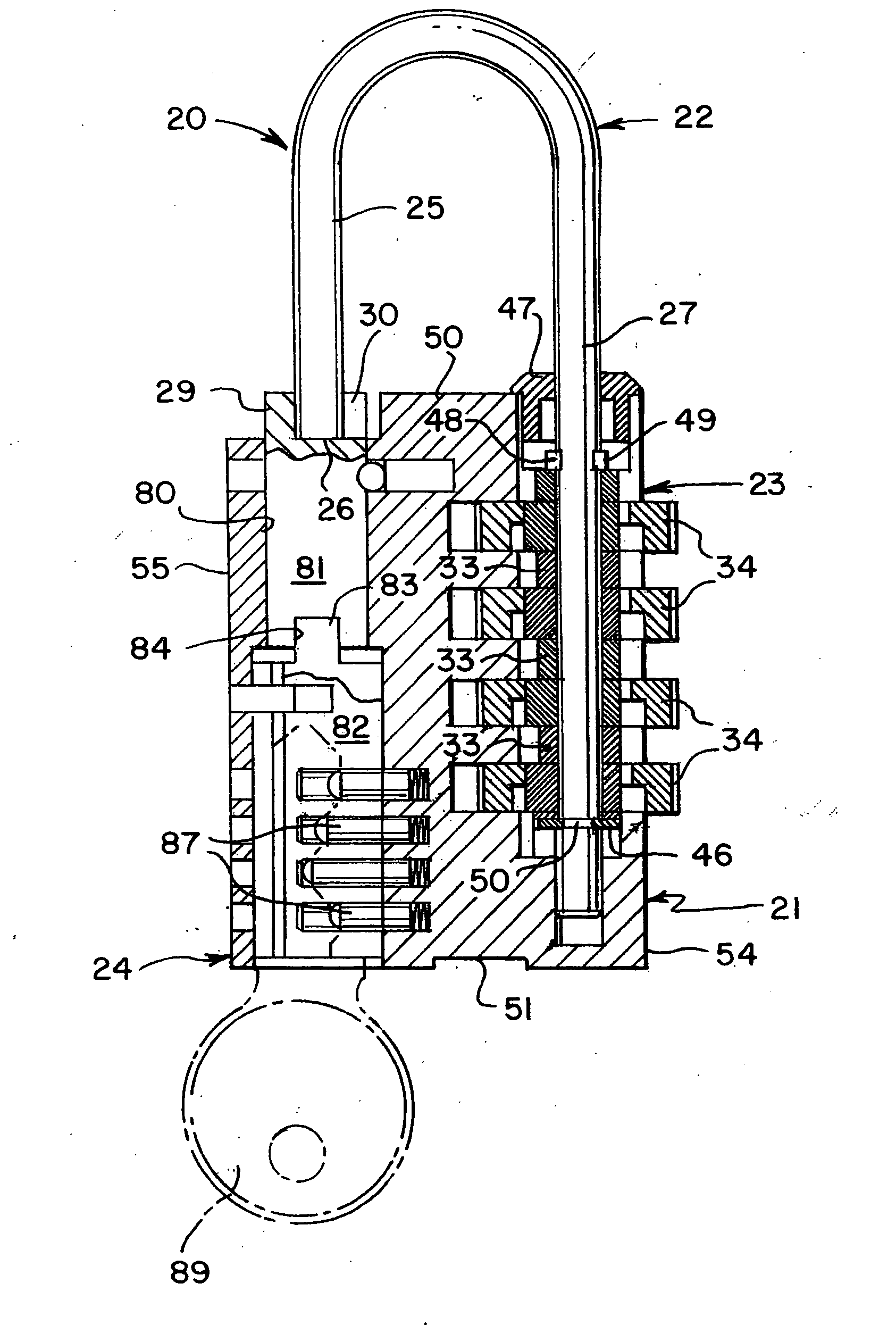
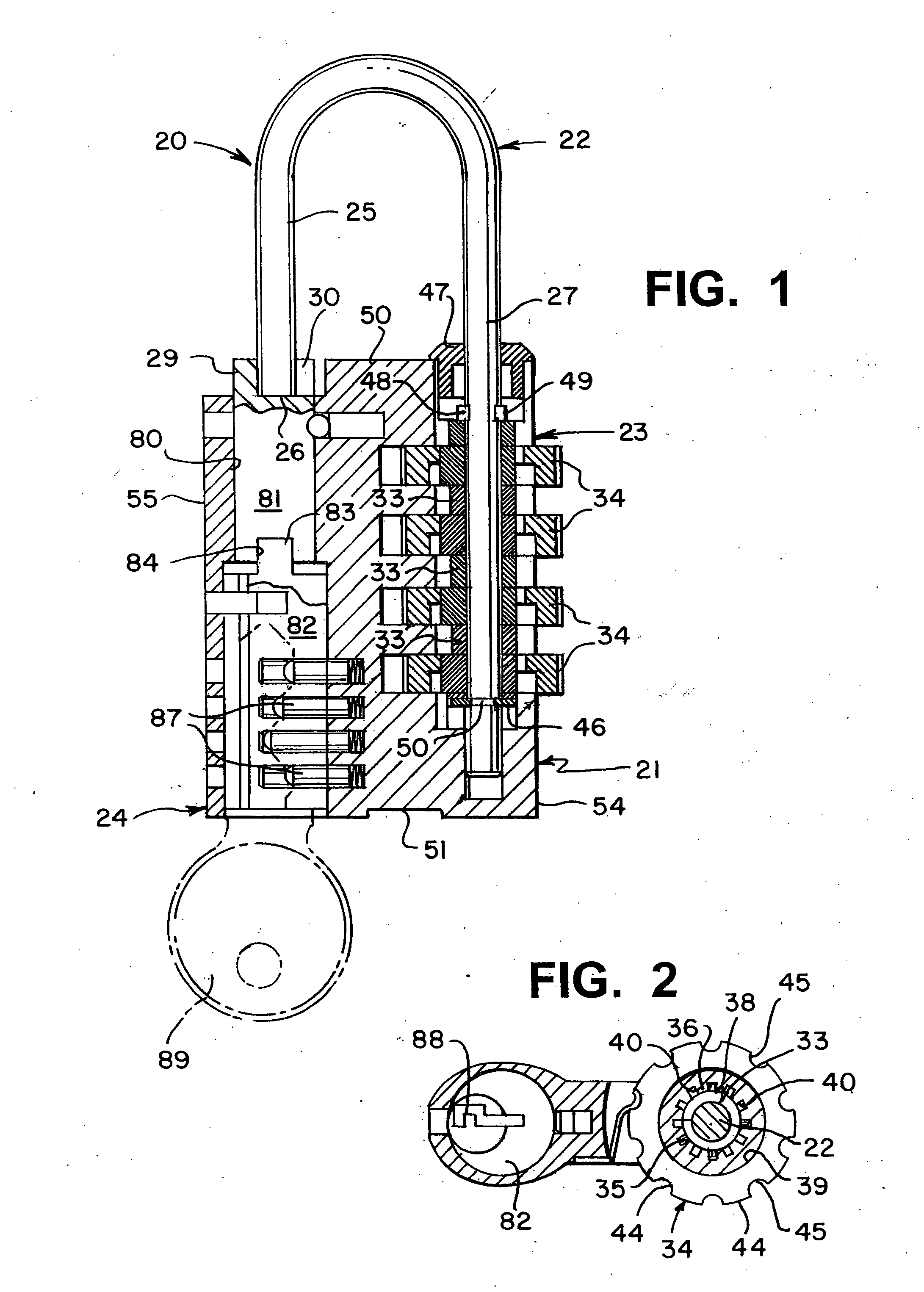
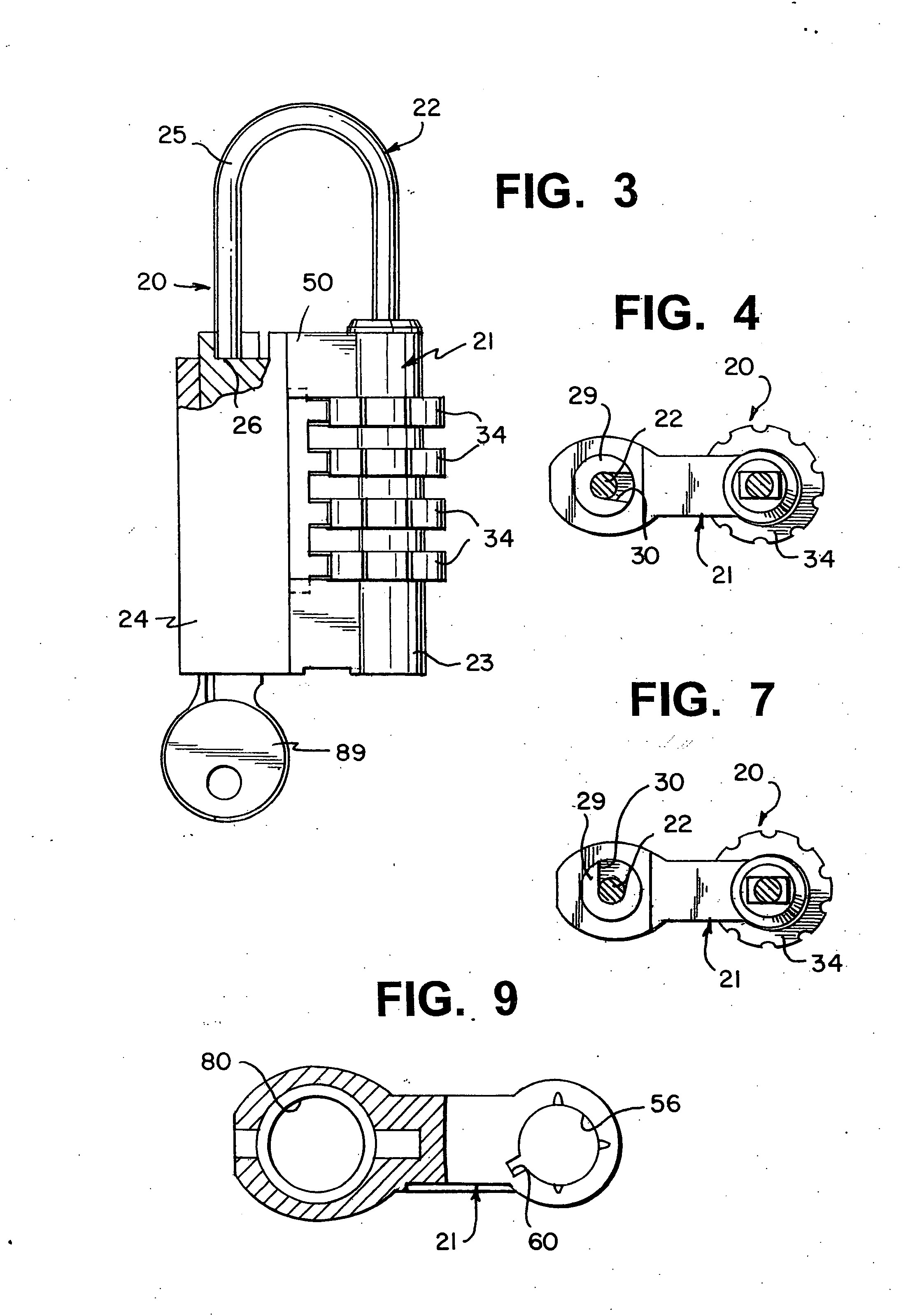
[0275] In the preferred construction of this embodiment of the present invention, padlock 20 comprises a construction substantially equivalent to the padlock construction depicted in FIGS. 1-19 and detailed above. In this regard, dual locking mode padlock 20 comprises housing 21, shac...
fifth embodiment
[0296] In addition to the four preferred embodiments of the present invention shown in FIGS. 27-63, and fully detailed above, the present invention also comprises a fifth preferred embodiment for providing a signal / indicator to the user / owner whenever key controlled locking 24 portion of padlock 20 of the present invention is employed. In addition, as with the embodiments detailed above, this fifth embodiment also requires the user / owner to employ a special reset key in order to reposition the signal / indicator into its original location. By referring to FIGS. 64-75, along with the following detailed disclosure, the construction and operation of this fifth preferred embodiment can best be understood.
[0297] In the preferred construction of this embodiment of the present invention, padlock 20 comprises a construction substantially equivalent to the padlock construction depicted in FIGS. 43-54 and detailed above. In this regard, dual locking mode padlock 20 comprises housing 21, shackle...
PUM
 Login to View More
 Abstract
Description
Claims
Application Information
 Login to View More