
Residual accommodation threshold for correction of presbyopia and other presbyopia correction using patient data
a patient data and threshold technology, applied in the field of goal functions or visual function diagnostic metrics, can solve the problems of loss of near-distance focus ability, limited ability to change shape, and loss of elastic properties of crystalline lenses, so as to mitigate or treat presbyopia in a particular, improve near vision, and improve the effect of near vision
- Summary
- Abstract
- Description
- Claims
- Application Information
AI Technical Summary
Benefits of technology
Problems solved by technology
Method used
Image

Examples
Embodiment Construction
[0088]Although the methods, devices, and systems of the present invention are described primarily in the context of a laser eye surgery system, it should be understood that the techniques of the present invention may be adapted for use in other eye treatment procedures and systems such as contact lenses, intra-ocular lenses, radial keratotomy, collagenous corneal tissue thermal remodeling, removable corneal lens structures, glass spectacles, corneal ring implants, and the like.
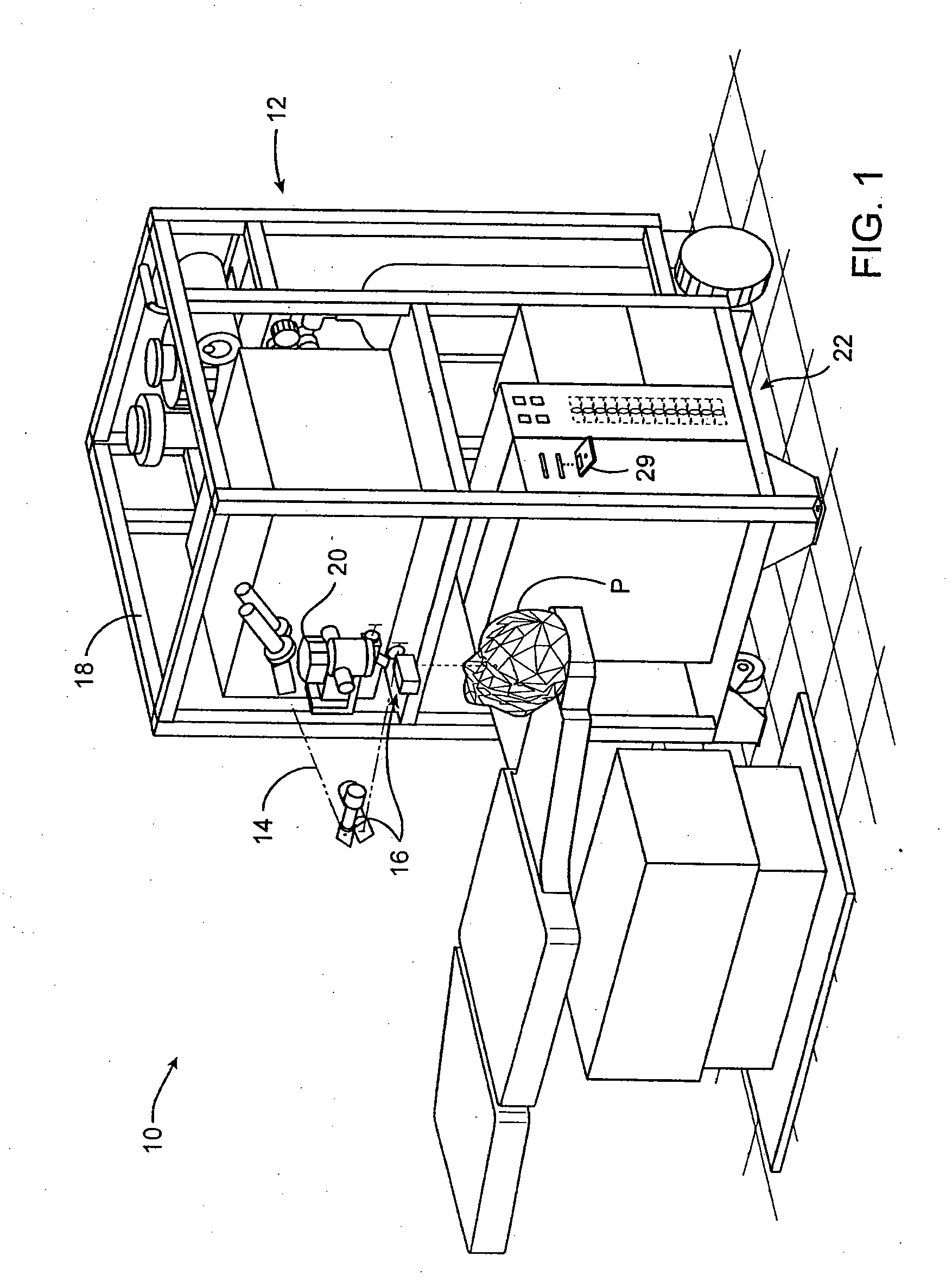
[0089]Turning now to the drawings, FIG. 1 illustrates a laser eye surgery system 10 of the present invention, including a laser 12 that produces a laser beam 14. Laser 12 is optically coupled to laser delivery optics 16, which directs laser beam 14 to an eye E of patient P. A delivery optics support structure (not shown here for clarity) extends from a frame 18 supporting laser 12. A microscope 20 is mounted on the delivery optics support structure, the microscope often being used to image a cornea of eye E.
[0...
PUM
 Login to View More
 Abstract
Description
Claims
Application Information
 Login to View More