Method for object detection

a technology for object detection and object detection, applied in the field of object detection, can solve the problems of reducing the overall processing effort of information about the presence of objects in digital images and the location thereof, requiring relatively high power consumption, and not being able to implement technology, so as to reduce the computation time of the neural network and limit the connection of the neural network

US20090161912A1Inactive Publication Date: 2009-06-25YATOM RAVIV +2
7 Cites 45 Cited by

Patent Information

Authority / Receiving Office
US · United States
Patent Type
Applications(United States)
Current Assignee / Owner
Publication Date
2009-06-25
Estimated Expiration
Not applicable · inactive patent

Smart Images

  • Figure 1
    Figure 1
  • Figure 2
    Figure 2
  • Figure 3
    Figure 3
Patent Text Reader

Abstract

In one aspect, the present invention is directed to a method for object detection, the method comprising the steps of: dividing a digital image into a plurality of sub-windows of substantially the same dimensions; processing the image of each of the sub-windows by a cascade of homogeneous classifiers (each of the homogenous classifiers produces a CRV, which is a value relative to the likelihood of a sub-window to comprise an image of the object of interest, and wherein each of the classifiers has an increasing accuracy in identifying features associated with the object of interest); and upon classifying by all of the classifiers of the cascade a sub-window as comprising an image of the object of interest, applying a post-classifier on the cascade CRVS, for evaluating the likelihood of the sub-window to comprise an image of the object of interest, wherein the post-classifier differs from the homogenous classifiers.
Need to check novelty before this filing date? Find Prior Art

Description

[0001] The present application claims the benefit of U.S. Provisional Application No. 61 / 016,162, filed on Dec. 21, 2007, and incorporated herein by reference.FIELD OF THE INVENTION

[0002] The present invention relates to the field of object detection in optical processing devices. More particularly, the invention relates to an improved object detection method, in comparison to the prior art.BACKGROUND OF THE INVENTION

[0003] The term “Object Detection” refers herein in the art to detection of an object in a digital image, and the location of the object on the digital image. The object may be a human figure, a manufactured piece, and so on.

[0004] Object detection does not deal with identifying an object, but rather with detecting whether a digital image comprises a searched object, and the location thereof in the digital image. As such object detection is usually used as pre-processing for a more complicated process, such as detecting whether a digital image comprises a human face and the...

Examples

an example

[0062]Assuming a digital image is divided into M sub-windows Si (each one is a 20*20 sub-image in the form of an integral image), and the cascade of classifiers comprises N classifiers Gj.

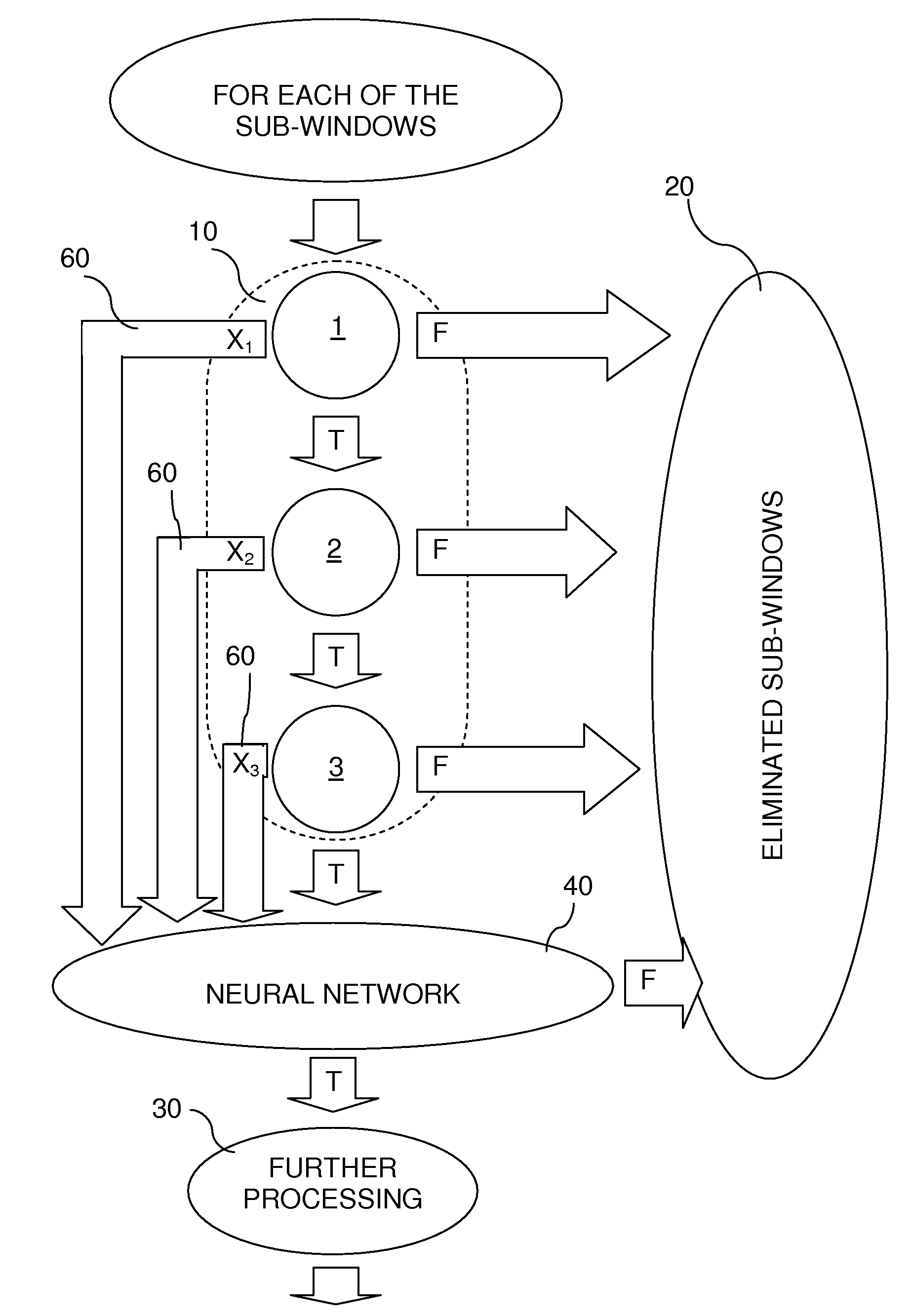
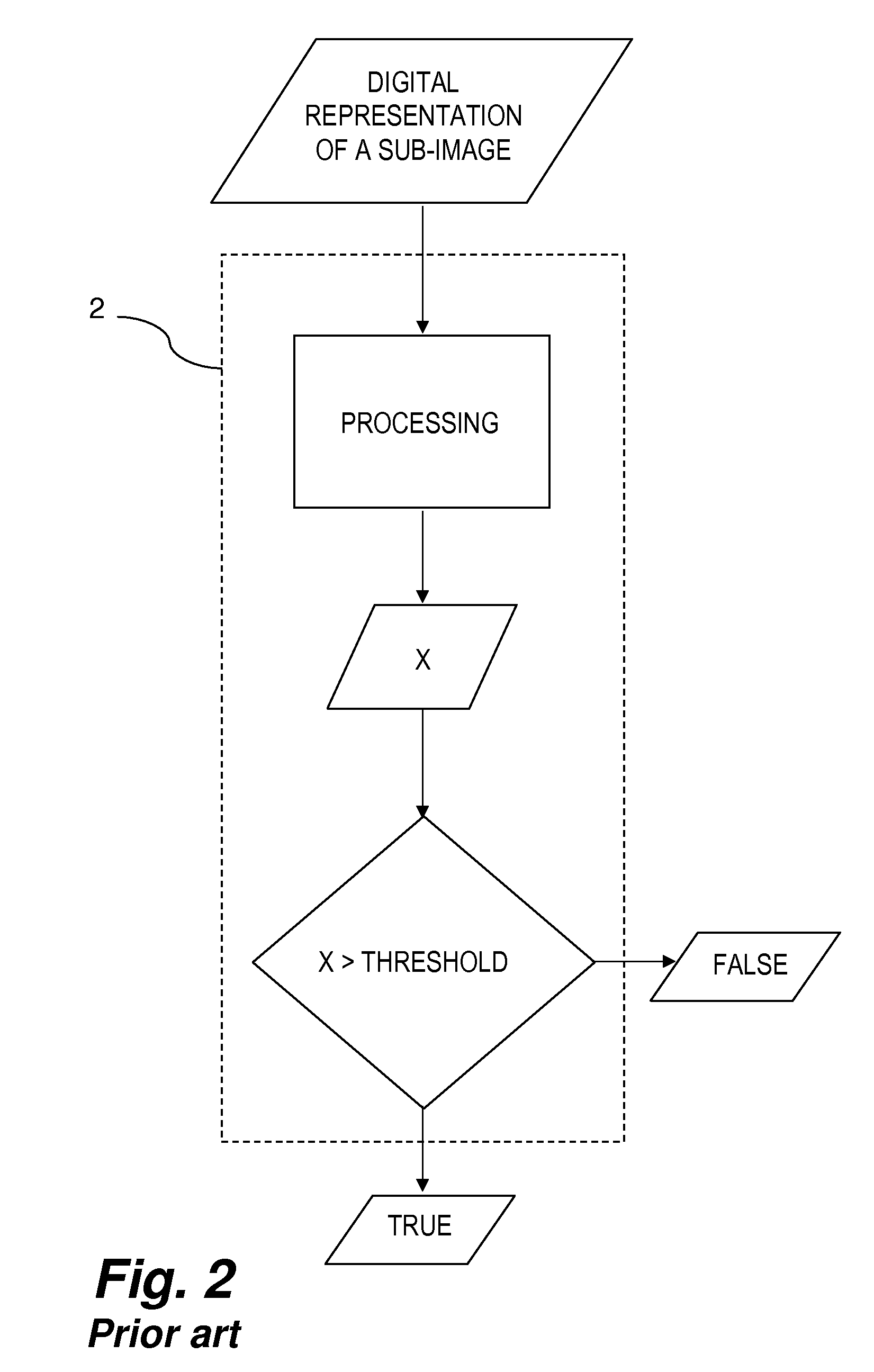
[0063]Vj is a vector Xj=Gj(Si). Xj is the output of classifier Gj before threshold Tj translates the output to a Boolean value. A True or False value may be determined by threshold Tj.

[0064]According to embodiments of the present invention, vector Vj, j=1 to M, is used as input for a Supportive Neural Network. Thus, assuming NN(V) is the Supportive Neural Network, the result thereof is B=NN(V), wherein B is Boolean value, indicating whether the object is in the sub-window or not.

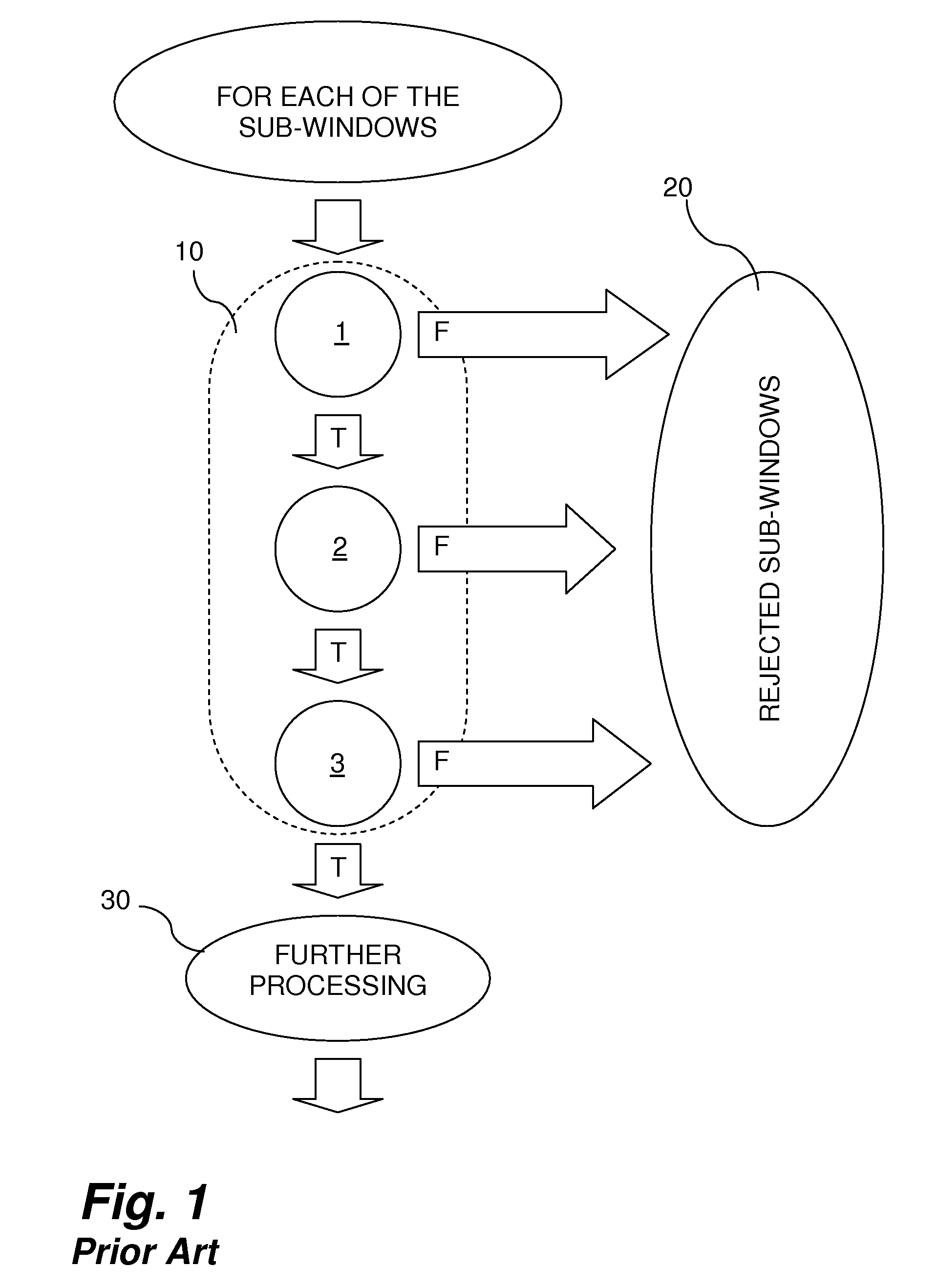
[0065]In contrast to the prior art, which makes no use of the results of the classifiers (i.e., the vector Vj), according to embodiments of the present invention, results of the classifiers are used as inputs for SNN.

[0066]In order to use a Supportive Neural Network as means for detecting whether a sub-window which has been...