Method and structure for self-sealed joint proof-of-knowledge and diffie-hellman key-exchange protocols

a proof-of-knowledge and key-exchange technology, applied in the field of proof-of-knowledge (pok), can solve the problems of inconvenient use, inconvenient design of correct and secure dhke protocols, and inability to meet the requirements of security and privacy, and achieve the effect of improving the security, privacy and efficiency of authenticated dhke protocols, soundness and robustness of the underlying design

a proof-of-knowledge and key-exchange technology, applied in the field of proof-of-knowledge (pok), can solve the problems of inconvenient use, inconvenient design of correct and secure dhke protocols, and inability to meet the requirements of security and privacy, and achieve the effect of improving the security, privacy and efficiency of authenticated dhke protocols, soundness and robustness of the underlying design

US20100205443A1Inactive Publication Date: 2010-08-12ANDREW C YAO

Image

Smart Image Click on the blue labels to locate them in the text.
Viewing Examples
Smart Image
  • Method and structure for self-sealed joint proof-of-knowledge and diffie-hellman key-exchange protocols
  • Method and structure for self-sealed joint proof-of-knowledge and diffie-hellman key-exchange protocols
  • Method and structure for self-sealed joint proof-of-knowledge and diffie-hellman key-exchange protocols

Examples

Experimental program
Comparison scheme
Effect test

Embodiment Construction

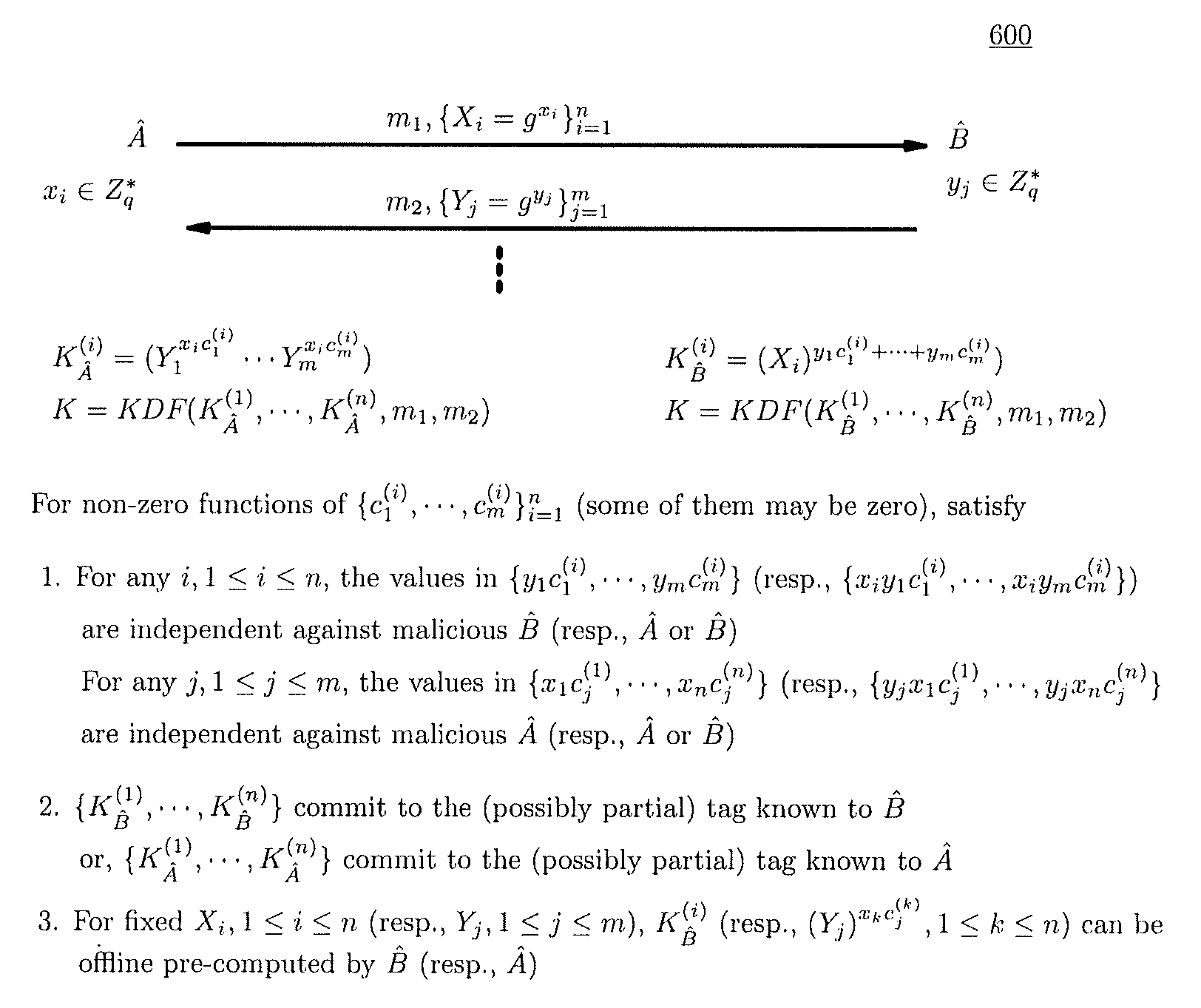
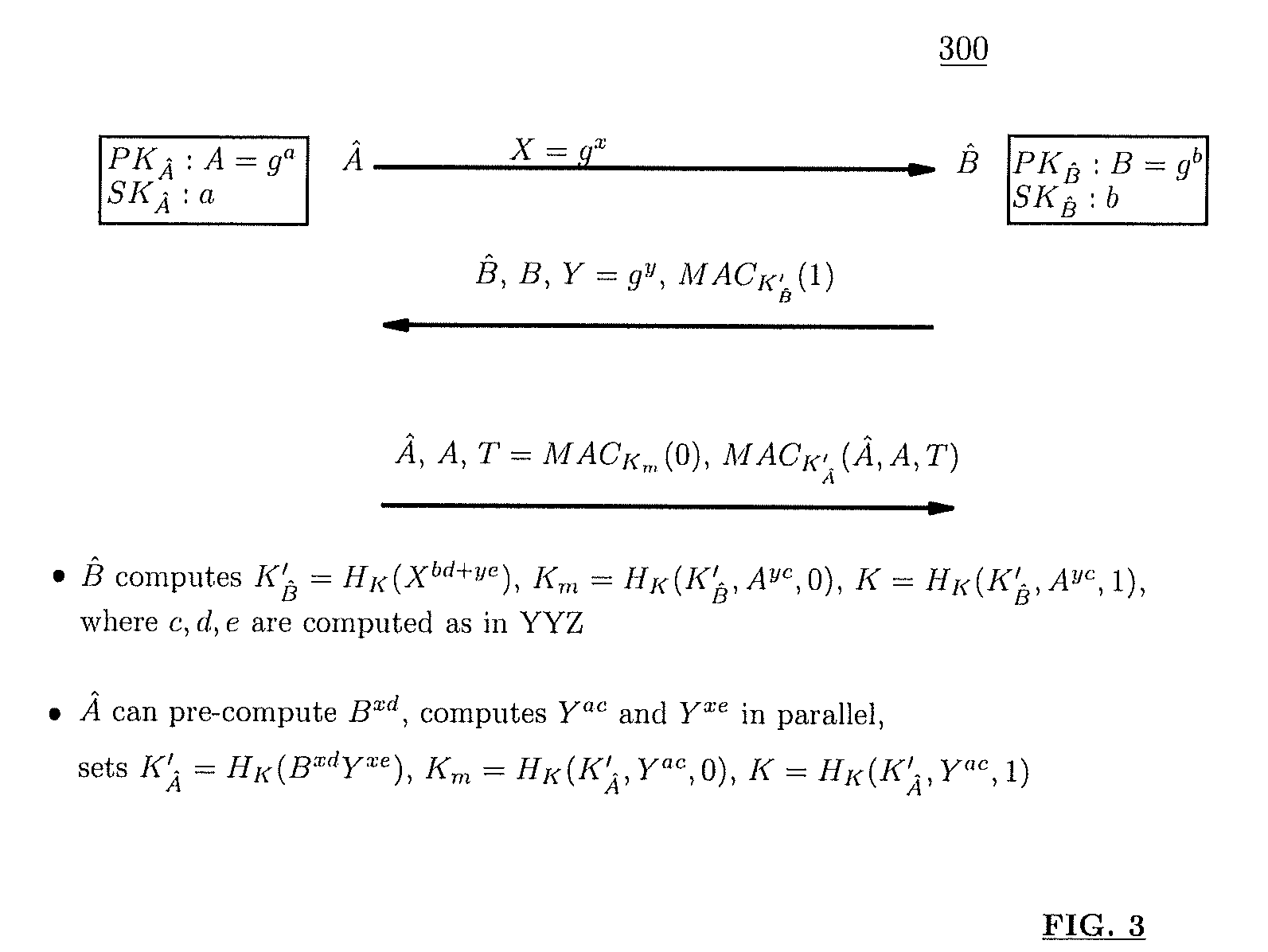
[0038]Referring now to the drawings, and more particularly to FIGS. 1-13, wherein are shown exemplary embodiments of the methods and structures according to the present invention.

Preliminary Notes

[0039]As a preliminary note on groups and notations, all the protocols and operations discussed herein assume a cyclic subgroup G of a finite group G′, where the order of G′ is N, there order of G is q of G′, g is a generator of G, where q is a large prime (typically, |q|=160, where |q| denotes the bit length of q, e.g., |q|=└ log2 q┘ meaning the logarithm of q to base 2). The inventors use multiplicative representation of group operations herein, but the treatment is equally applicable to additive groups, e.g., elliptic curves or any other algebraic groups or specific groups, finite fields, composite moduli, etc. The operations of exponents are assumed to be module q, while operations of group elements are assumed to be module N. For simplicity, the parameters G, q, g are assumed to be fix...

the structure of the environmentally friendly knitted fabric provided by the present invention; figure 2 Flow chart of the yarn wrapping machine for environmentally friendly knitted fabrics and storage devices; image 3 Is the parameter map of the yarn covering machine
Login to View More

PUM

No PUM Login to View More

Abstract

A method (and structure) for a party (the prover) to prove its knowledge, jointly and non-malleably, of multiple secret (fixed and / or ephemeral) Diffie-Hellman exponents (DH-exponents), corresponding to its public (fixed and / or ephemeral) DH-components and with respect to the public (fixed and / or ephemeral) challenging DH-components from another party (the verifier). The joint proof-of-knowledge (JPOK) consists of secrets made by multiplying multiple DH-secrets, which can be generated and verified by each party by its own secret DH-exponents and the public DH-components of both parties. To ensure the non-malleability of the JPOK, the method invented herein makes all these multiplied DH-secrets to be independent, and makes the session-tag committed to the multiplied DH-secrets. To preserve players' privacy and / or to improve protocol efficiency, the invented method makes the DH-secrets to be multiplied to further satisfy at least one of the following (besides above independence and commitments properties): (1) Deniability: all the DH-secrets to be multiplied can be computed out merely from the ephemeral secret DH-exponents and the public DH-components of both parties; (2) Pre-computability: a DH-secret involving a fixed DH-component of a party can be offline pre-computed by its peer; (3) Post-ID computability: a DH-secret involving an ephemeral DH-component of a party can be computed by its peer without knowing that party's identity and / or fixed DH-components. The secrets made by multiplying multiple DH-secrets can then be used to derive session-keys and to generate and verify authenticators between the parties. The invented method can also be used in parallel or subsequently by the parties, possibly with reserved player roles in different runs of the method, for mutual identifications, key confirmations, and for achieving more advanced cryptographic protocols in various settings.

Description

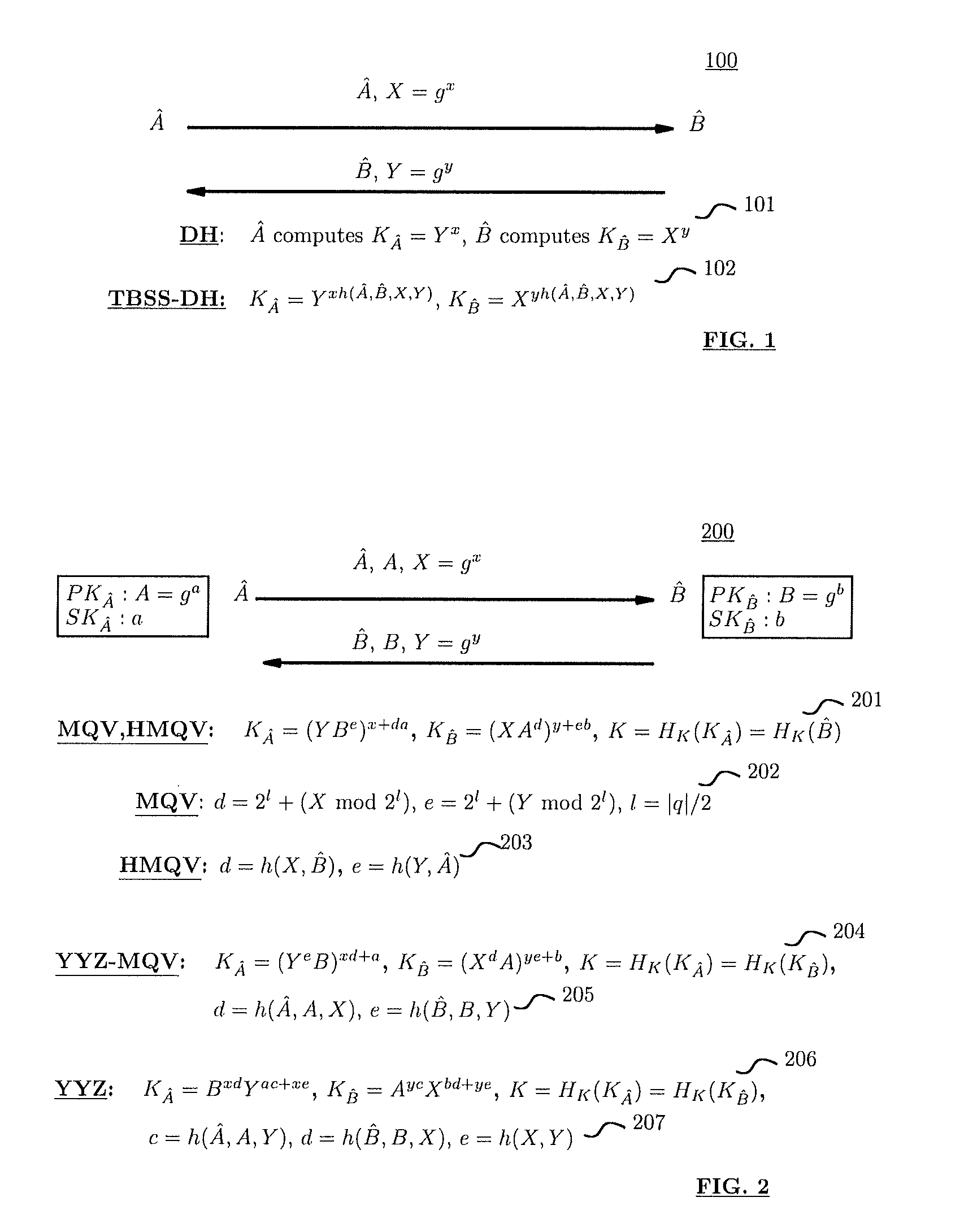
BACKGROUND OF THE INVENTION[0001]1. Technical Field[0002]Aspects of the present invention generally relate to proof-of-knowledge (POK), which allows a prover to convince a verifier of its knowledge of the multiple secret DH-exponents, corresponding to some public (fixed and / or ephemeral) DH-components, while revealing no knowledge of the supposed secrets. The POK is aimed for concurrent non-malleability security, robust secrecy exposure resistance, privacy preserving and on-line efficiency. By viewing fixed DH-components as public-keys and each party proving its knowledge of secret DH-exponents using the invented POK method, in exemplary embodiments, this particularly yields authenticated Diffie-Hellman key-exchange (DHKE) protocols.[0003]2. Description of the Related Art[0004]The Diffie-Hellman key-exchange (DHKE) protocol 101, illustrated in FIG. 1, is at the root of public-key cryptography (PKC), and is one of the main pillars of both theory and practice of cryptography. Generall...

Claims

the structure of the environmentally friendly knitted fabric provided by the present invention; figure 2 Flow chart of the yarn wrapping machine for environmentally friendly knitted fabrics and storage devices; image 3 Is the parameter map of the yarn covering machine
Login to View More

Application Information

Patent Timeline
12 Aug 2010
Publication
US20100205443A1
IPC
H04L9/32
CPC
H04L9/3218; H04L9/0841
Inventors
ZHAO, YUNLEI; DING, SUFEN