Insect Protective Garment

US20130232676A1Inactive Publication Date: 2013-09-12CORZATT PAUL

Image

Smart Image Click on the blue labels to locate them in the text.
Viewing Examples
Smart Image
  • Insect Protective Garment
  • Insect Protective Garment
  • Insect Protective Garment

Examples

Experimental program
Comparison scheme
Effect test

Embodiment Construction

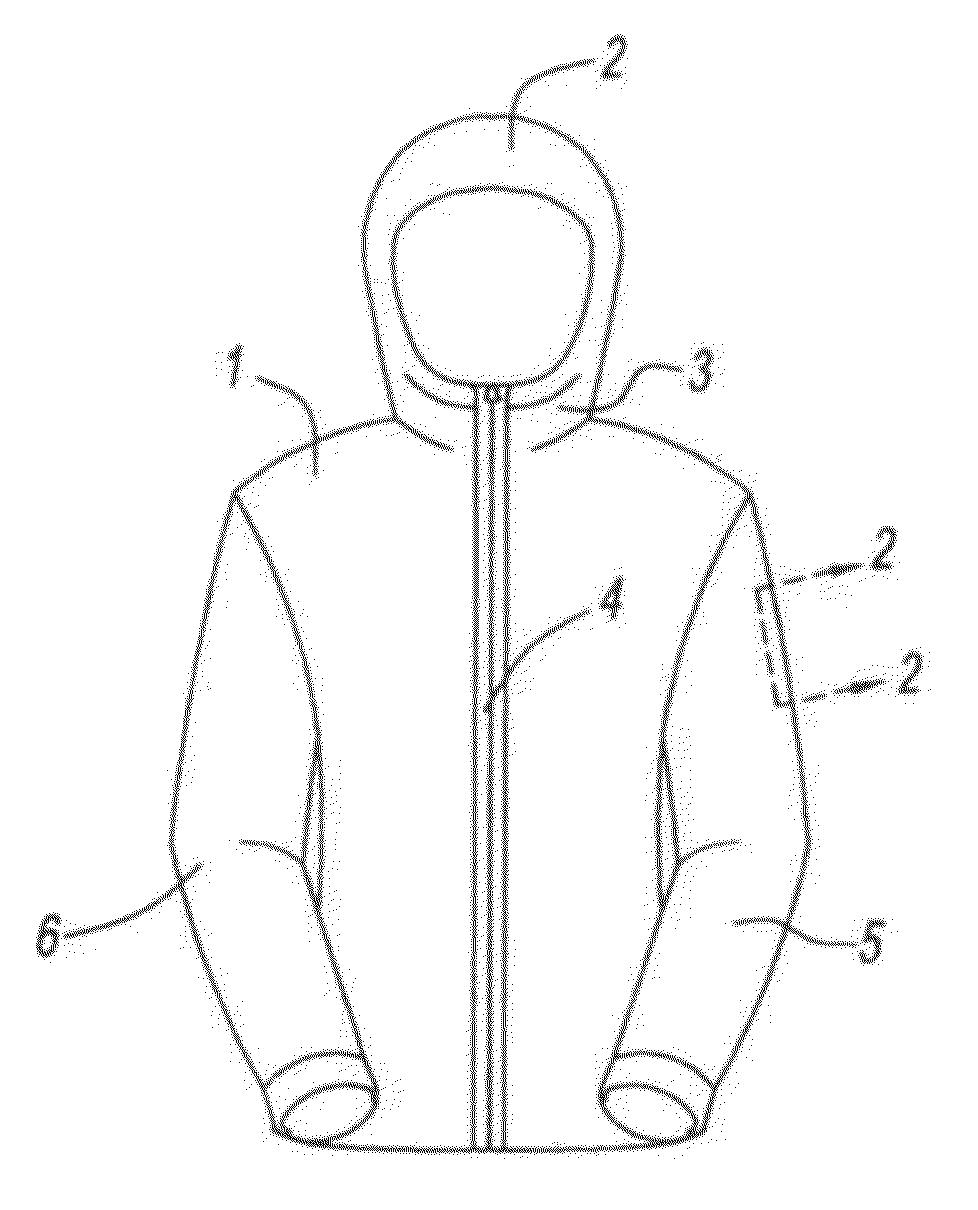
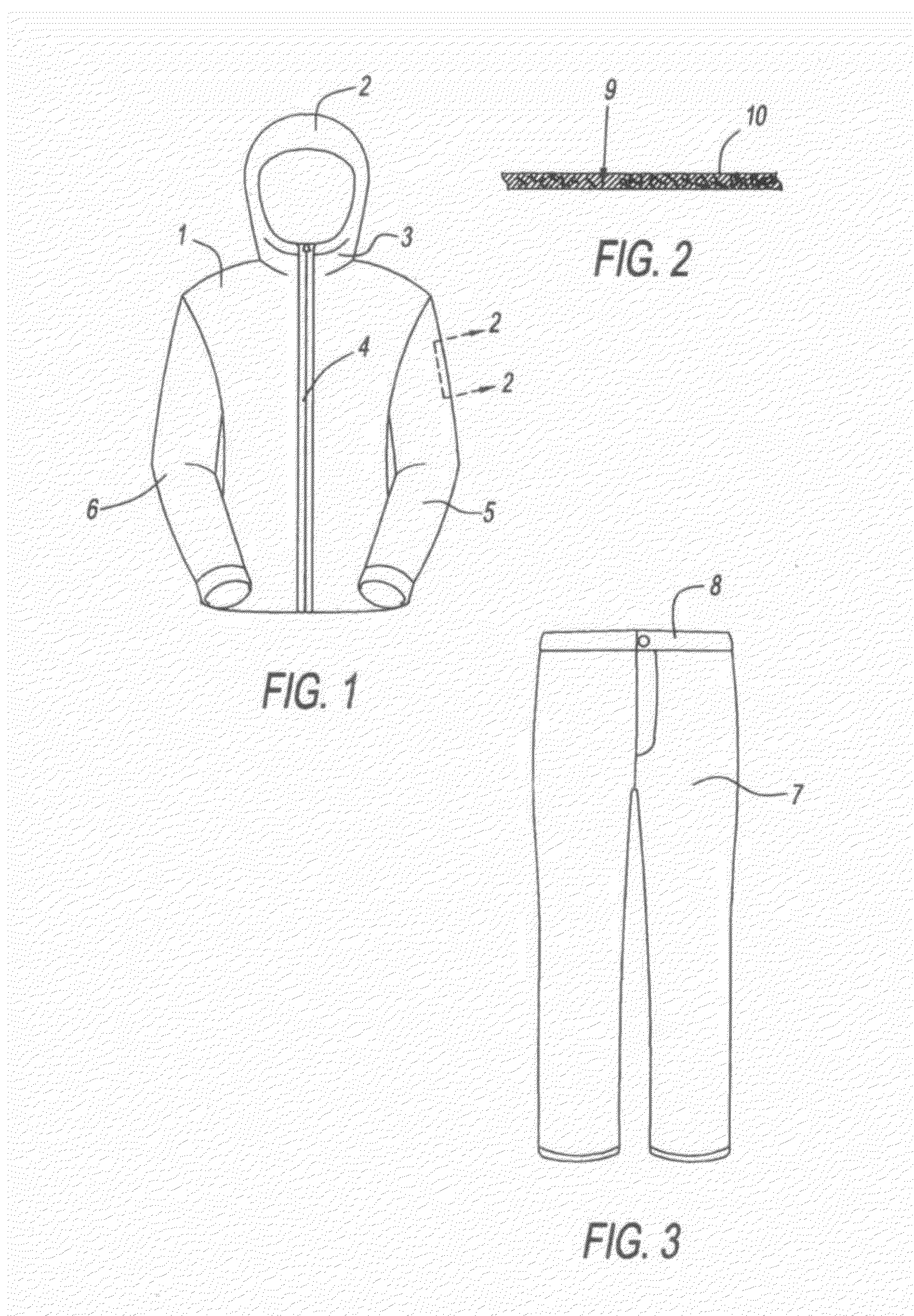
[0017]FIG. 1 shows a garment 1 that covers the upper torso of a wearer in the form of a jacket. The upper torso garment 1 has a hood 2 attached thereto and the hood connects to the jacket 1 at a neck line 3. The jacket has a front closing portion by way of zipper 4 that may be attached to the jacket 1 by way of fabric strips (now shown), which is a common practice in the construction of jackets. The jacket 1 also has sleeves 5 and 6 attached thereto.

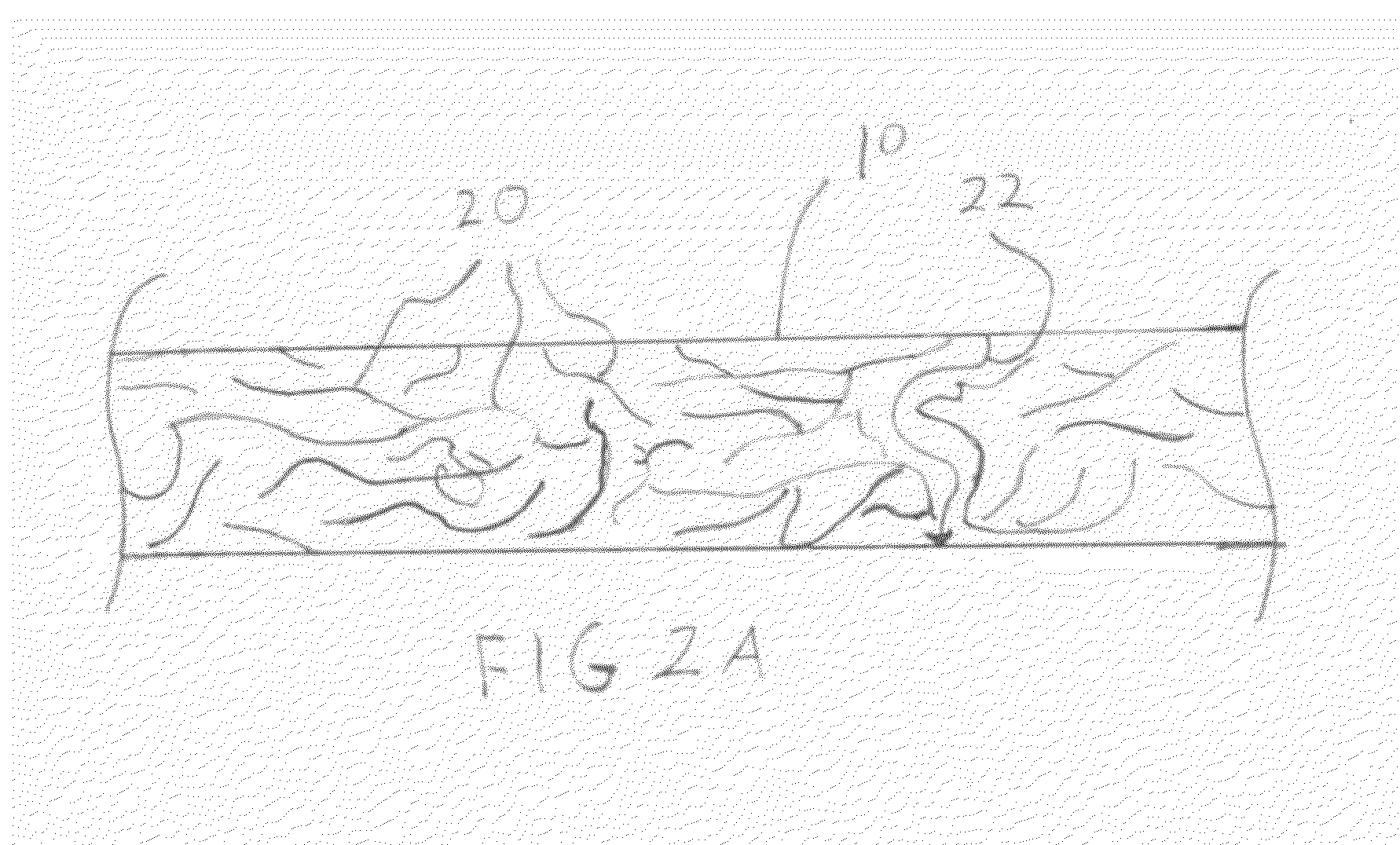
[0018]The most important aspect of the invention is the fabric material forming the garment, which is illustrated in FIGS. 2 and 2A. FIG. 2 is taken along the arrows 2-2 on the sleeve of FIG. 1. The fabric 10, shown in FIG. 2, consists of a non-woven material that exhibits enough of a thickness 9 to prevent any insect stinger bite from fully penetrating and impaling into the skin of the wearer. Such thickness should be a, at a minimum, 3 mm thick an preferably at least ¼ inch thick.

[0019]As further shown in FIG. 2A, fabric 10 includes ir...

the structure of the environmentally friendly knitted fabric provided by the present invention; figure 2 Flow chart of the yarn wrapping machine for environmentally friendly knitted fabrics and storage devices; image 3 Is the parameter map of the yarn covering machine
Login to View More

PUM

No PUM Login to View More

Abstract

The inventive concept is directed to an insect protective garment that is manufacture of synthetic fibers to produce a non-woven fabric to result in a predetermined thickness that will not allow the stinger of an insect to reach the skin of a wearer. The resulting non-woven fabric exhibits a multitude of convoluted interstices that allow a ventilation of the skin of wearer to be ventilated in certain climates. The non-woven fabric cannon collapse on itself to reduce its thickness. The garment may consist of an upper torso covering jacket including a hood and lower torso covering pair of pants. The protective garment may include an insect repellent substance that may be instrumental in keeping insects away from the garment from the beginning in certain climates.

Description

RELATED APPLICATION[0001]This application is a continuation in part of U.S. patent application Ser. No. 12 / 803,748 filed Jul. 6, 2010.FIELD OF THE INVENTION[0002]This invention related to an insect protective garment composed of non-woven fabric and constructed to frustrate penetration of the garment by the stinger of a mosquito or other insect.[0003]There are many insect protective garments known in the prior art. They are mainly constructed of several layers of fabric that are close to the skin of the wearer. The closest layer to the skin of the wearer is designed to be comfortable to the skin of the wearer and act as an air pervious so that the wearer feels the ventilated air. Then there is another layer that is maintained at some distance from the bottom layer so that insect bites cannot penetrate to the skin of the wearer.[0004]U.S. Pat. No. 4,395,781 discloses an insect protection garment that comprises a light weight garment that is sufficiently loose to keep insects away fro...

Claims

the structure of the environmentally friendly knitted fabric provided by the present invention; figure 2 Flow chart of the yarn wrapping machine for environmentally friendly knitted fabrics and storage devices; image 3 Is the parameter map of the yarn covering machine
Login to View More

Application Information

Patent Timeline
12 Sep 2013
Publication
US20130232676A1
IPC
A41D13/00
CPC
A41D13/0002; A41D13/001
Inventors
CORZATT, PAUL