
Gem-dinitro ester energetic material using esterification and preparation method thereof
a technology of dinitro ester and energetic material, which is applied in the field of gem-dinitro ester energetic material, can solve the problems of deteriorating the total performance of the explosive, and achieve the effects of improving the viscosity of the plasticizer, improving the energy density, and improving the energy density
- Summary
- Abstract
- Description
- Claims
- Application Information
AI Technical Summary
Benefits of technology
Problems solved by technology
Method used
Image

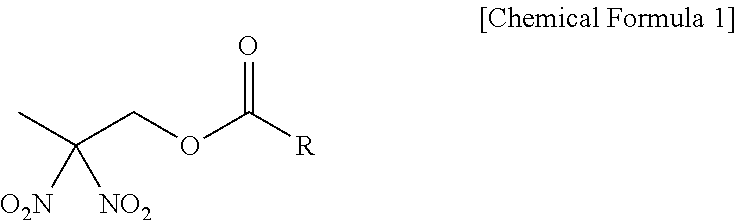
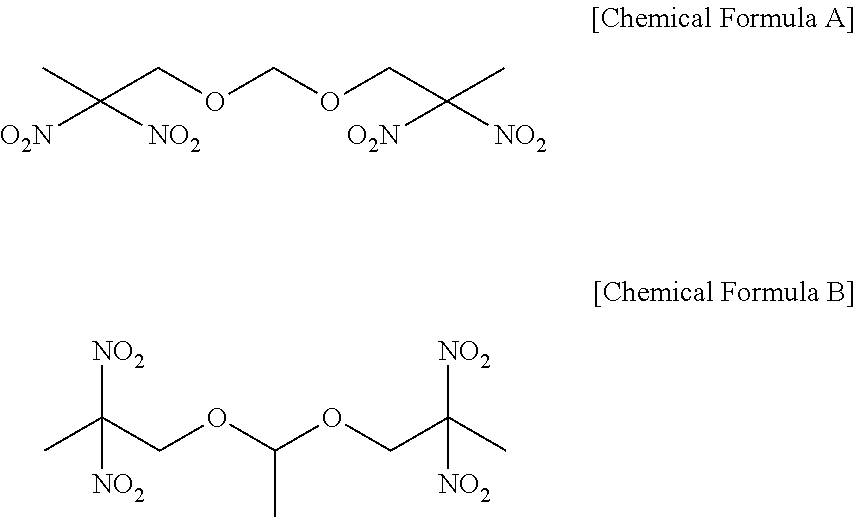
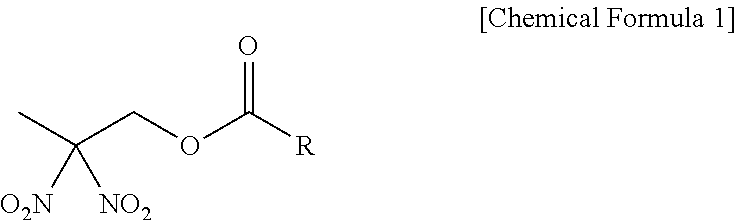
Examples
example 1
of 2,2-Dinitropropyl Hexanoate
[0028]
[0029]Dinitropropanol (25.5 g, 0.17 mol), hexanoic acid (21.7 g, 0.19 mol), and 50 g of polyphosphoric acid were added to 50 mL of dichloroethane, and the resulting mixture was slowly stirred using a stirrer. The solution thus obtained was slowly heated to 70° C. and then reacted for 15 hr (overnight). After the reaction, the temperature of the reactor was lowered to room temperature, and the stirrer was powered off. When the temperature of the reactor was room temperature, the dichloroethane layer was decanted, followed by extraction with a 1 N sodium hydroxide aqueous solution and then distillation under reduced pressure, affording 2,2-dinitropropyl hexanoate (39.2 g, yield: 93%).
[0030]NMR and thermoanalytical results: 1H NMR (CDCl3) δ 4.88 (s, 2 H), 2.32 (t, 2 H), 2.08 (s, 3 H), 1.58 (m, 2 H), 1.28 (m, 4 H), 0.87 (t, 3 H); Tg (glass transition temperature): −101.99° C., Td (decomposition temperature): 268.00° C.
example 2
of 2,2-Dinitropropyl 2-Ethylhexanoate
[0031]
[0032]Dinitropropanol (25.5 g, 0.17 mol), 2-ethylhexanoic acid (27.4 g, 0.19 mol) and 50 g of polyphosphoric acid were added to 50 mL of dichloroethane and the resulting mixture was slowly stirred using a stirrer. The solution thus obtained was slowly heated to 70° C. and then reacted for 15 hr (overnight). After the reaction, the temperature of the reactor was lowered to room temperature, and the stirrer was powered off. When the temperature of the reactor was room temperature, the dichloroethane layer was decanted, followed by extraction with a 1 N sodium hydroxide aqueous solution and then distillation under reduced pressure, affording 2,2-dinitropropyl 2-ethylhexanoate (41.0 g, yield: 87%).
[0033]NMR and thermoanalytical results: 1H NMR (CDCl3) δ 4.90 (s, 2 H), 2.30 (m, 1 H), 2.19 (s, 3 H), 1.55 (m, 4 H), 1.23 (m, 4 H), 0.89 (m, 6 H); Tg (glass transition temperature): −96.96° C., Td (decomposition temperature): 245.67° C.
example 3
of 2,2-Dinitropropyl Octanoate
[0034]
[0035]Dinitropropanol (25.5 g, 0.17 mol), octanoic acid (27.4 g, 0.19 mol) and 50 g of polyphosphoric acid were added to 50 mL of dichloroethane and the resulting mixture was slowly stirred using a stirrer. The solution thus obtained was slowly heated to 70° C. and then reacted for 15 hr (overnight). After the reaction, the temperature of the reactor was lowered to room temperature, and the stirrer was powered off. When the temperature of the reactor was room temperature, the dichloroethane layer was decanted, followed by extraction with a 1 N sodium hydroxide aqueous solution and then distillation under reduced pressure, affording 2,2-dinitropropyl octanoate (42.3 g, yield: 90%).
[0036]NMR and thermoanalytical results: 1H NMR (CDCl3) δ 4.88 (s, 2 H), 2.35 (t, 2 H), 2.17 (s, 3 H), 2.13 (s, 3 H), 1.58 (m, 2 H), 1.25 (m, 8 H), 0.86 (t, 3 H); Tg (glass transition temperature): −99.15° C., Td (decomposition temperature): 260.83° C.
PUM
| Property | Measurement | Unit |
|---|---|---|
| temperature | aaaaa | aaaaa |
| dimensional stability | aaaaa | aaaaa |
| viscosity | aaaaa | aaaaa |
Abstract
Description
Claims
Application Information
 Login to View More