Unlock instant, AI-driven research and patent intelligence for your innovation.

Data rate control for event-based vision sensor

a data rate control and event-based technology, applied in error detection/correction, photometry using electric radiation detectors, instruments, etc., can solve problems such as sensor failure, sensor loss, system loss of information about its status, etc., to reduce power

Active Publication Date: 2018-07-05
SONY ADVANCED VISUAL SENSING AG
View PDF2 Cites 8 Cited by
  • Summary
  • Abstract
  • Description
  • Claims
  • Application Information

AI Technical Summary

Benefits of technology

The patent text is about a sensor that can be adjusted based on the scene it's placed in to collect the necessary data. This allows the overall system to have as much information as possible about its state. Additionally, the number of events can be controlled based on the sensor's state to manage power consumption. For example, the number of events can be reduced during a sleep cycle and then increased during normal operating mode. This invention helps gather and manage data effectively for various applications.

Problems solved by technology

The variable amount of change events to be read out from the sensor can pose problems on the sensor and at the system level, especially if there are more events to be read out than what the processor can process in real-time.
Discarding the events if they cannot be processed leads to data loss and thus the system loses information about its status (e.g. about its movement and position).
In the case of a change detection sensor, the result could be that the sensor will miss events occurring in a portion of its pixel field, for example.

Method used

the structure of the environmentally friendly knitted fabric provided by the present invention; figure 2 Flow chart of the yarn wrapping machine for environmentally friendly knitted fabrics and storage devices; image 3 Is the parameter map of the yarn covering machine
View more

Image

Smart Image Click on the blue labels to locate them in the text.
Viewing Examples
Smart Image
  • Data rate control for event-based vision sensor
  • Data rate control for event-based vision sensor
  • Data rate control for event-based vision sensor

Examples

Experimental program
Comparison scheme
Effect test

Embodiment Construction

[0035]FIG. 1A is a block diagram of an event based change detection sensor 100 having event rate control.

[0036]In general, the change detection sensor 100 include five elements that are specifically relevant to the present system:

[0037]array of change detection pixels 110;

[0038]an event rate detector 200;

[0039]a controller 120;

[0040]a threshold generation circuit 130; and

[0041]a readout circuit 140.

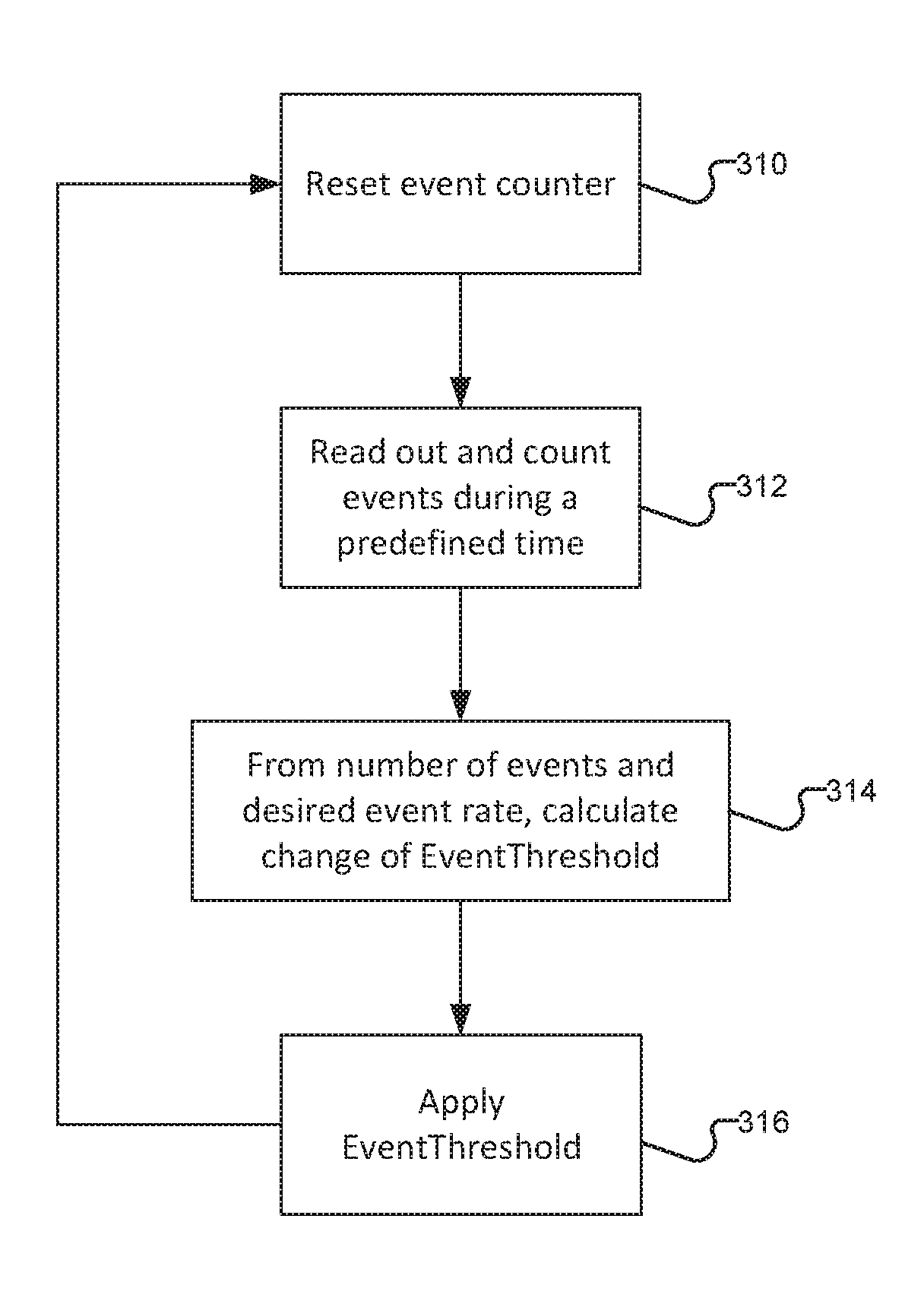
[0042]The pixel array 110 generates a variable amount of data: change events. The event rate detector 200 periodically assesses the events such as by counting or estimating the change events. Then the controller 120 adapts the sensor configuration so that in the next time step the pixel array 110 generates an amount of change events closer to the desired rate.

[0043]The pixel array can be any array of change detection pixels such as described in U.S. Pat. Appl. No. US 2008 / 00135731, by Lichtsteiner, et al., entitled “Photoarray for Detecting Time-Dependent image Data”, which is incorporate...

the structure of the environmentally friendly knitted fabric provided by the present invention; figure 2 Flow chart of the yarn wrapping machine for environmentally friendly knitted fabrics and storage devices; image 3 Is the parameter map of the yarn covering machine
Login to View More

PUM

No PUM Login to View More

Abstract

In dynamic vision sensor (I)VS) or change detection sensors, the chip or sensor is configured to control or modulate the event rate. For example, this control can be used to keep the event rate close to a desired rate or within desired bounds. Adapting the configuration of the sensor to the scene by changing the ON-event and / or the OFF-event thresholds, allows having necessary amount of data, but not much more than necessary, such that the overall system gets as much information about its state as possible.

Description

RELATED APPLICATIONS[0001]This application claims priority to Swiss Provisional Patent Application No. CH20160001764, filed on 30 Dec. 2016, and Swiss Provisional Patent Application No. CH20160001765, filed on 30 Dec. 2016, both of which are incorporated herein by reference in their entirety.BACKGROUND OF THE INVENTION[0002]Today, machine vision is mostly based on conventional cameras and their associated frame-based image sensors. For some machine vision tasks, e.g., object recognition, these conventional frame-based cameras are well suited. However, for other tasks, e.g., tracking or position and motion estimation, the conventional image sensors have drawbacks.[0003]The main drawback is that conventional cameras produce a significant amount of redundant and unnecessary data, which has to be captured, communicated and processed. This high data load slows down the reaction time by decreasing temporal resolution, results in increased power consumption, and increases the size and cost...

Claims

the structure of the environmentally friendly knitted fabric provided by the present invention; figure 2 Flow chart of the yarn wrapping machine for environmentally friendly knitted fabrics and storage devices; image 3 Is the parameter map of the yarn covering machine
Login to View More

Application Information

Patent Timeline
no application Login to View More
IPC IPC(8): G06T7/20G06F11/00
CPCG06T7/20G06F11/004G06F2201/86G06F2201/88H01L27/1461H04N25/40H04N25/44H04N25/77G01J1/46H04N25/573H04N25/766H04N25/778H04N25/7795H04N25/78H04N25/75H04N25/772H04N25/47
Inventor BERNER, RAPHAELBRANDLI, CHRISTIANZANNONI, MASSIMO
Owner SONY ADVANCED VISUAL SENSING AG