Check patentability & draft patents in minutes with Patsnap Eureka AI!

Hydrogen selective catalytic reduction for NOx

a hydrogen selective catalytic and catalyst technology, applied in the direction of machines/engines, separation processes, mechanical equipment, etc., can solve the problems of nox traps that may still be too high for nox traps to be effective, urea scr systems are not without shortcomings, and the effect of 15 ppm may be impacted

Inactive Publication Date: 2007-01-16
SOUTHWEST RES INST
View PDF9 Cites 11 Cited by
  • Summary
  • Abstract
  • Description
  • Claims
  • Application Information

AI Technical Summary

Problems solved by technology

Sulfur increases the regenerating temperature of a CRT, which adversely affects its performance.
However, evidence implies that 15 ppm may still be too high for NOx traps to be effective.
Despite their effectiveness, urea SCR systems are not without their shortcomings.
Urea SCR is based on ammonia reduction, with urea being the reductant of choice for vehicular applications, due to the perception that a supply of ammonia on-board a vehicle would be unsafe.
Ammonia is considered to be highly toxic, whereas urea is only mildly toxic.
But the problem with urea SCR is that a separate supply of urea is required on-board.
Not only does this requirement call for a separate storage tank, but the urea must be replenished periodically and there is no infrastructure to provide a nationwide supply.
Also, the system required to introduce urea into the exhaust stream is complex.
In sum, there are many issues affecting the practicality of using urea for SCR.

Method used

the structure of the environmentally friendly knitted fabric provided by the present invention; figure 2 Flow chart of the yarn wrapping machine for environmentally friendly knitted fabrics and storage devices; image 3 Is the parameter map of the yarn covering machine
View more

Image

Smart Image Click on the blue labels to locate them in the text.
Viewing Examples
Smart Image
  • Hydrogen selective catalytic reduction for NOx

Examples

Experimental program
Comparison scheme
Effect test

Embodiment Construction

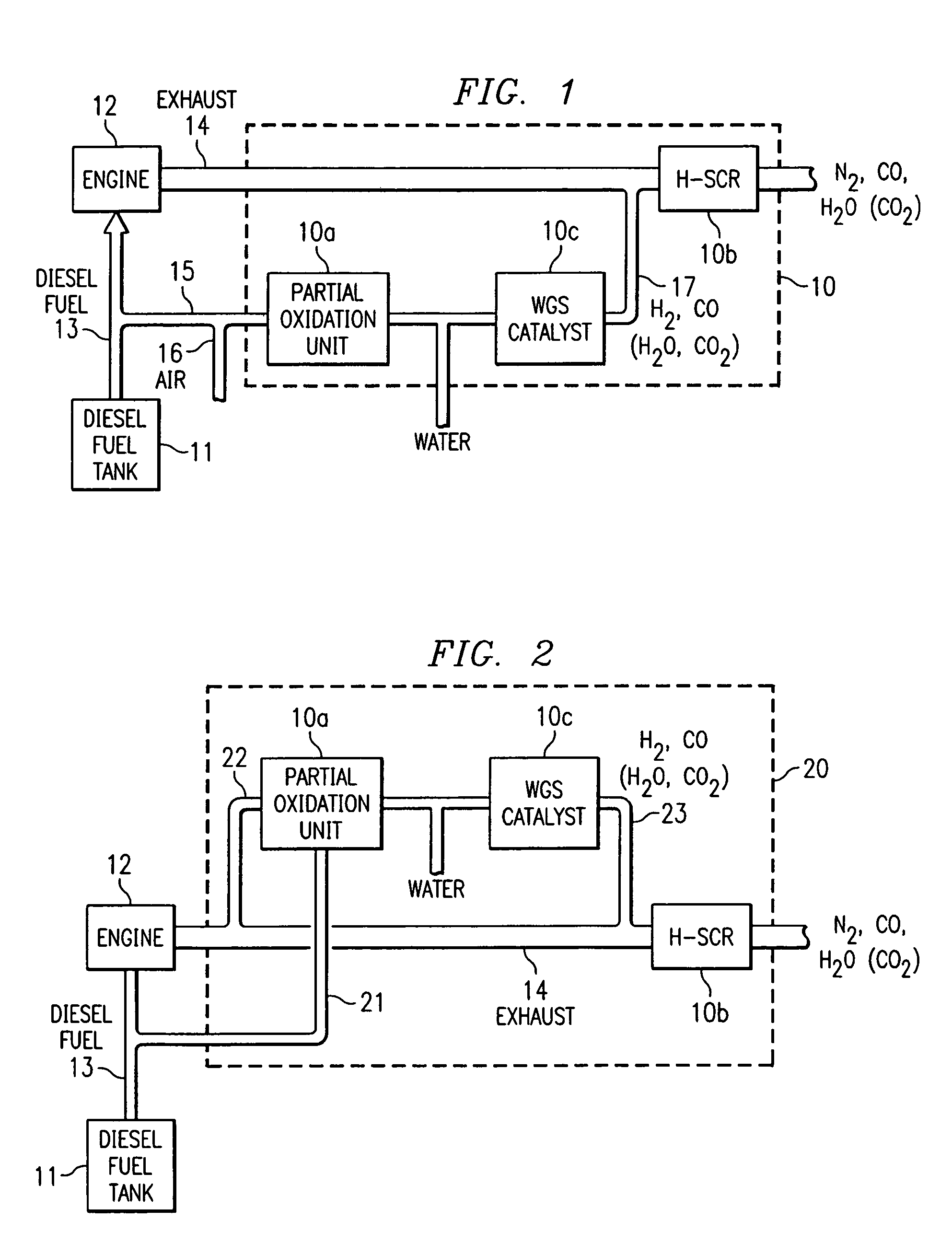
[0010]The invention described herein is directed to an SCR system that does not require urea as the reductant. The system uses diesel fuel instead of urea, which eliminates the requirement for a second supply tank and the need for a urea supply infrastructure.

[0011]FIGS. 1 and 2 describe two different embodiments of the invention. Both use an oxidation unit 10a and a hydrogen selective catalytic reduction (H-SCR) unit 10b, but in different configurations. Both embodiments are used with diesel engines, which do not run rich. The oxidation unit 10a acts as a hydrogen generator, and runs “offline” of the main exhaust gas stream so that it may operate in a rich fuel environment. The hydrogen from oxidation unit 10a is fed to the H-SCR catalyst 10b, which continuously converts NOx to N2 and H2O. An optional water gas shift (WGS) catalyst 10c may be interposed between the partial oxidation unit 10a and the H-SCR catalyst 10b, to generate additional hydrogen.

[0012]As explained below, diese...

the structure of the environmentally friendly knitted fabric provided by the present invention; figure 2 Flow chart of the yarn wrapping machine for environmentally friendly knitted fabrics and storage devices; image 3 Is the parameter map of the yarn covering machine
Login to View More

PUM

PropertyMeasurementUnit
exhaust gas temperaturesaaaaaaaaaa
temperaturesaaaaaaaaaa
regenerating temperatureaaaaaaaaaa
Login to View More

Abstract

An emission control system for reducing NOx in the exhaust of a diesel engine. A partial oxidation system receives diesel fuel from the engine's fuel tank and partially oxidizes the diesel fuel into hydrogen. The hydrogen is then introduced into the main exhaust line and the hydrogen-enhanced exhaust is delivered to a hydrogen selective catalytic reduction unit, which uses the hydrogen to convert the NOx to nitrogen.

Description

RELATED PATENT APPLICATION[0001]This application is a divisional of U.S. patent application Ser. No. 10 / 093,199, filed Mar. 7, 2002, and entitled “NOx Reduction System for Diesel Engines, Using Hydrogen Selective Catalytic Reduction.”TECHNICAL FIELD OF THE INVENTION[0002]This invention relates to emission reduction systems for diesel engines, and more particularly to nitrogen oxide reduction using a hydrogen-selective catalytic reduction catalyst.BACKGROUND OF THE INVENTION[0003]In an effort to reduce ambient levels of air pollution in the United States, the United States Environmental Protection Agency (EPA) has proposed a tightening of the emissions standards for heavy-duty diesel engines. This proposal includes measures for reducing the allowable sulfur content of diesel fuel. The proposal aims to lower emissions by about 95 percent, with nitrogen oxides (NOx) and particulate matter (PM) emission standards of 0.2 and 0.01 gram per brake horsepower hour, respectively.[0004]Existin...

Claims

the structure of the environmentally friendly knitted fabric provided by the present invention; figure 2 Flow chart of the yarn wrapping machine for environmentally friendly knitted fabrics and storage devices; image 3 Is the parameter map of the yarn covering machine
Login to View More

Application Information

Patent Timeline
no application Login to View More
Patent Type & Authority Patents(United States)
IPC IPC(8): B01D53/56B01D53/94F01N3/20
CPCB01D53/9409F01N3/2066B01D2255/1025B01D2257/404Y02T10/24F01N2240/30F01N2610/04F01N2610/08Y02A50/20Y02T10/12
Inventor BARTLEY, GORDON JAMES JOHNSTONSHARP, CHRISTOPHER ALAN
Owner SOUTHWEST RES INST
Features
  • R&D
  • Intellectual Property
  • Life Sciences
  • Materials
  • Tech Scout
Why Patsnap Eureka
  • Unparalleled Data Quality
  • Higher Quality Content
  • 60% Fewer Hallucinations
Social media
Patsnap Eureka Blog
Learn More