AI technical title is built by Patsnap AI team. It summarizes the technical point description of the patent document.
a safety iv catheter and spring clip technology, applied in the field of safety iv catheters, can solve the problems of limited usefulness and full acceptance of the patient, the force required to engage the needle slot within the guard flange is relatively large, and the health care worker is vulnerable to the transmission of various dangerous blood-borne pathogens
Inactive Publication Date: 2007-09-04
B BRAUN MELSUNGEN AG
View PDF88 Cites 203 Cited by
Summary
Abstract
Description
Claims
Application Information
AI Technical Summary
This helps you quickly interpret patents by identifying the three key elements:
Problems solved by technology
Method used
Benefits of technology
Benefits of technology
[0010]It is accordingly an object of the present invention to provide a safety IV catheter which reliably and automatically prevents accidental, inadvertent contact with the needle tip after use.
[0011]It is a further object of the invention to provide a safety catheter which provides reliable protection to the healthcare practitioner against needle sticks without requiring any change in the manner of use of the safety catheter by the practitioner.
[0012]It is another object of the present invention to provide a safety IV catheter of the type described which is relatively simple and inexpensive to manufacture.
Problems solved by technology
The problem is that, immediately after the withdrawal of the needle from the patient's vein, the healthcare worker, who is at this time involved in at least two urgent procedures, must place the exposed needle tip at a nearby location and address the tasks required to accomplish the needle withdrawal.
It is at this juncture that the exposed needle tip creates a danger of an accidental needle stick occurring, which, under the circumstances, leaves the healthcare worker vulnerable to the transmission of various dangerous blood-borne pathogens, including AIDS and hepatitis.
The prior art safety catheters all exhibit one or more drawbacks that have thus far limited their usefulness and full acceptance by healthcare workers.
For example, in the safety catheter disclosed in the Lemieux patent, the force required to engage the needle slot within the guard flange is relatively great and would interfere with the removal of the needle.
As a result, the safety catheter disclosed in the Lemieux patent would not consistently function in a reliable manner.
Similarly, the user of the safety catheter disclosed in the Dombrowski patent would have to exert a considerable force to remove the protective cap from the catheter hub when the cap engages a needle.
The safety catheter disclosed in the Dombrowski patent would also be relatively expensive to fabricate because of its inclusion of a flexible flange and a tether.
The McLees device also requires the assembly of two separate components and is thus relatively costly to manufacture.
Method used
the structure of the environmentally friendly knitted fabric provided by the present invention; figure 2 Flow chart of the yarn wrapping machine for environmentally friendly knitted fabrics and storage devices; image 3 Is the parameter map of the yarn covering machine
View more
Image
Smart Image Click on the blue labels to locate them in the text.
Viewing Examples
Smart Image
Click on the blue label to locate the original text in one second.
Reading with bidirectional positioning of images and text.
Smart Image
Examples
Experimental program
Comparison scheme
Effect test
Embodiment Construction
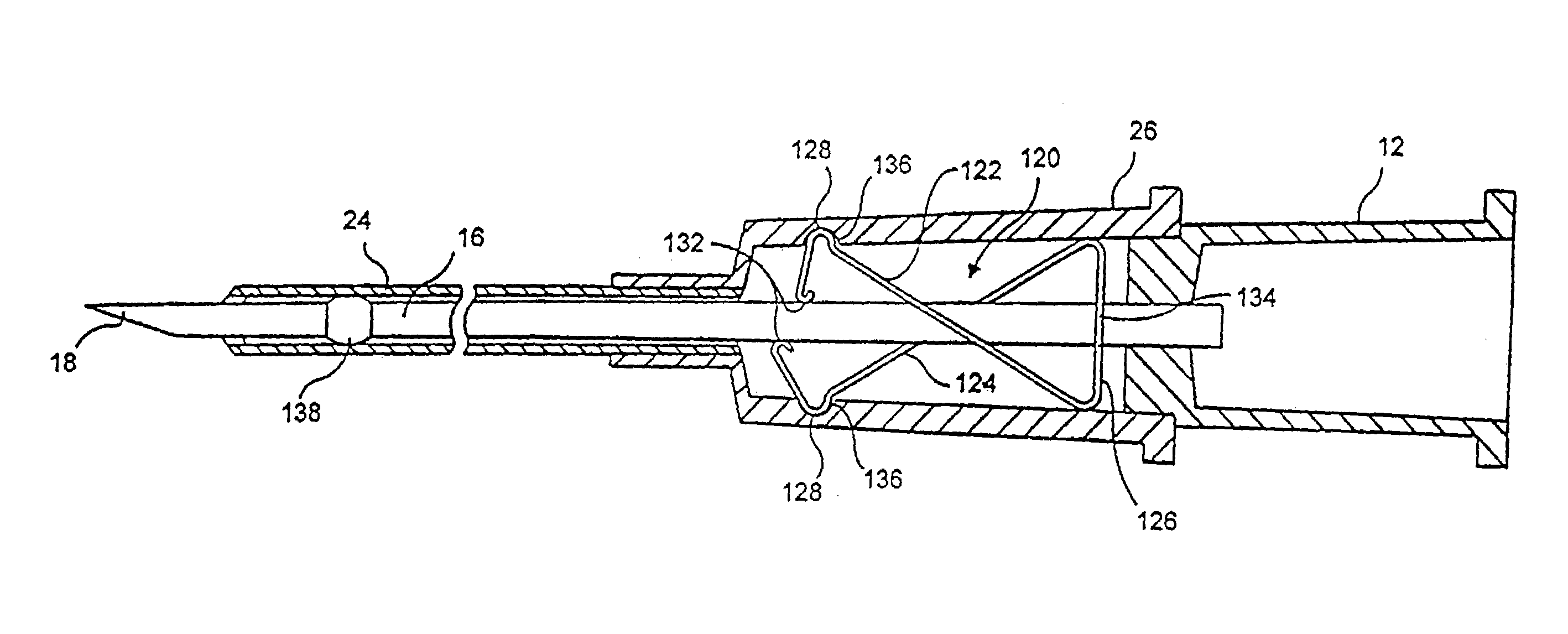
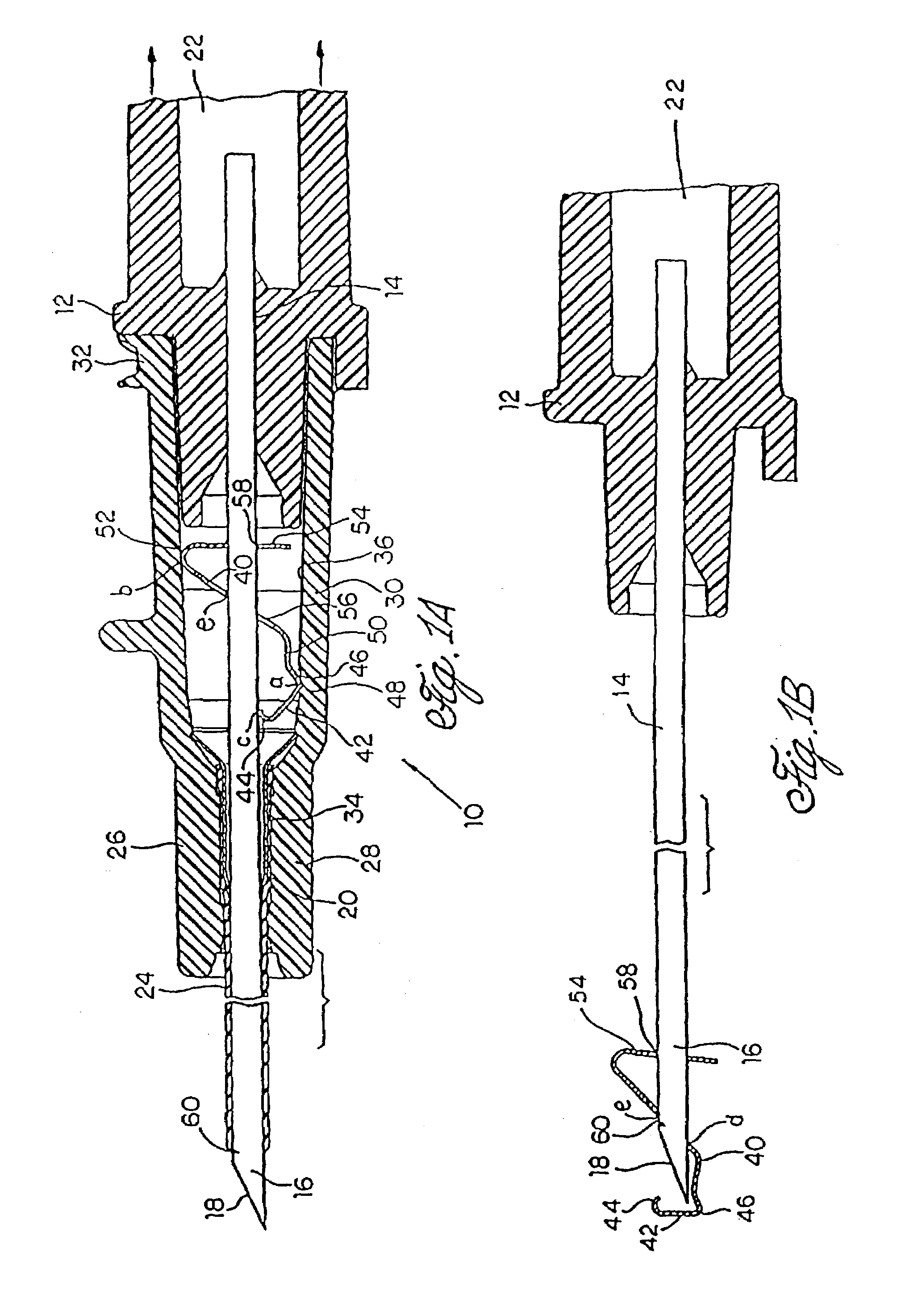
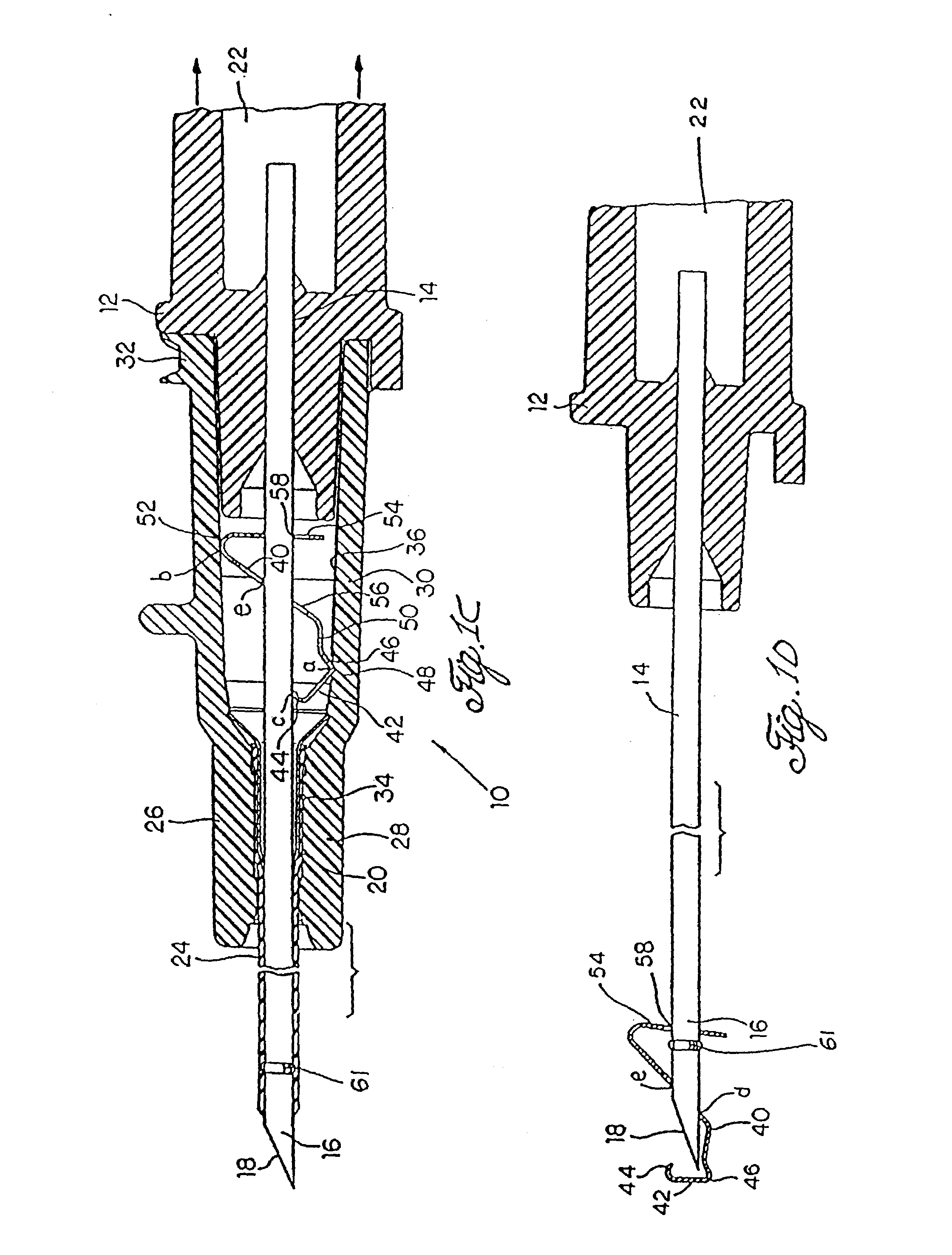
[0044]The safety IV catheter of the invention, generally designated 10 in the embodiment illustrated in FIGS. 1A and 1B, includes a needle hub 12 that includes an axial opening 14 which securely receives the proximal end of a needle 16 having a sharpened tip 18. The needle hub 12, as is conventional, is hollow and includes a flash chamber 22. As is also conventional, the needle 16 is received within a hollow tubular catheter 24, the proximal end of which is concentrically affixed within the distal end of a catheter hub 26 having a distal section 28 and a contiguous, larger diameter proximal section 30.
[0045]The catheter hub 26 terminates at its proximal end in a Luer fitting 32 adapted to receive a tubing set which, in a known manner, administers intravenous fluid into the patient. The catheter 24 is secured within an axial passageway 34 in the distal hub section 28 by means of a sleeve 20 received within the passageway 34, which engages the proximal end of the catheter. Passageway ...
the structure of the environmentally friendly knitted fabric provided by the present invention; figure 2 Flow chart of the yarn wrapping machine for environmentally friendly knitted fabrics and storage devices; image 3 Is the parameter map of the yarn covering machine
Login to View More
PUM
Login to View More
Abstract
A safety IV catheter includes a unitary, resilient needle guard received in a catheter hub. The needle guard includes a proximal arm or wall that includes an opening through which a needle passes for axial movement. When the needle is retracted from the catheter, it releases the force that had previously prevented movement of the needle guard within the catheter hub. This in turn causes the needle guard to snap into a position in which it is clamped onto the needle shaft and in which its distal wall blocks access to the needle tip. In this condition, the spring needle guard and needle can be removed from the catheter hub. A slot or crimp may be formed in the needle shaft that engages with the needle guard after the protected needle and needle guard are removed from the catheter hub, thereby to prevent removal of the protected needle from the needle guard.
Description
CROSS-REFERENCE TO RELATED APPLICATIONS[0001]This is a continuation of application Ser. No. 09 / 638,641 filed Aug. 14, 2000, now U.S. Pat. No. 6,616,630, which is a continuation-in-part of application Ser. No. 09 / 183,697, filed Oct. 30, 1998, now U.S. Pat. No. 6,287,278, which is a continuation-in-part of application Ser. No. 09 / 097,170, filed Jun. 12, 1998, now U.S. Pat. No. 6,117,108, which is a continuation-in-part of application Ser. No. 08 / 915,148, filed Aug. 20, 1997, now abandoned, their contents are expressly incorporated herein by reference.FIELD OF THE INVENTION[0002]This invention relates generally to intravenous (IV) catheters, and, in particular, to a safety IV catheter in which the needle tip is automatically covered after needle withdrawal to prevent the healthcare worker from making accidental contact with the needle tip.BACKGROUND OF THE INVENTION[0003]IV catheters are primarily used to administer fluids, sometimes containing medications, directly into a patient's va...
Claims
the structure of the environmentally friendly knitted fabric provided by the present invention; figure 2 Flow chart of the yarn wrapping machine for environmentally friendly knitted fabrics and storage devices; image 3 Is the parameter map of the yarn covering machine
Login to View More
Application Information
Patent Timeline
Application Date:The date an application was filed.
Publication Date:The date a patent or application was officially published.
First Publication Date:The earliest publication date of a patent with the same application number.
Issue Date:Publication date of the patent grant document.
PCT Entry Date:The Entry date of PCT National Phase.
Estimated Expiry Date:The statutory expiry date of a patent right according to the Patent Law, and it is the longest term of protection that the patent right can achieve without the termination of the patent right due to other reasons(Term extension factor has been taken into account ).
Invalid Date:Actual expiry date is based on effective date or publication date of legal transaction data of invalid patent.


 Login to View More
  Login to View More