Efficient virtual concatenation datapath for SONET/SDH

a virtual concatenation and datapath technology, applied in the direction of multiplex communication, time-division multiplex, electrical apparatus, etc., can solve the problems of affecting the efficiency of the data transfer process, arbitrary differential delay, and large restriction of the number of different signals that may be combined into one link, so as to eliminate the arbitrary differential delay

US7424036B1Inactive Publication Date: 2008-09-09MICROSEMI STORAGE SOLUTIONS
8 Cites 25 Cited by

Patent Information

Authority / Receiving Office
US · United States
Patent Type
Patents(United States)
Current Assignee / Owner
Publication Date
2008-09-09
Estimated Expiration
Not applicable · inactive patent

Smart Images

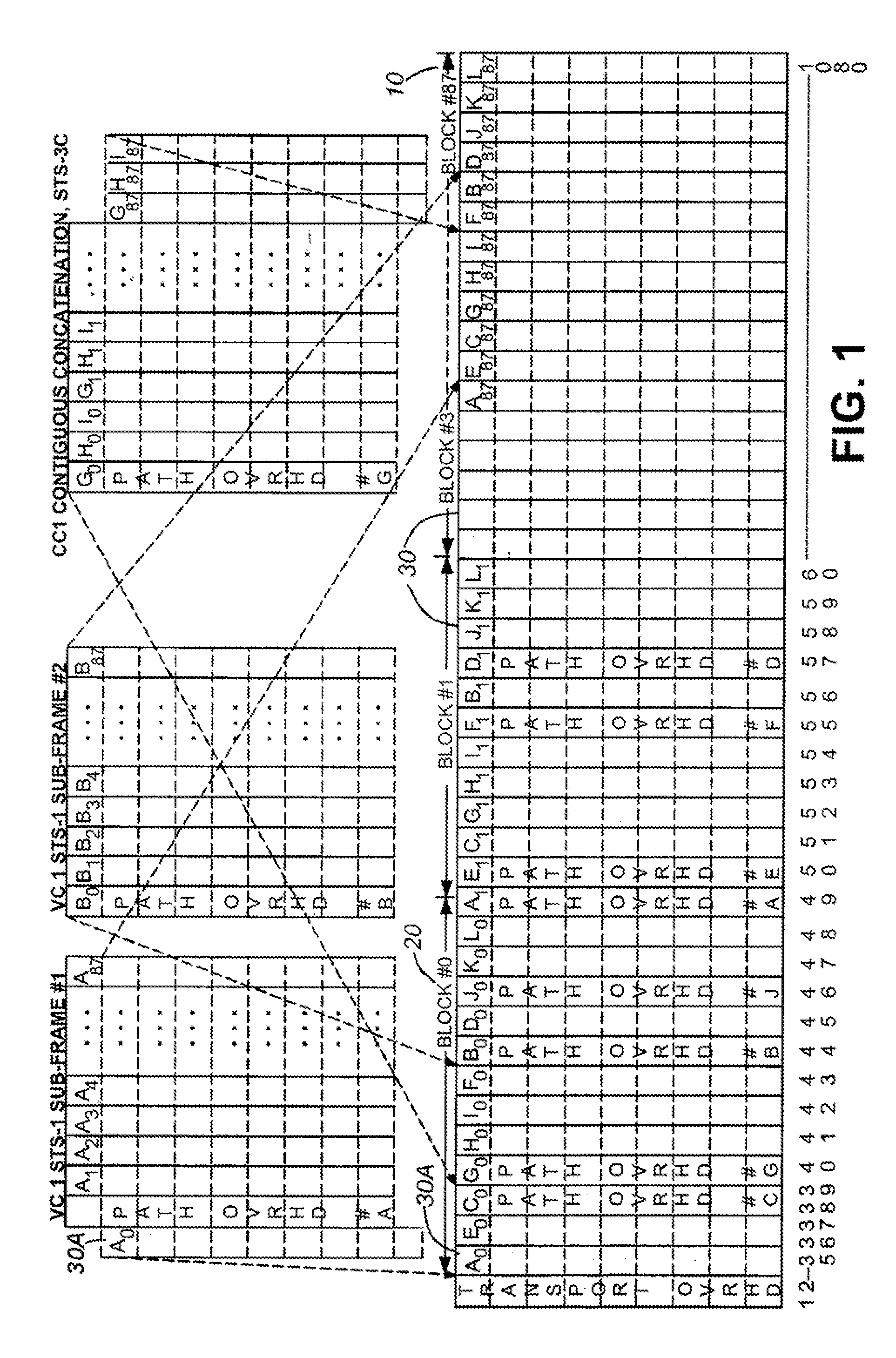
  • Figure 1
    Figure 1
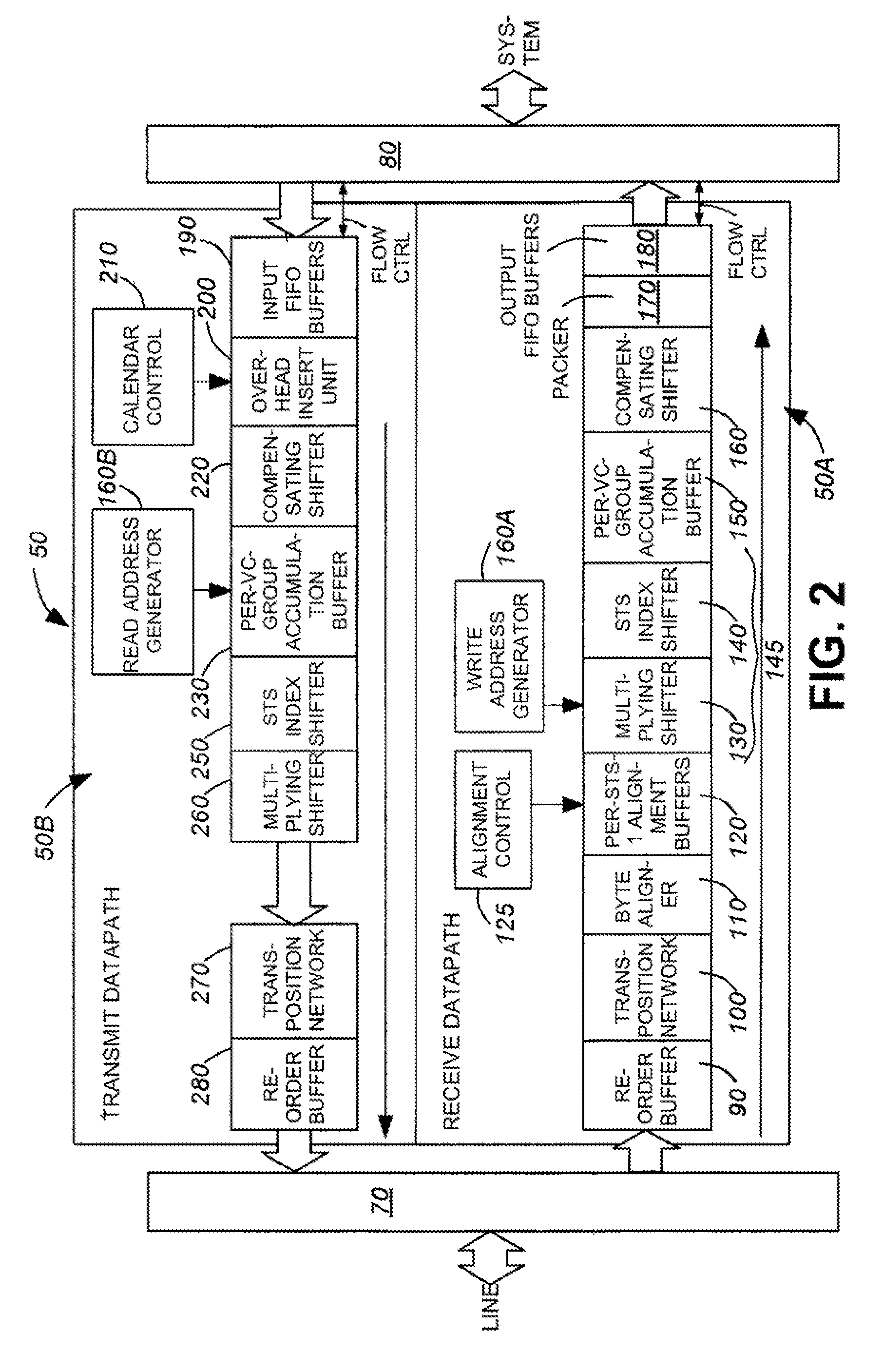
  • Figure 2
    Figure 2
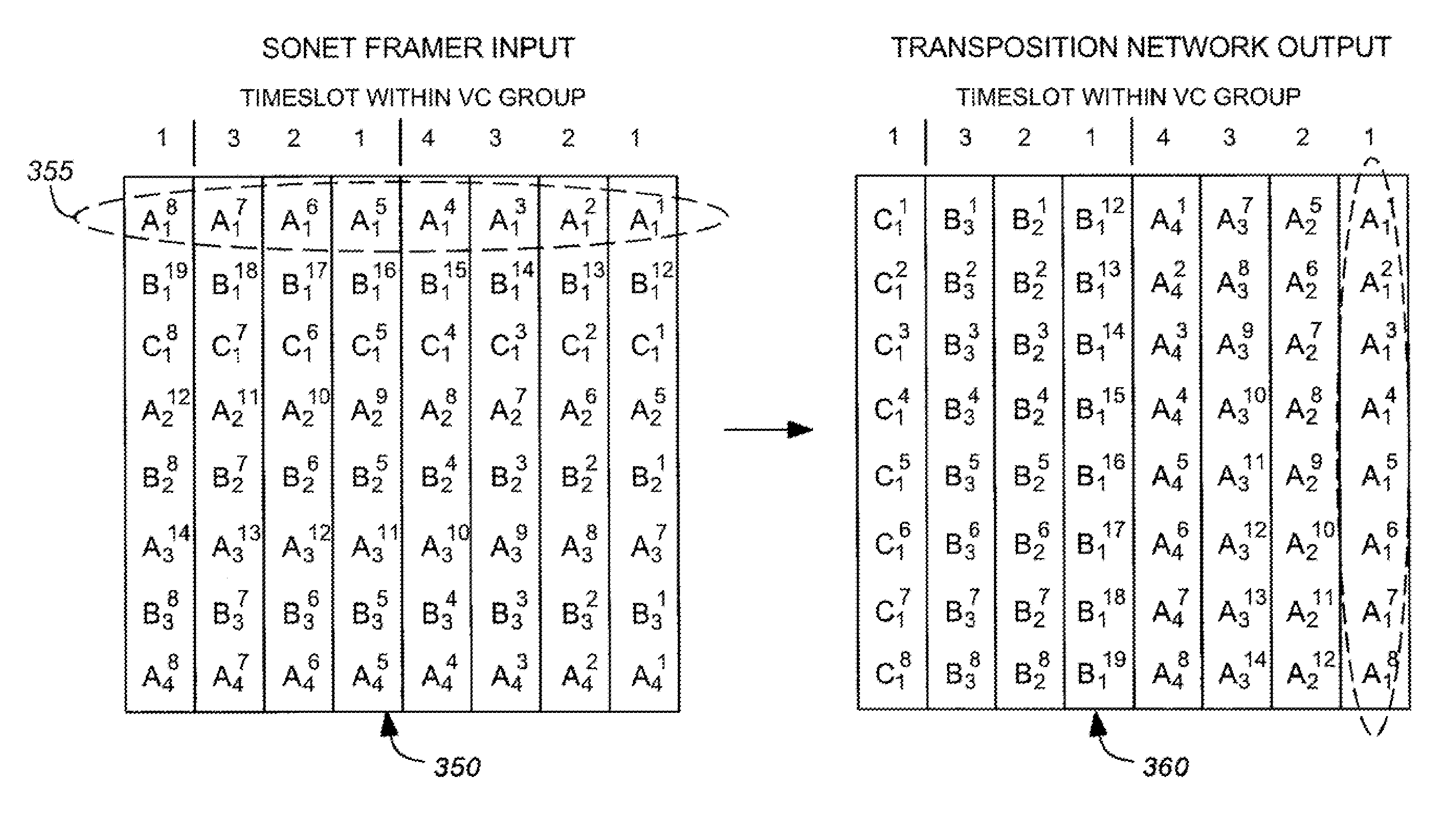
  • Figure 3
    Figure 3
Patent Text Reader

Abstract

The present invention is a SONET payload processing system capable of handling virtual concatenation of SONET payloads. The payload processing system enables combinations of sub-frames, comprising an arbitrary number of virtual concatenation data streams, to be multiplexed into a single SONET frame stream. The present invention further provides a processing system that is not limited by the number of sub-frames or the grouping arrangement. The payload processing system accepts both virtual concatenation and contiguous concatenation within the same SONET frame stream and processes them into blocks of data that do not intermix information from different channels.
Need to check novelty before this filing date? Find Prior Art

Description

FIELD OF INVENTION

[0001] This invention relates to a datapath utilized for processing for virtually concatenated SONET payloads.BACKGROUND TO THE INVENTION

[0002] The Synchronous Optical Network (SONET) was created as the standard fiber optic transmission system for long-distance telephone and data communications. SONET is most commonly described as a high bit-rate fiber-optic-based transport method that provides the foundation for linking high-speed ATM (Asynchronous Transfer Mode) switches and multiplexers and providing users with B-ISDN (Broadband-Integrated Services Digital Network) compliant services. SONET has a very detailed architecture and also contains a series of protocols to implement this architecture. As the architecture is quite complex, this document will only describe those portions of the protocols and frame structure that are useful for explanation purposes.

[0003] First, the SONET hierarchy consists of a number of levels, organized according to data transmission speed...

Examples

Embodiment Construction

[0041]FIG. 1 illustrates an example of a SONET frame 10 containing both contiguously concatenated (CC) and virtually concatenated (VC) sub-frames of data. FIG. 1 represents an OC-12 frame 10 that consists of 3 VC frames and 1 CC frame in 12 timeslots. The 3 VC frames each contain sub-frames. In FIG. 1, the first two sub-frames of the first VC frame are shown. The two first sub-frames are labeled as VC1 STS-1 sub-frame#1, VC1 STS-1 subframe#2, respectively. The first sub-frame, VC1 STS-1 sub-frame#1, has both an overhead portion and a payload portion, 87 columns by 9 rows, as is required by the SONET protocol. The columns of the payload and the overhead portions of the first sub-frame, VC1 STS-1 sub-frame#1, are labeled A0, A1, A3, . . . , A87. The second sub-frame 1, VC1 STS-1 subframe#2, is comprised of columns labeled B1, B2, . . . , B87. The first VC frame consists of a third and a fourth sub-frame, not shown in FIG. 1. However, the data columns of the third sub-frame and the fou...