
Toner and two-component developer
a technology of toner and developer, applied in the field of toner and two-component developers, can solve the problems of reducing humidity resistance, degrading flowability of toner, and difficult to control surface condition to be uniform, so as to prevent the exudation of release agent, maintain excellent flowability, and achieve sufficient development performance
- Summary
- Abstract
- Description
- Claims
- Application Information
AI Technical Summary
Benefits of technology
Problems solved by technology
Method used
Image

Examples
example 1
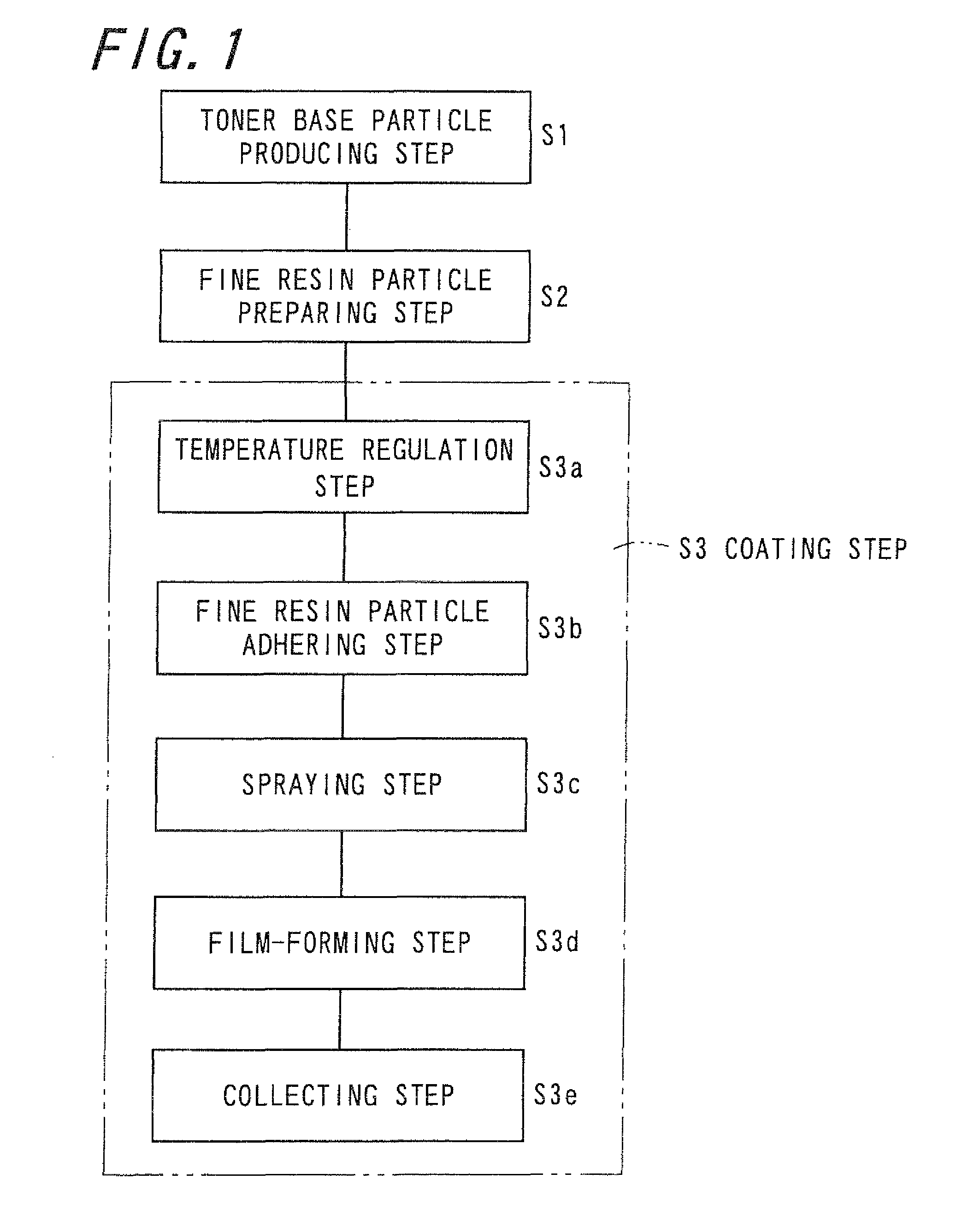
[Toner Base Particle Producing Step S1]
[0189]
Polyester resin (trade name: DIACRON,87.5% (100 parts) manufactured by Mitsubishi Rayon Co., Ltd.,glass transition temperature of 55° C.,softening temperature of 130° C.)C.I. Pigment Blue 15:35.0% (5.7 parts)Release agent (paraffin wax, melting point of6.0% (6.9 parts)75° C.)Charge control agent (trade name: Bontron E84,1.5% (1.7 parts)manufactured by Orient Chemical Industries, Ltd.)
[0190]After pre-mixing the afore-mentioned materials by Henschel mixer (trade name: FM20C, manufactured by Mitsui Mining Co., Ltd.), the obtained mixture was melt and kneaded by KNEADEX (trade name, manufactured by Mitsui Mining Co., Ltd.) at 140° C. After coarsely pulverizing the melt-kneaded material by a cutting mill (trade name: VM-16, manufactured by Orient Co., Ltd.), it was finely pulverized by a jet mill (manufactured by Hosokawa Micron Corporation) and then classified by a pneumatic classifier (manufactured by Hosokawa Micron Corporation) to produce ...
example 2
(Preparing of Fine Resin Particle B)
[0197]Styrene butyl acrylate copolymer fine resin particles B (glass transition temperature of 62° C. and softening temperature of 112° C.) with a volume average particle size of 0.1 μm were obtained in the same manner as the fine resin particles A except that the polymerization condition of styrene and butyl acrylate was changed. A molecular weight (weight average) of the fine resin particles B was 17,200, and the storage elastic modulus G′ thereof at 125° C. was 2.4×10³Pa.
[0198]A toner of Example 2 was obtained in the same manner as Example 1 except that the fine resin particles A are changed to the fine resin particles B.
example 3
(Preparing of Fine Resin Particle C)
[0199]Styrene butyl acrylate copolymer fine resin particles C (glass transition temperature of 60° C. and softening temperature of 115° C.) with a volume average particle size of 0.1 μm were obtained in the same manner as the fine resin particles A except that the polymerization condition of styrene and butyl acrylate was changed. A molecular weight (weight average) of the fine resin particles C was 18,200, and the storage elastic modulus G′ thereof at 125° C. was 4.1×10³Pa.
[0200]A toner of Example 3 was obtained in the same manner as Example 1 except that the fine resin particles A are changed to the fine resin particles C.
PUM
 Login to View More
 Abstract
Description
Claims
Application Information
 Login to View More