
Pressure-sensitive adhesive sheet
An adhesive sheet and adhesive layer technology, applied in pressure-sensitive films/sheets, adhesive additives, film/sheet release coatings, etc., can solve problems such as insufficient peelability and reduced adhesion
Patent Information
- Authority / Receiving Office
- CN · China
- Patent Type
- Applications(China)
- Current Assignee / Owner
- Publication Date
- 2008-02-27
Smart Images
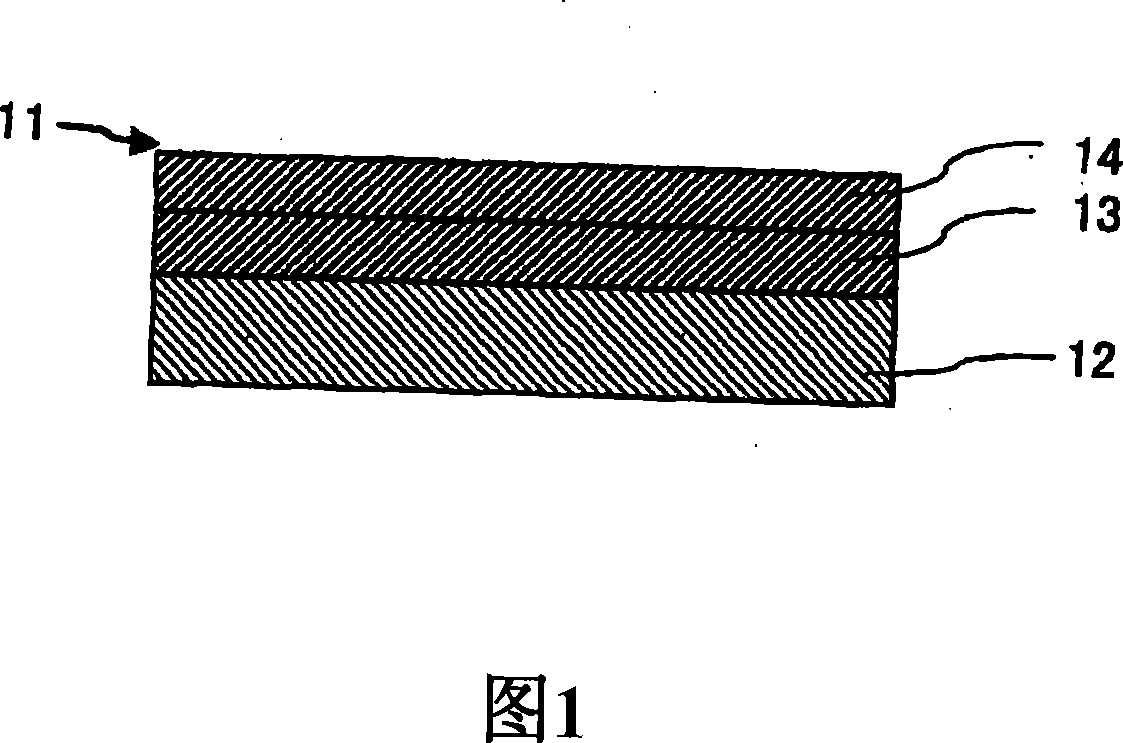
Figure 1
Abstract
Description
technical field
[0001] The present invention relates to a pressure-sensitive adhesive sheet for processing, which is used for processing workpieces such as semiconductor wafers. Background technique
[0002] Semiconductor wafers made of silicon, germanium, gallium-arsenic, etc. are prepared in a large-diameter form, and then diced with a pressure-sensitive adhesive sheet attached to its back side (the side opposite to the side on which the circuit pattern has been formed) , cleaning, drying, expanding, pickup and installation steps.
[0003] Recently, it has been desired that a pressure-sensitive adhesive sheet used in a semiconductor wafer dicing step has sufficient adhesive force during the period from the dicing step to the swelling step, and has such an adhesive force degree during picking that the pressure-sensitive adhesive sheet in the pressure-sensitive adhesive sheet The adhesive does not remain attached to the chip.
[0004] Such a pressure-sensitive adhesive she...
Examples
Embodiment 1
[0098] 98 parts of methyl methacrylate and 2 parts of acrylic acid were copolymerized in a conventional manner to obtain a solution containing an acrylic polymer having a weight average molecular weight of 80,000 (glass transition temperature, 95° C.).
[0099] The solution containing the acrylic polymer was then applied onto a separator and dried to form an intermediate layer (thickness, 5 μm). This intermediate layer was transferred onto a flexible polyvinyl chloride film (substrate, with a thickness of 100 μm). Incidentally, the flexible polyvinyl chloride film contains DOP (dioctyl phthalate) as a plasticizer.
[0100]Subsequently, 50 parts of methyl acrylate, 20 parts of 2-ethylhexyl acrylate, and 5 parts of acrylic acid were copolymerized in a conventional manner to obtain a solution containing an acrylic polymer having a weight average molecular weight of 1,000,000. To 100 parts of this solution was added 3 parts of 2,2-dimethoxy-1,2-phenylethan-1-one (trade name "Irga...
Embodiment 2
[0103] This example differs from Example 1 in that an acrylic polymer containing poly(methyl methacrylate) is used as an intermediate layer constituent material instead of the acrylic polymer used in Example 1. The acrylic polymer including poly(methyl methacrylate) had a weight average molecular weight of 50,000 and a glass transition temperature of 105°C. The pressure-sensitive adhesive sheet obtained in this example is referred to as pressure-sensitive adhesive sheet B.
Embodiment 3
[0105] In this example, an intermediate layer constituting material prepared in the following manner was used. In place of the acrylic polymer used in Example 1, an acrylic polymer comprising NK-380 (trade name; manufactured by Nippon Shokubai Co., Ltd.) having an amino group introduced by graft copolymerization was prepared. To 100 parts of this acrylic polymer were added 20 parts of an epoxy crosslinking agent (trade name, Epikote 828; manufactured by Japan Epoxy Resins Co., Ltd.) and 40 parts of dioctyl phthalate as a plasticizer . Thus, a material for constituting the intermediate layer was prepared. The pressure-sensitive adhesive sheet C of this example was prepared in the same method as in Example 1 except using this material. The acrylic polymer including NK-380 had a weight average molecular weight of 70,000 and a glass transition temperature of 90°C.