
Quasi-blackbody absorbent high-efficient concentration solar cell assembly
A solar cell and absorption type technology, which is applied in the field of solar energy utilization, can solve the problems of reduced service life of grid lines, heating of grid lines, inconvenient use, etc., and achieves the effects of high concentration multiple, high heat dissipation efficiency, and reduced manufacturing cost.
Patent Information
- Authority / Receiving Office
- CN · China
- Patent Type
- Applications(China)
- Current Assignee / Owner
- Publication Date
- 2009-07-08
- Estimated Expiration
- Not applicable · inactive patent
Smart Images
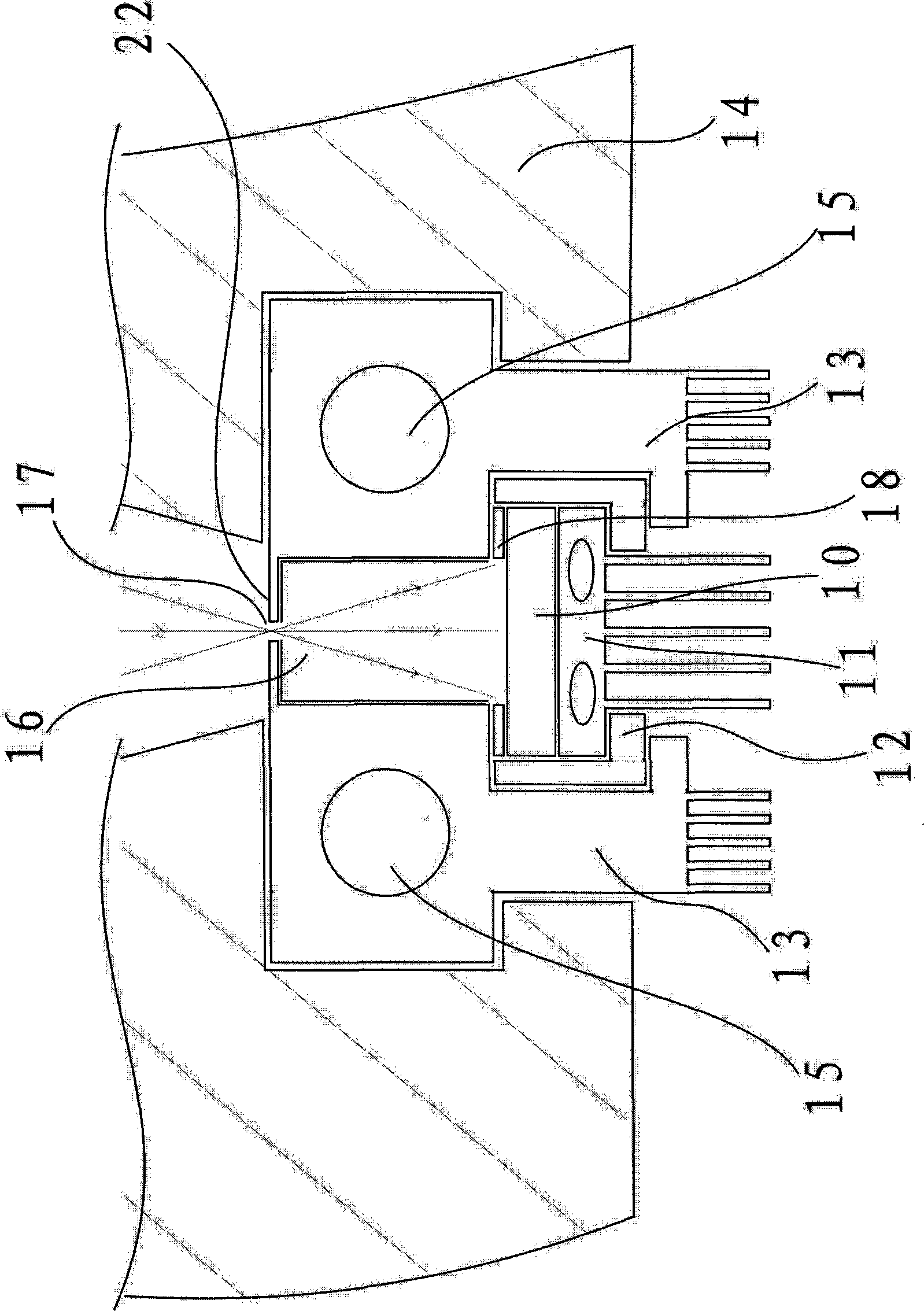
Figure 1 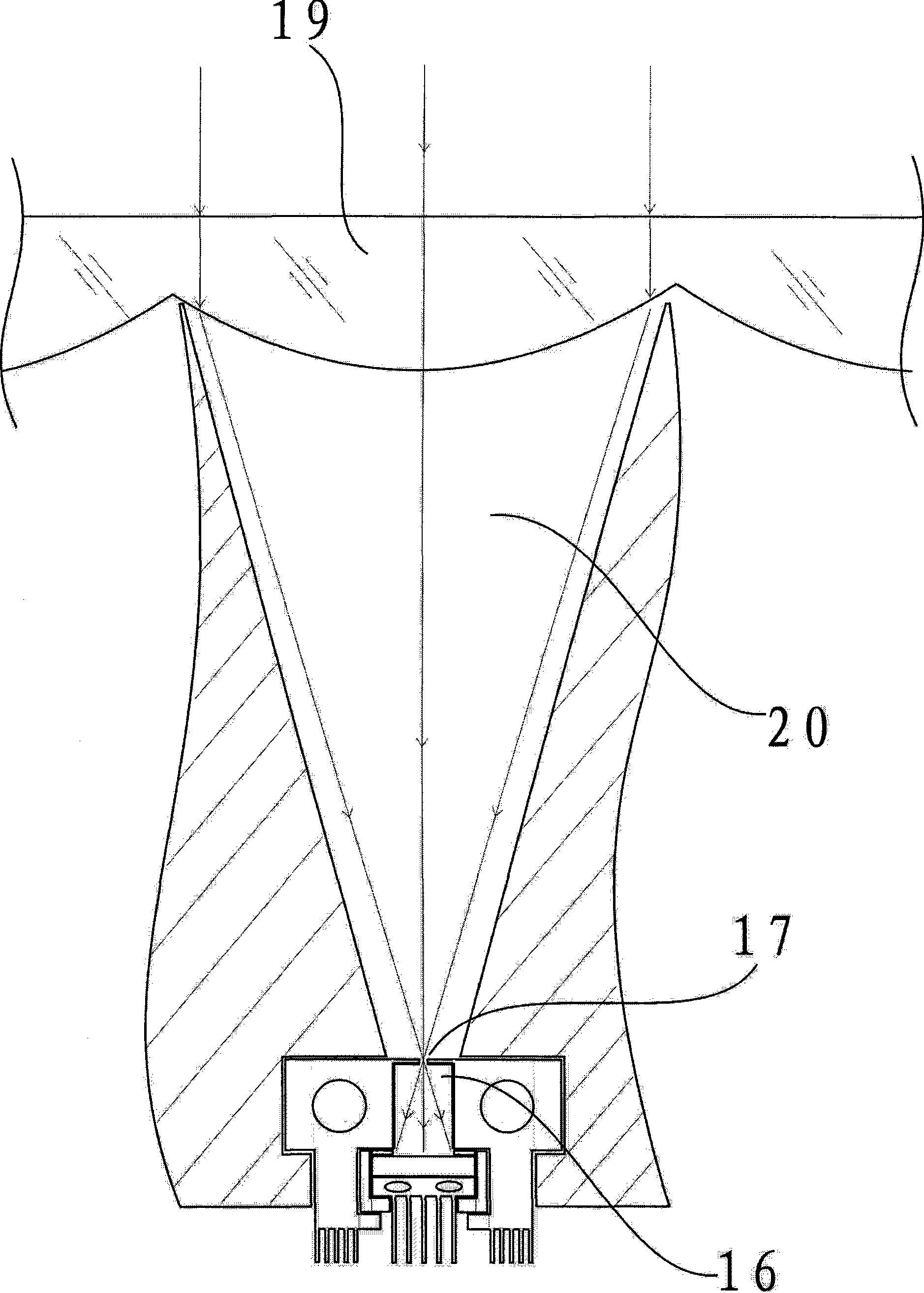
Figure 2 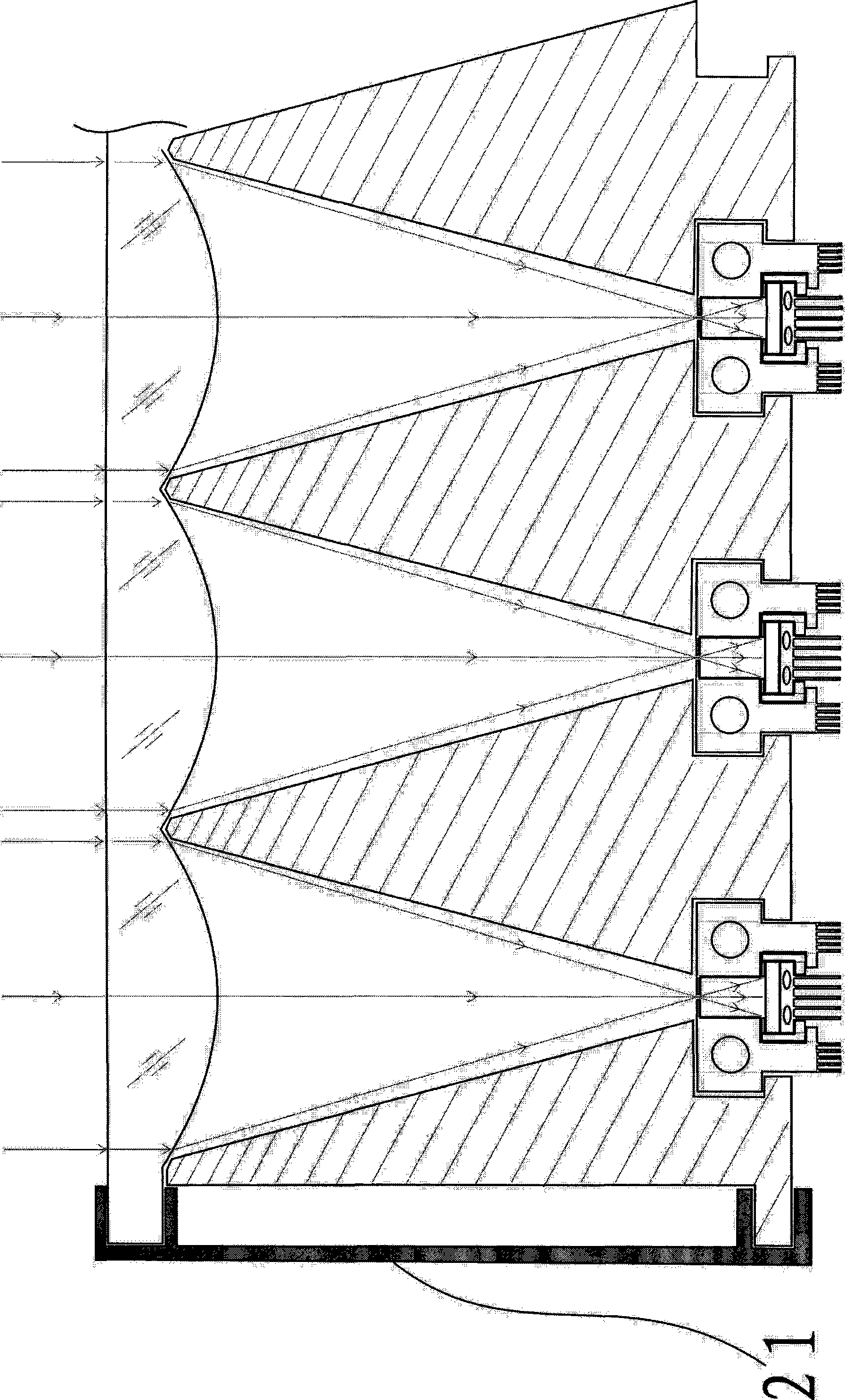
Figure 3
Abstract
Description
technical field
[0001] The invention relates to a photoelectric conversion module of a concentrated photovoltaic system, belonging to the technical field of solar energy utilization. Background technique
[0002] The existing concentrating solar photovoltaic cell power generation basically uses a convex lens or a Fresnel lens and a catadioptric mirror to irradiate the solar photovoltaic cell with sunlight to generate electricity. The main reason for this is because of the higher production costs of photovoltaic cells. How to use fewer photovoltaic cells to generate more electricity is the goal pursued by many researchers. According to the performance characteristics of conventional solar photovoltaic cells, the output power of photovoltaic cells is basically proportional to the light intensity under the sunlight irradiation of low-magnification lenses below 10 times. However, since the temperature generated by concentrated light has a great influence on the performance of ...
Examples
Embodiment Construction
[0018] Such as figure 1 , figure 2 , image 3 As shown, the present invention provides a quasi-black body absorption type high-efficiency concentrating solar cell assembly, which mainly consists of a silicon cell 10, a back heat sink 11, an adhesive 12, a conductive heat dissipation metal member 13, an internal support 14, a flexible contact electrode 18, Strip lens array board 19 and packaging frame 21 . Among them, the silicon battery 10 is in the shape of a long and thin strip, and there are flexible contact electrodes 18 packaged with good electrical conductivity on both sides of the front of the silicon battery 10. The back is packaged with a back heat sink 11, and there is a cavity 16 coated with an internal reflection layer between the focus point formed by the strip lens array plate 19 and the upper surface of the silicon battery 10. There is a strip-shaped opening on the cavity 16, just It is located at the focus point formed by the strip lens array plate 19 , and...