
Aloe emodin derivative and preparation method thereof
A technology of aloe-emodin and derivatives, which is applied in the direction of drug combination, organic chemistry, antineoplastic drugs, etc., can solve the problems of gastrointestinal stimulation, difficulty of aloe-emodin, poor bioavailability, etc., and achieve less by-products and easy preparation Simple method, water-soluble and stable effect
Patent Information
- Authority / Receiving Office
- CN · China
- Patent Type
- Applications(China)
- Current Assignee / Owner
- Publication Date
- 2012-12-26
- Estimated Expiration
- Not applicable · inactive patent
Smart Images
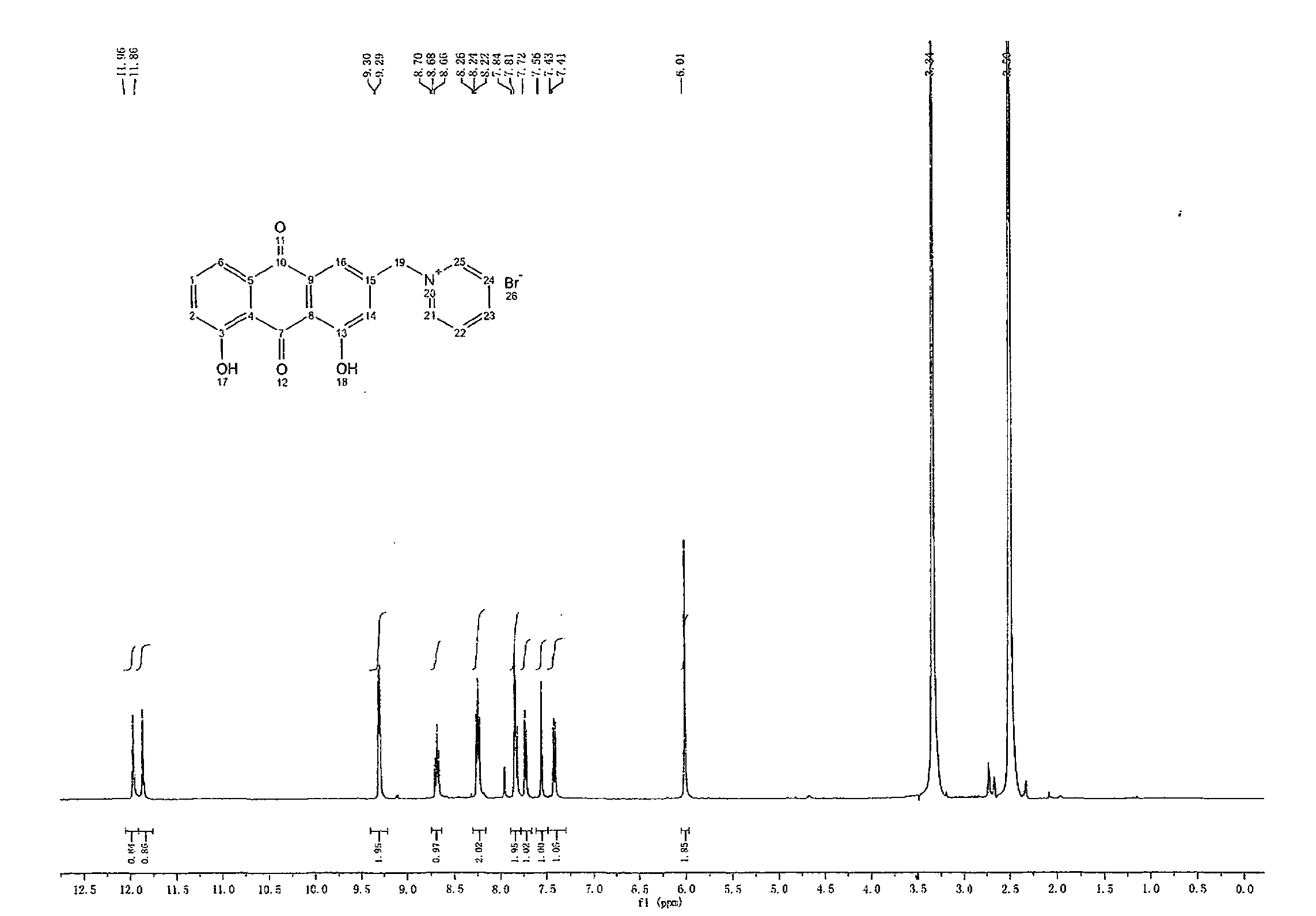
Figure 1 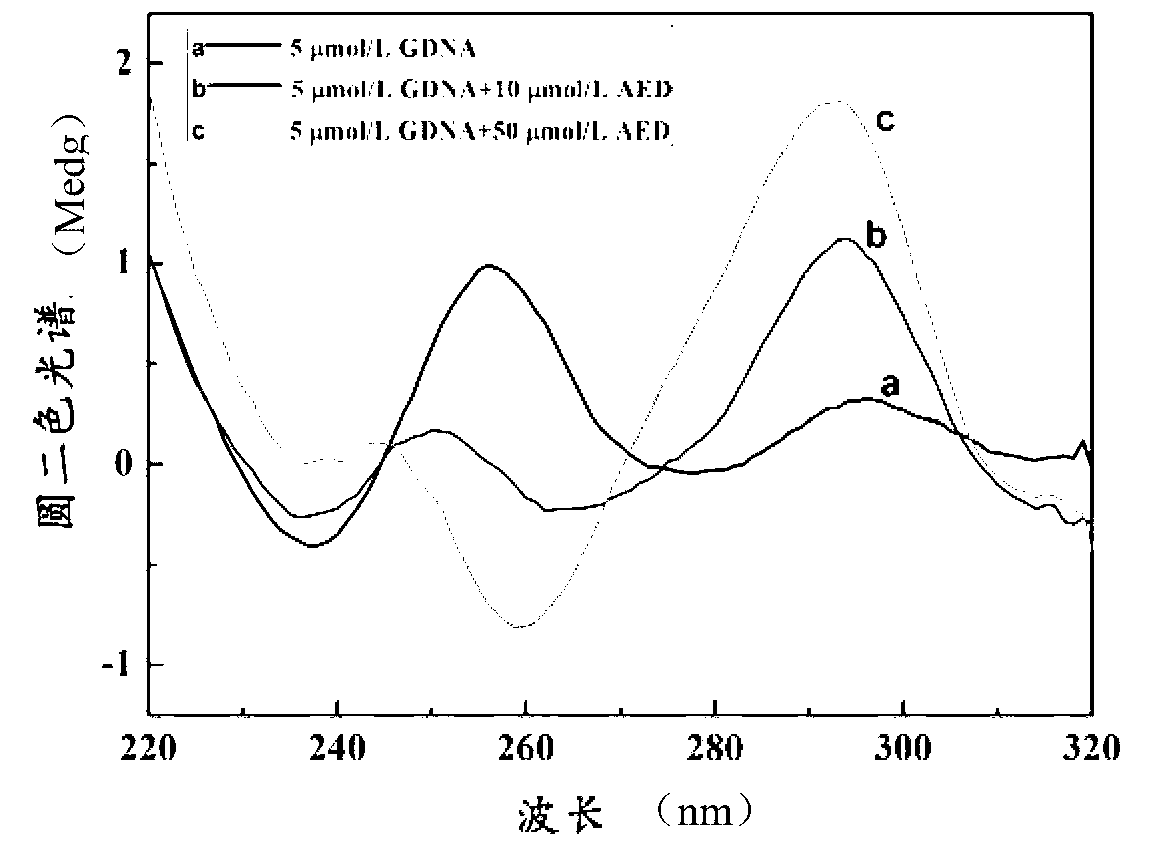
Figure 2 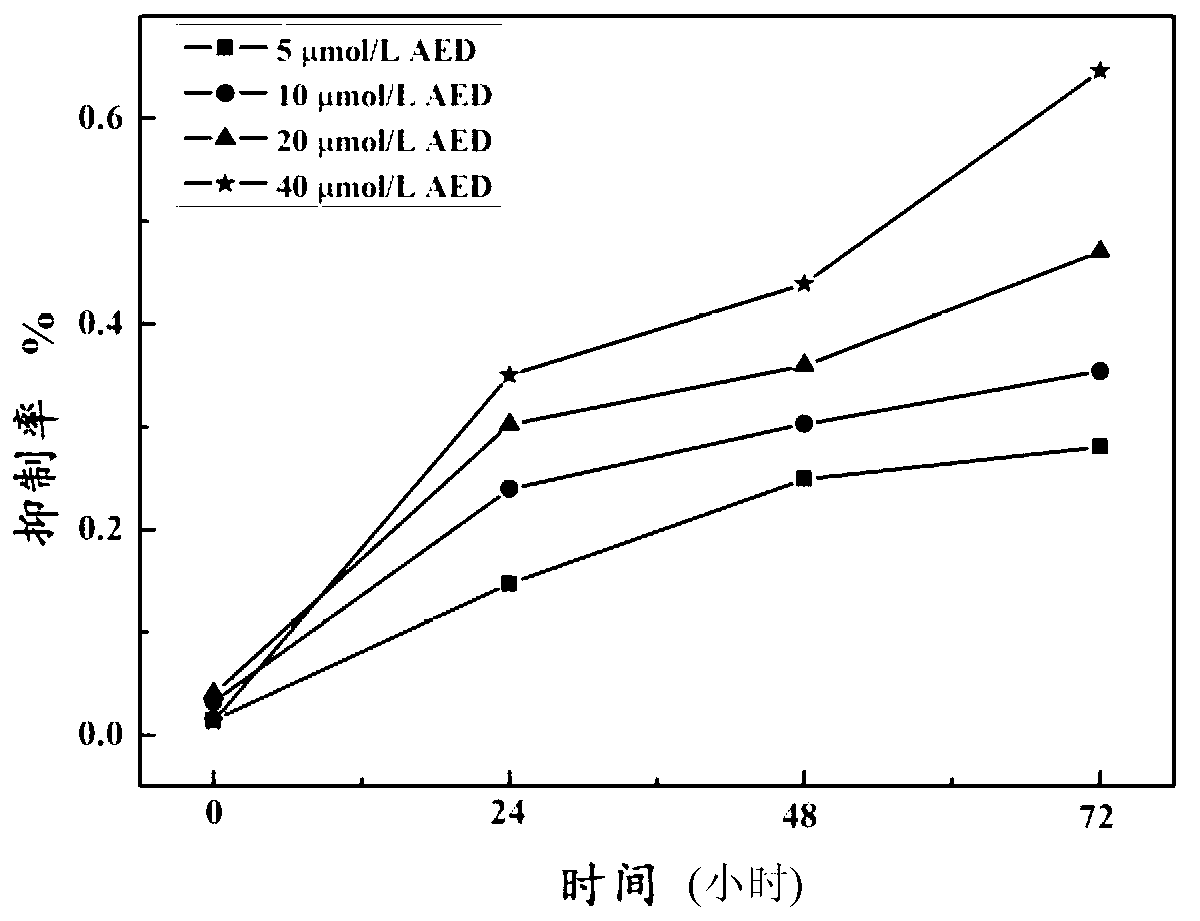
Figure 3
Abstract
Description
technical field
[0001] The invention belongs to the technical field of organic synthesis, and particularly relates to an aloe-emodin derivative with natural aloe-emodin as a matrix and a preparation method thereof. Background technique
[0002] In the research and development of anti-tumor drugs, the screening of anti-tumor drug lead compounds based on biological target molecules is one of the research hotspots of anti-tumor drugs. The formation of G-quadruplex DNA can effectively inhibit the activity of telomerase and the elongation of telomeres, thereby curbing the massive proliferation of tumor cells. Therefore, compounds that can induce GDNA to form a G-quadruplex structure or specifically bind to G-quadruplex and stabilize it are expected to inhibit the growth of tumor cells, thereby achieving anticancer effects. The screening and structural design of compounds for the targets of anticancer drugs is a hot spot that chemists and biologists are paying close attention to....
Examples
Embodiment 1
[0029] Take the synthesis of 1-[(9,10-dihydro-1,8-dihydroxy-9,10-dioxo-3-anthracenyl)methyl]pyridinium bromide as an example, molecular mass: 411.0, structural formula for:
[0030] Formula 1)
[0031] where R is
[0032] The preparation method of above-mentioned 1-[(9,10-dihydro-1,8-dihydroxyl-9,10-dioxo-3-anthracenyl)methyl]pyridinium salt bromide comprises the following steps:
[0033] (1) Synthesis of 3-bromomethyl-1,8-dihydroxy-9,10-anthraquinone
[0034] Add 0.50g of aloe-emodin to 18.5mL of dry dichloromethane, add 1.93g of triphenylphosphine and 2.45g of carbon tetrabromide to the reaction solution at 0°C, The molar ratio of carbonized carbon was 1:4:4, stirred at room temperature for 2.5 hours, filtered, the filtrate was concentrated, and the residue was purified by silica gel column chromatography to obtain 0.52g of 3-bromomethyl-1,8-dihydroxy-9, 10-anthraquinone, the chemical reaction formula is:
[0035] Formula 1)
[0036] (2) Synthesis of aloe-emodin ...
Embodiment 2
[0042] Taking the synthesis of 1-[(9,10-dihydro-1,8-dihydroxy-9,10-dioxo-3-anthracenyl)methyl]pyridinium bromide as an example, the preparation method comprises the following steps:
[0043] (1) Synthesis of 3-bromomethyl-1,8-dihydroxy-9,10-anthraquinone
[0044] Add 0.5g of aloe-emodin to 18.5mL of dry dichloromethane, add 1.45g of triphenylphosphine and 1.84g of carbon tetrabromide to the reaction solution at 0°C, The molar ratio of carbonized carbon was 1:3:3, stirred at room temperature for 2.5 hours, filtered, the filtrate was concentrated, and the residue was purified by silica gel column chromatography. The chemical reaction formula was formula (1), and 0.50 g of 3-bromomethyl- 1,8-Dihydroxy-9,10-anthraquinone.
[0045] (2) Synthesis of aloe-emodin derivatives
[0046] Dissolve 0.2 g of 1,8-dihydroxy-3-bromomethyl-9,10-anthraquinone prepared in step (1) in 6 mL of dry N,N-dimethylformamide, add 0.15 mL of pyridine , the molar ratio of 3-bromomethyl-1,8-dihydroxy-9,10...
Embodiment 3
[0048] Taking the synthesis of 1-[(9,10-dihydro-1,8-dihydroxy-9,10-dioxo-3-anthracenyl)methyl]pyridinium bromide as an example, the preparation method comprises the following steps:
[0049] (1) Synthesis of 3-bromomethyl-1,8-dihydroxy-9,10-anthraquinone
[0050] Add 0.5g of aloe-emodin to dry dichloromethane to dissolve completely, add 2.42g of triphenylphosphine and 3.06g of carbon tetrabromide to the reaction solution in turn at 0°C, aloe-emodin and triphenylphosphine, tetrabromide The molar ratio of carbonized carbon is 1:5:5, stirred at room temperature for 2.5 hours, filtered, the filtrate is concentrated, and the residue is purified by silica gel column chromatography. The chemical reaction formula is formula (1), and 0.49 g of 3-bromomethyl- 1,8-Dihydroxy-9,10-anthraquinone.
[0051] (2) Synthesis of aloe-emodin derivatives
[0052] Dissolve 0.2 g of 3-bromomethyl-1,8-dihydroxy-9,10-anthraquinone obtained in step (1) in 7 mL of dry N,N-dimethylformamide, add 0.24 mL of...