
Vector without frameshift mutation after recombination, method and application of site-directed gene knock-in in Xenopus frog genome
A genome and clawed frog technology, applied in the field of genetic engineering, can solve the problems of cumbersome, low efficiency, and inability to do long-term genetic research.
Patent Information
- Authority / Receiving Office
- CN · China
- Patent Type
- Patents(China)
- Current Assignee / Owner
- Publication Date
- 2018-05-25
- Estimated Expiration
- Not applicable · inactive patent
Smart Images

Figure 1 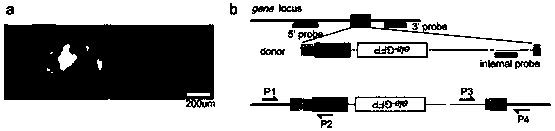
Figure 2 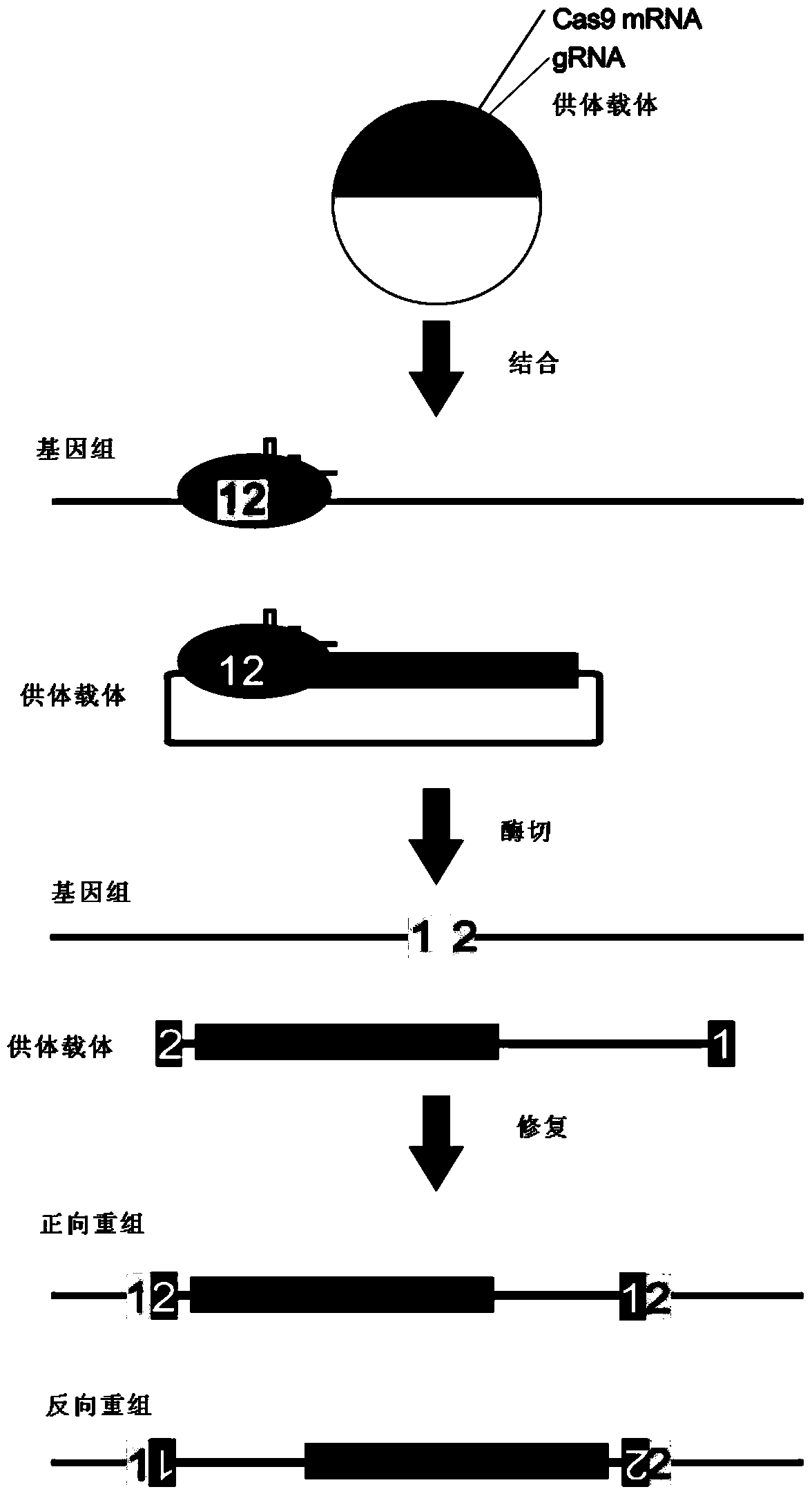
Figure 3
Abstract
Description
technical field
[0001] The invention relates to the field of genetic engineering, in particular to a carrier that does not produce frameshift mutations after recombination, a method for gene-directed knock-in in the Xenopus genome, and an application thereof. Background technique
[0002] The African clawed frog (Xenopus laevis) is a classic model animal for the study of early embryology. It has the advantages of large embryos and large egg production. The tropical clawed frog (Xenopus tropicalis) has all the advantages of the African clawed frog. In addition, this species is small, has a short reproductive cycle (4-5 months), and is a diploid species, which is suitable for genetic research.
[0003] The entire genome of the tropical clawed frog has been sequenced. Its genome has about 1.7 billion base pairs and contains 20,000 to 21,000 genes, of which about 1,700 genes are very similar to the corresponding genes of humans, and nearly 80% of all human genes Genes related ...
Examples
example 1
[0093] Example 1 Gene site-specific insertion in exon 5 of the ets1 gene in Xenopus tropicalis
[0094] 1. Cas9 target site
[0095] The ets1 target is the target site corresponding to ets1-T2 in Table 1 in the literature (Guo et al., 2014) (the sequence is shown in SEQUENCE NO.15, that is, 5-GGTTCAGAGAATTCAGAGGGCGG-3)
[0096] 2. Preparation of Cas9mRNA and gRNA
[0097] Synthesize Cas9 mRNA and gRNA according to the following scheme:
[0098] 1) Preparation of Cas9 mRNA
[0099] Endonuclease NotI will 10ug pCS2-3×FLAG-NLS-SpCas9-NLS (addgene ID: 51307; vector structure as image 3 Shown in a) The plasmid was linearized, and Cas9 mRNA was prepared by in vitro transcription using SP6.
[0100] 2) gRNA preparation
[0101] a. Vector preparation
[0102] Referring to the method of the literature (Guo et al., 2014), the Cas9 target site shown in SEQUENCE NO.15 was cloned into the backbone vector by using the enzyme digestion effect of BbsI, and the backbone vector was pUC57...
example 2
[0131] Example 2 Carrying out site-directed gene insertion in exon 3 of the ets2 gene in Xenopus tropicalis
[0132] 1. Cas9 target site
[0133] The ets2 target is the target site corresponding to ets2 in Table 1 in the literature (Guo et al., 2014) (the sequence is shown in SEQUENCE NO.25), that is, ggtctggact cttactctca tgg.
[0134] 2. Preparation of Cas9mRNA and gRNA
[0135] 1. Preparation of Cas9 mRNA, see Example 1
[0136] 2. Preparation of gRNA, see Example 1
[0137] a. Vector preparation
[0138] Referring to the method of the literature (Guo et al., 2014), the Cas9 target site as shown in SEQUENCE NO.25 was cloned into the backbone vector by using the enzyme digestion effect of BbsI, and the backbone vector was pUC57-T7-gRNA plasmid (vector structured as image 3 b) to obtain ets2-specific gRNA.
[0139] b. gRNA transcription synthesis, see Example 1
[0140] 3.donor preparation
[0141] 1) PCR amplification
[0142] The genome sequence (611bp) containing...
example 3
[0157] Example 3 Carrying out gene-directed insertion at intron 1 of the tropical clawed frog tyrosinase gene to achieve the effect of no frame shift
[0158] 1. Preparation of Cas9 mRNA and gRNA
[0159] 1) Cas9mRNA synthesis method is the same as in Example 1
[0160] 2) Preparation of gRNA
[0161] The target site is within intron 1, about 600bp away from exon 2, named tyr-int1.
[0162] The target site recognition sequence is 5-GGGGTCCCTAACTTCCTCTATGG-3 (SEQUENCE NO.31).
[0163] The two annealed single-stranded sequences are as follows:
[0164] tyr-int1-S: 5-TAGGGGTCCCTAACTTCCTCTA-3 (SEQUENCE NO.32)
[0165] tyr-int1-A: 5-AAACTAGAGGAAGTTAGGGACC-3 (SEQUENCE NO.33)
[0166] The gRNA synthesis method is the same as Example 1.
[0167] 2.donor preparation
[0168] 1) PCR amplification
[0169] Using PCR amplification (template is the genome of Xenopus tropicalis) to obtain the partial sequence of the intron containing the tyr-int1 target site and the exon adjacent to...