
Synthetic method of pyrrol-indole compound as drug intermediate
A synthesis method and compound technology, which are applied in the synthesis of fused ring compounds and the synthesis of pyrroloindole compounds, can solve problems such as affecting industrial scale-up production efficiency and safety, using highly toxic reagents, and narrowing the scope of application of substrates. , to achieve the effect of good application prospects and broad market promotion value
Patent Information
- Authority / Receiving Office
- CN · China
- Current Assignee / Owner
- Publication Date
- 2016-01-06
- Estimated Expiration
- Not applicable · inactive patent
Smart Images
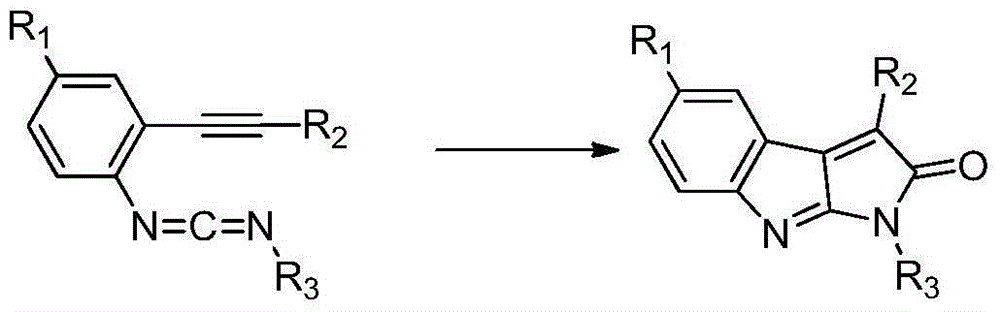
Figure 1 
Figure 2 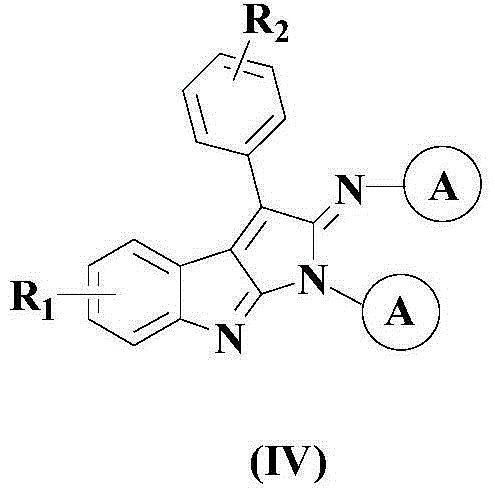
Figure 3
Abstract
Description
technical field
[0001] The invention relates to a method for synthesizing condensed ring compounds, more specifically to a method for synthesizing pyrroloindole compounds, and belongs to the field of synthesizing pharmaceutical intermediates. Background technique
[0002] In the fields of medicine, medical treatment, organic synthesis, etc., natural products containing indole structures occupy a very important position, because the structures containing indole often show good biological activities. Among the indole compounds, the pyrroloindole compounds are more important, which exist in a large number of alkaloids as the parent skeleton.
[0003] It is precisely because of the important role of pyrroloindole compounds that the development of new synthetic techniques for pyrroloindole compounds will facilitate the synthesis of drugs and their intermediates.
[0004] In recent years, a variety of synthetic methods for indole skeleton structures have been developed in the pri...
Examples
Embodiment 1
[0039]
[0040]At room temperature and under a nitrogen atmosphere, add 100 mmol of the above formula (I) compound, 140 mmol of the above formula (II) compound, 200mmol upper formula (III) compound, 15mmol composite catalyst (for 5mmolPd 2 (dba) 3 Mixture with 10mmol trimethylphosphine (copper hexafluoroacetylacetonate), 5mmol gallium trichloride and 200mmol organic base 2,4-lutidine, then heat up to 70°C and insulate and fully stir for 6 hours;
[0041] After the reaction is finished, filter the reaction system, cool the filtrate to room temperature, adjust the pH value to neutral, add deionized water to fully shake and wash, then extract 2-3 times with chloroform, combine the organic phases, and dry over anhydrous magnesium sulfate. After distillation under reduced pressure, the obtained residue was separated by silica gel column chromatography, and acetone and ethyl acetate in equal volume ratio were used as washing liquids to obtain the compound of the above formula (I...
Embodiment 2
[0044]
[0045] At room temperature and under a nitrogen atmosphere, add 100 mmol of the above formula (I) compound, 200 mmol of the above formula (II) compound, 250mmol formula (III) compound, 24mmol composite catalyst (for 6mmolPd 2 (dba) 3 Mixture with 18mmol trimethylphosphine (copper hexafluoroacetylacetonate), 8mmol gallium trichloride and 250mmol organic base 2,4-lutidine, then heat up to 80°C and insulate and fully stir for 5 hours;
[0046] After the reaction is finished, filter the reaction system, cool the filtrate to room temperature, adjust the pH value to neutral, add deionized water to fully shake and wash, then extract 2-3 times with chloroform, combine the organic phases, and dry over anhydrous magnesium sulfate. After distillation under reduced pressure, the obtained residue was separated by silica gel column chromatography, and acetone and ethyl acetate in equal volume ratio were used as washing liquids to obtain the compound of the above formula (IV) wi...
Embodiment 3
[0049]
[0050] At room temperature and under a nitrogen atmosphere, add 100 mmol of the above formula (I) compound, 170 mmol of the above formula (II) compound, 300mmol formula (III) compound, 20mmol composite catalyst (for 6mmolPd 2 (dba) 3 Mixture with 14mmol trimethylphosphine (copper hexafluoroacetylacetonate), 10mmol gallium trichloride and 300mmol organic base 2,4-lutidine, then heat up to 85°C and insulate and fully stir for 4 hours;
[0051] After the reaction is finished, filter the reaction system, cool the filtrate to room temperature, adjust the pH value to neutral, add deionized water to fully shake and wash, then extract 2-3 times with chloroform, combine the organic phases, and dry over anhydrous magnesium sulfate. After distillation under reduced pressure, the obtained residue was separated by silica gel column chromatography, and acetone and ethyl acetate in equal volume ratio were used as washing liquids to obtain the compound of the above formula (IV) w...