
A kind of preparation method of high-strength polypeptide hydrogel
A hydrogel, high-strength technology, applied in the direction of non-active ingredient medical preparations, medical preparations containing active ingredients, pharmaceutical formulations, etc., can solve the problem of low cross-linking strength, poor self-supporting performance, difficult to effectively control, etc. problem, to achieve the effect of improving mechanical strength and gelling ability
Patent Information
- Authority / Receiving Office
- CN · China
- Patent Type
- Patents(China)
- Current Assignee / Owner
- Publication Date
- 2017-12-15
Smart Images
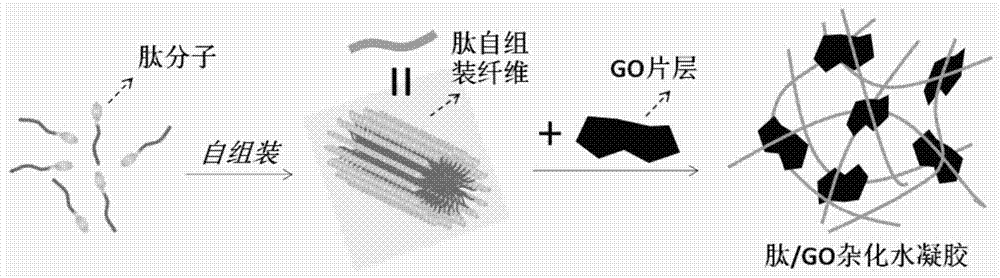
Figure 1 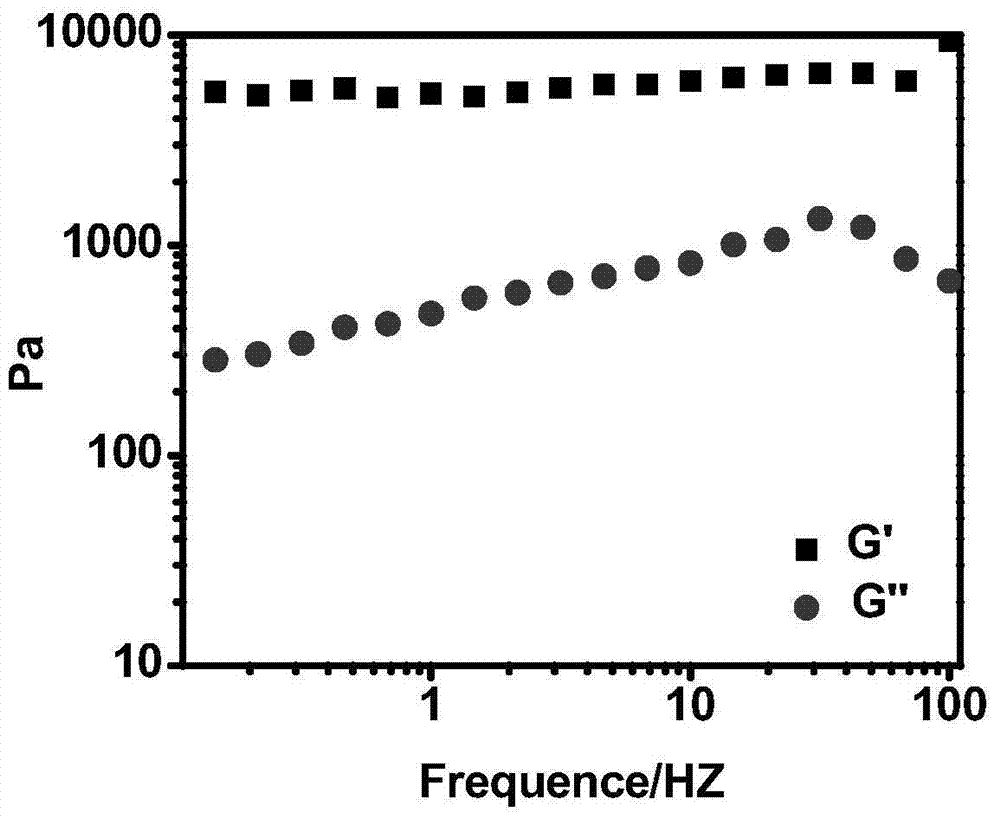
Figure 2 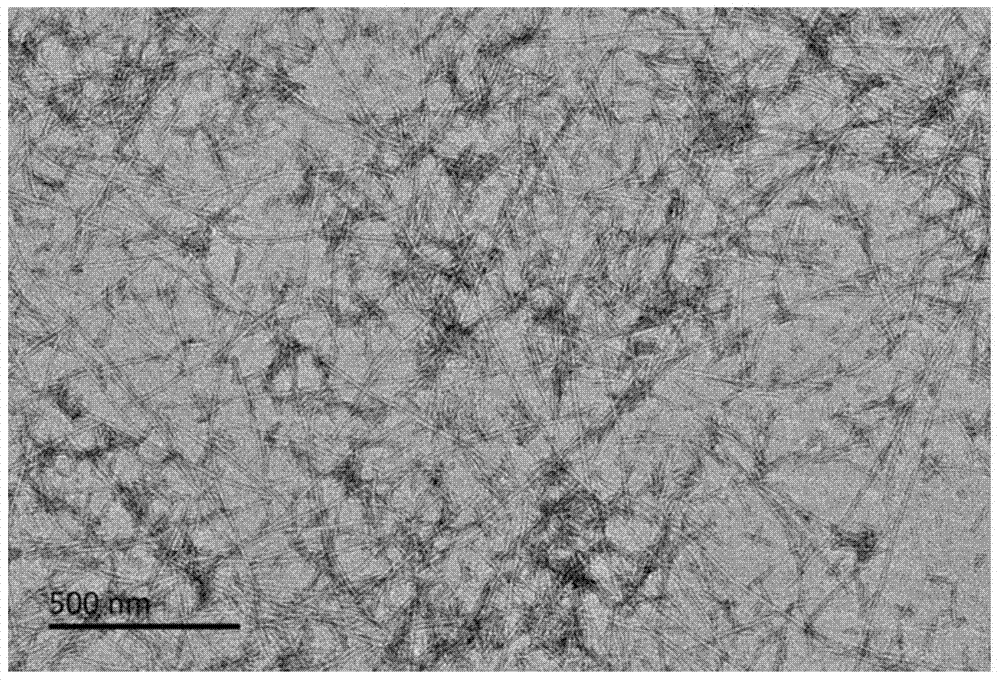
Figure 3
Abstract
Description
technical field
[0001] The invention relates to a preparation method of a hydrogel, in particular to a preparation method of a high-strength polypeptide hydrogel; it belongs to the field of chemical preparation. Background technique
[0002] Hydrogel is a gel material with water as the dispersion medium. Due to its rich pore structure and three-dimensional network structure that can provide better permeability and mechanical support, it has broad application prospects in many fields. In recent years, hydrogel materials have attracted the attention of scientists at home and abroad, and a lot of research has been done on their applications in biomedicine, such as tissue engineering and drug delivery. Ordinary hydrogels can be obtained by covalent cross-linking between high-molecular-weight synthetic polymers or between some small molecules, but such cross-linking methods need to be carried out by chemical synthesis. Since most of the chemical reagents are toxic, the hydrogel ...
Examples
Embodiment 1
[0035] (1) Preparation I 3 K polypeptide molecule 4.0mmol / L aqueous solution, ultrasonic mixing, ultrasonic power 100W, ultrasonic time 10min; stand at room temperature for 3 days to make it self-assemble into a long fiber structure, at this time the system cannot form a hydrogel;
[0036] (2) Add GO sheets with a length of 300±200nm, a width of 300±200nm, and a thickness of 1-2nm in the solution containing the long polypeptide fiber structure, so that the concentration of the GO sheet is 0.1mg / mL (that is, every mL Add 0.1mg GO flakes to the solution), mix with ultrasonic, the ultrasonic power is 100W, and the ultrasonic time is 12min; the pH value of the mixed solution is adjusted to 10.5 by using NaOH solution with a concentration of 0.5mol / L, and it is allowed to stand at room temperature for 6 hours to form a hybrid Hydrogels.
[0037]The storage modulus (G') of the hydrogel obtained in Example 1 can reach 4000Pa, the energy dissipation modulus (G") can reach 500Pa, and ...
Embodiment 2
[0039] (1) Prepare K 3 A 3 I 3 G 3 V 3 Polypeptide molecule 4.0mmol / L aqueous solution, ultrasonic mixing, ultrasonic power 100W, ultrasonic time 10min; stand at room temperature for 3 days to make it self-assemble into a long fiber structure;
[0040] (2) Add GO sheets with a length of 300±200nm, a width of 300±200nm, and a thickness of 1-2nm to the above-mentioned long fiber structure solution, so that the concentration of the GO sheet is 0.02mg / mL, ultrasonically mix, and the ultrasonic power 100W, ultrasonic time is 10min; use 0.5mol / L NaOH solution to adjust the pH of the mixed solution to 10.0, and let it stand at room temperature for 6 hours to form a hybrid hydrogel.
[0041] The storage modulus (G') of the hydrogel obtained in Example 2 can reach 5000Pa, the energy dissipation modulus (G") can reach 600Pa, and the gel pore size is less than 500nm; the self-supporting hybrid Hydrogels.
Embodiment 3
[0043] (1) Prepare K 3 A 3 I 3 G 3 V 3 Polypeptide molecule 4.0mmol / L aqueous solution, ultrasonic mixing, ultrasonic power 100W, ultrasonic time 10min; stand at room temperature for 3 days to make it self-assemble into a long fiber structure;
[0044] (2) Add GO sheets with a length of 300±200nm, a width of 300±200nm, and a thickness of 1-2nm to the above-mentioned long fiber structure solution, so that the concentration of the GO sheet is 0.1mg / mL, ultrasonically mix, and the ultrasonic power 100W, ultrasonic time is 10min; use 0.5mol / L NaOH solution to adjust the pH of the mixed solution to 10.0, and let it stand at room temperature for 6 hours to form a hybrid hydrogel.
[0045] The storage modulus (G') of the hydrogel obtained in Example 3 can reach 6000Pa, the loss modulus (G") can reach 1000Pa, and the gel pore size is less than 500nm. figure 2 It is the rheological measurement result of the hybrid hydrogel of this embodiment; a self-supporting hybrid hydrogel can...