
Preparation method of 2,3-dichloro-4-hydroxyaniline
A technology of hydroxyaniline and dichloro, which is applied in the field of preparation of intermediate 2,3-dichloro-4-hydroxyaniline, can solve the problems of high cost, increased risk of large-scale production, unfriendly metal waste residue, etc. Gentle, simple operation, low reaction cost effect
Patent Information
- Authority / Receiving Office
- CN · China
- Current Assignee / Owner
- Publication Date
- 2016-07-06
- Estimated Expiration
- Not applicable · inactive patent
Smart Images

Figure 1 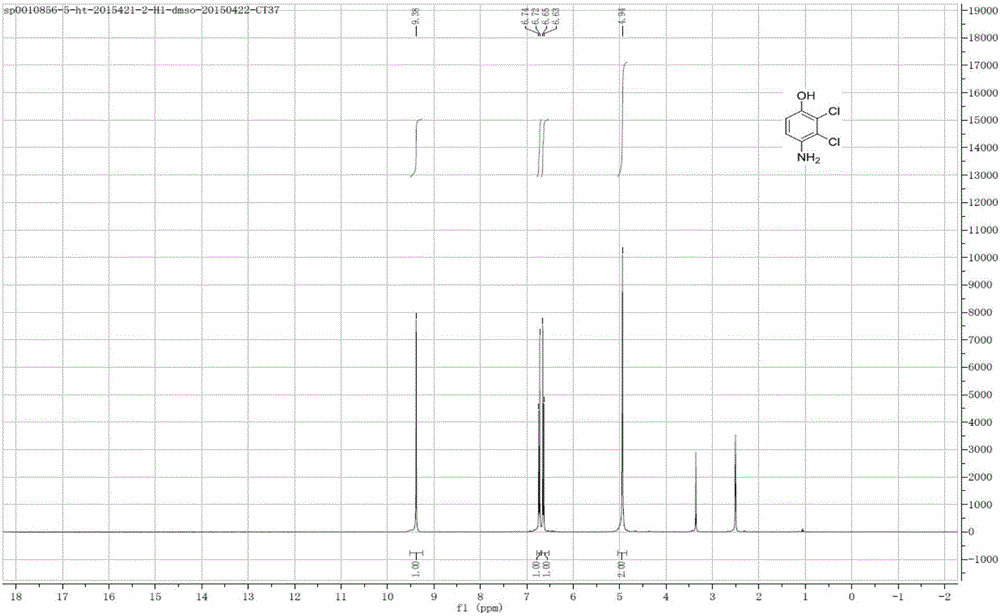
Figure 2 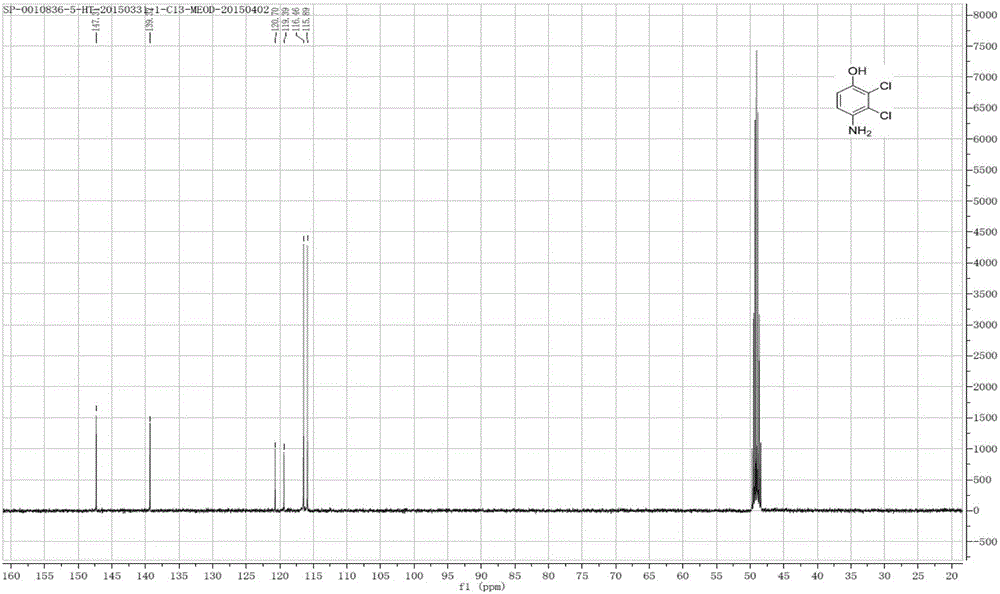
Figure 3
Abstract
Description
Technical field
[0001] The invention belongs to the technical field of crop protection agents, and specifically relates to a preparation method of intermediate 2,3-dichloro-4-hydroxyaniline. Background technique
[0002] Amide fungicides have been successfully developed and used since 1966. This type of crop protection agent has been used as a fungicide for nearly 50 years. Cyprofen is a new amide fungicide with systemic and protective properties developed by Bayer and officially launched in 1999. Cyprofen and its derivative fungicides have toxicological data that are safe and beneficial to crops, and have good ecological effects, making them ideal comprehensive pest management drugs.
[0003] 2,3-Dichloro-4-hydroxyaniline is a key intermediate of cyclofenac and its derivatives for crop fungicides. Its synthesis method has been reported and protected by Bayer Company, that is, it is composed of substituted aryl azo compounds. The raw materials are reduced to obtain the tar...
Examples
Embodiment 1
[0035] Preparation of 2,3-dichloro-4-hydroxyaniline by reduction in sodium borohydride / ethanol system
[0036] In a 100 ml two-necked flask equipped with a stirring bar and a reflux condenser, add 8.0 g (0.03 moles) of raw material 2,3-dichloro-4-phenylazophenol, dissolve in 40 ml of ethanol solution, and place in an ice-water bath Add 4.5 g (0.12 mol) of sodium borohydride in small portions. After the dropwise addition was completed, the ice bath was removed under stirring, and the reaction was continued for 4 hours at room temperature. After the reaction, the dilute hydrochloric acid solution was neutralized to pH=7, extracted three times with ethyl acetate, the combined organic phase was dried with anhydrous sodium sulfate, the solvent was evaporated by a rotary evaporator, 20 ml of toluene was recrystallized, and the product was obtained by drying after filtration: 4.95 g of light pink crystals, yield 92%.
[0037] Figure 2-4 shows the 2,3-dichloro-4-hydroxyaniline 1 ...
Embodiment 2
[0039] Preparation of 2,3-dichloro-4-hydroxyaniline by reduction with sodium borohydride and sodium hydroxide / ethanol system
[0040] In a 100 ml two-necked flask equipped with a stirring bar and a reflux condenser, add 8.0 grams (0.03 moles) of raw material 2,3-dichloro-4-phenylazophenol, and dissolve 1 gram of sodium hydroxide in 40 milliliters of ethanol solution 4.5 g (0.12 mol) of sodium borohydride was added in small portions in an ice-water bath. After the dropwise addition was completed, the ice bath was removed under stirring, and the reaction was continued for 4 hours at room temperature. After the reaction, the dilute hydrochloric acid solution was neutralized to pH=7, extracted three times with ethyl acetate, the combined organic phase was dried with anhydrous sodium sulfate, the solvent was evaporated by a rotary evaporator, 20 ml of toluene was recrystallized, and the product was obtained by drying after filtration: 5.08 g of light pink crystals, yield 95%, puri...