
An indoleamine-2,3-dioxygenase inhibitor of nitrogen-containing alkylated and arylated sulfoximines
A technology of alkyl and aryl, applied in the field of medicinal chemistry
Patent Information
- Authority / Receiving Office
- CN · China
- Patent Type
- Patents(China)
- Current Assignee / Owner
- Publication Date
- 2020-10-09
Smart Images
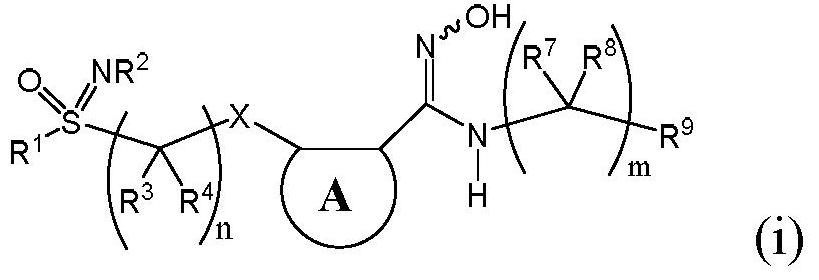
Figure 1 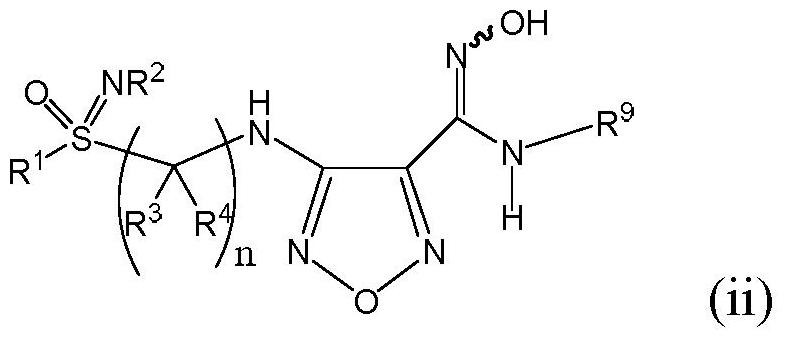
Figure 2 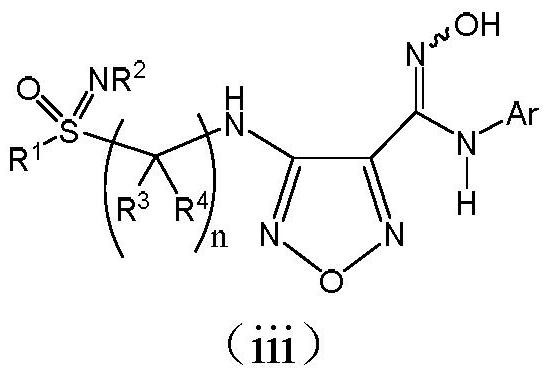
Figure 3
Abstract
Description
technical field
[0001] The invention belongs to the technical field of medicinal chemistry, and specifically relates to an IDO inhibitor containing nitrogen alkylation, arylation and acylation sulfoximine and a 1,2,5-oxadiazole structure and a preparation method thereof. Background technique
[0002] Indoleamine-2,3-dioxygenase (Indoleamine-2,3-dioxygenase, IDO) is a monomeric enzyme containing heme first discovered in cells by the Hayaishi group in 1967. The cDNA-encoded protein is composed of Composed of 403 amino acids, with a molecular weight of 45kDa, it is the rate-limiting enzyme for the catabolism of the tryptophan-kynurenine pathway, and is widely expressed in various mammalian tissues (Hayaishi O. et al Science, 1969, 164, 389-396). In the cells of tumor patients, IDO often plays an important physiological role in inducing immune tolerance in the tumor microenvironment, and its mediated tryptophan (Trp)-kynurenine (Kynurenine, Kyn) metabolic pathway participates i...
Examples
Embodiment 1
[0252] (±)(Z)-nitrogen-(3-bromo-4-fluorophenyl)-nitrogen'-hydroxy-4-((2-(nitrogen,sulfur-dimethylsulfoximine)ethyl)amino) -1,2,5-oxadiazole-3-carboxamidine
[0253]
[0254] The first step: 4-amino-nitrogen'-hydroxy-1,2,5-oxadiazole-3-carboxamidine
[0255]
[0256] Dissolve malondicyanide (3.2g, 48.5mmol) in 70mL of water and heat until completely dissolved. Under cooling in an ice-water bath, sodium nitrite (3.8 g, 55 mmol) and 6N hydrochloric acid (0.6 mL) were added. After reacting in an ice bath for 0.5 hours, the temperature was raised to room temperature and reacted for 2 hours. The reaction solution was continued to be cooled in an ice bath, and 50% aqueous solution of hydroxylamine hydrochloride (9.9 g, 150 mmol) was added dropwise to the reaction solution. After stirring for half an hour, the reaction solution was raised to room temperature for 1 hour. Heat to reflux for 2 hours. After the reaction is complete, adjust the pH to 7.0 with 8 mL of 6N hydrochlor...
Embodiment 2
[0301] (±)(Z)-nitrogen-(3-bromo-4-fluorophenyl)-nitrogen'-hydroxy-4-((3-(sulfur-methyl-nitroethylsulfoximine)ethyl)amino )-1,2,5-oxadiazole-3-carboxamidine
[0302]
[0303] According to the preparation method of Example 1, the reagent in the tenth step was replaced with triethyloxonium tetrafluoroborate, and then the conditions in the eleventh step were used to obtain the target compound.
[0304] 1 H NMR: (400MHz, acetone-d 6 ):δ10.85(s,1H),8.12(s,1H),7.28-7.26(m,1H),7.17-7.13(m,1H),7.02-6.98(m,1H),6.64(s,1H ),3.81(s,2H),3.57(s,1H),3.43-3.40(m,1H),3.31-3.06(m,5H),1.11-1.05(m,3H).
[0305] MS(ESI):[M+H] + m / z=449.0
Embodiment 3
[0307] (±)(Z)-nitrogen-(3-bromo-4-fluorophenyl)-nitrogen'-hydroxy-4-(2-(sulfur-methyl-nitrogen-phenylsulfoximine)ethyl)amino )-1,2,5-oxadiazole-3-carboxamidine
[0308]
[0309] The first step: (±) 4-(3-bromo-4-fluorophenyl) 3-4-(((2-(methyl sulfoxide phenylimine) ethyl) tert-butoxycarbonylamino)-1 ,2,5-oxadiazol-3-yl)-1,2,4-oxadiazolone
[0310]
[0311] The product of the ninth step of Example 1 (20mg, 0.037mmol) was dissolved in dichloromethane (2ml), added phenylboronic acid (8mg, 0.055mmol), copper acetate (5mg) and stirred at room temperature for 2 hours, TLC showed that the reaction was complete , water (10ml), ethyl acetate (10mL) were added to the reaction solution, and then extracted with ethyl acetate (2x 10mL) to combine the organic phases, then washed with water (10mL), washed with saturated brine (10mL), and dried over sodium sulfate. After concentration, separation and purification by column chromatography gave the target compound (15 mg, 66% yield)
[...