
Gas auxiliary injection molding method of car roof handle
A gas-assisted injection molding technology, applied in the field of auto parts, can solve the problems of not being able to give full play to the advantages of gas-assisted molding technology, affecting the appearance and image of injection molded parts, and reducing the strength of plastic products, so as to improve the appearance and image, improve injection molding efficiency, reduce The effect of internal stress in the melt
Patent Information
- Authority / Receiving Office
- CN · China
- Patent Type
- Applications(China)
- Current Assignee / Owner
- Publication Date
- 2019-04-16
Smart Images
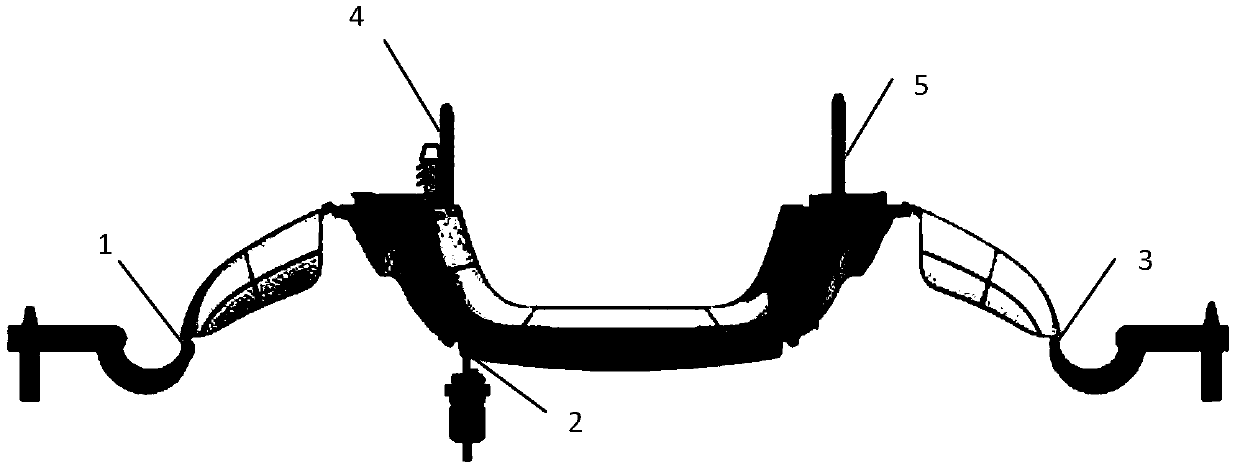
Figure 1 
Figure 2
Abstract
Description
technical field
[0001] The invention belongs to the technical field of auto parts, and in particular relates to a gas-assisted injection molding method for an auto ceiling handle. Background technique
[0002] Gas-assisted injection molding (hereinafter referred to as "gas-assisted molding" or GAIM), as a relatively new polymer processing technology, was not widely used industrially until the end of the last century. Compared with conventional injection molding (CIM), gas-assisted molding has the advantages of saving raw materials, shortening molding cycle, reducing clamping force and good dimensional stability of parts. Usually in the gas-assisted molding process, it is necessary to use high-pressure inert gas as the penetrating gas to push and compress the polymer melt until the melt fills the entire mold cavity, and then the melt is gradually cooled and solidified under the pressure of the gas. After the temperature of the part drops to the demoulding temperature, the mo...
Examples
Embodiment 1
[0047] The 3 gates and 2 air inlets set in this embodiment are as follows: figure 1 As shown, molten polypropylene is injected into the mold cavity through gate 1, gate 2 and gate 3. The melt temperature is 230°C and the mold temperature is 60°C. After the mold is fully injected, hold the pressure for 2s. Close gate 1 and gate 3, then open air inlet 4 and air inlet 5, nitrogen is injected into the cavity melt through air inlet 4 and air inlet 5, and the nitrogen pressure in air inlet 5 is adjusted to 8MPa , the nitrogen pressure at the inlet 4 is 5MPa, the nitrogen temperature at the two inlets is 0°C, the gas injection time is 3s, the nitrogen pushes the fluid to flow, and the excess fluid flows back to the injection molding system from the gate 2, the plastic in the mold The melt is formed into a hollow state, and the pressure is kept for 6s, and then the mold is cooled in liquid nitrogen at -180°C, the mold is opened, and the product is taken out.
Embodiment 2
[0049] The 3 gates and 2 air inlets set in this embodiment are as follows: figure 1 As shown, the molten polypropylene is injected into the mold cavity through gate 1, gate 2 and gate 3. The melt temperature is 230°C, the mold temperature is 60°C, and the mold is filled with pressure for 6 seconds. Close gate 1 and gate 3, then open air inlet 4 and air inlet 5, nitrogen is injected into the cavity melt through air inlet 4 and air inlet 5, and the nitrogen pressure in air inlet 5 is adjusted to 8MPa , the nitrogen pressure at the inlet 4 is 5MPa, the nitrogen temperature at the two inlets is 0°C, the gas injection time is 3s, the nitrogen pushes the fluid to flow, and the excess fluid flows back to the injection molding system from the gate 2, the plastic in the mold The melt is formed into a hollow state, and the pressure is kept for 6s, and then the mold is cooled in liquid nitrogen at -180°C, the mold is opened, and the product is taken out.
Embodiment 3
[0051] The 3 gates and 2 air inlets set in this embodiment are as follows: figure 1 As shown, molten polypropylene is injected into the mold cavity through gate 1, gate 2 and gate 3. The melt temperature is 230°C and the mold temperature is 60°C. After the mold is fully injected, hold the pressure for 2s. Close gate 1 and gate 3, then open air inlet 4 and air inlet 5, nitrogen is injected into the cavity melt through air inlet 4 and air inlet 5, and the nitrogen pressure in air inlet 5 is adjusted to 8MPa , the nitrogen pressure at the inlet 4 is 5MPa, the nitrogen temperature at the two inlets is 30°C, the gas injection time is 3s, the nitrogen pushes the fluid to flow, and the excess fluid flows back to the injection molding system from the gate 2, the plastic in the mold The melt is formed into a hollow state, and the pressure is kept for 6s, and then the mold is cooled in liquid nitrogen at -180°C, the mold is opened, and the product is taken out.