
Marker for evaluating sensitivity and/or prognosis of triple negative breast cancer to neoadjuvant chemotherapy drugs and application of marker
A technology for triple-negative breast cancer and chemotherapeutic drugs, which can be used in the field of biomedicine to solve problems such as unclear molecular mechanisms
Patent Information
- Authority / Receiving Office
- CN · China
- Current Assignee / Owner
- Publication Date
- 2021-05-07
Smart Images
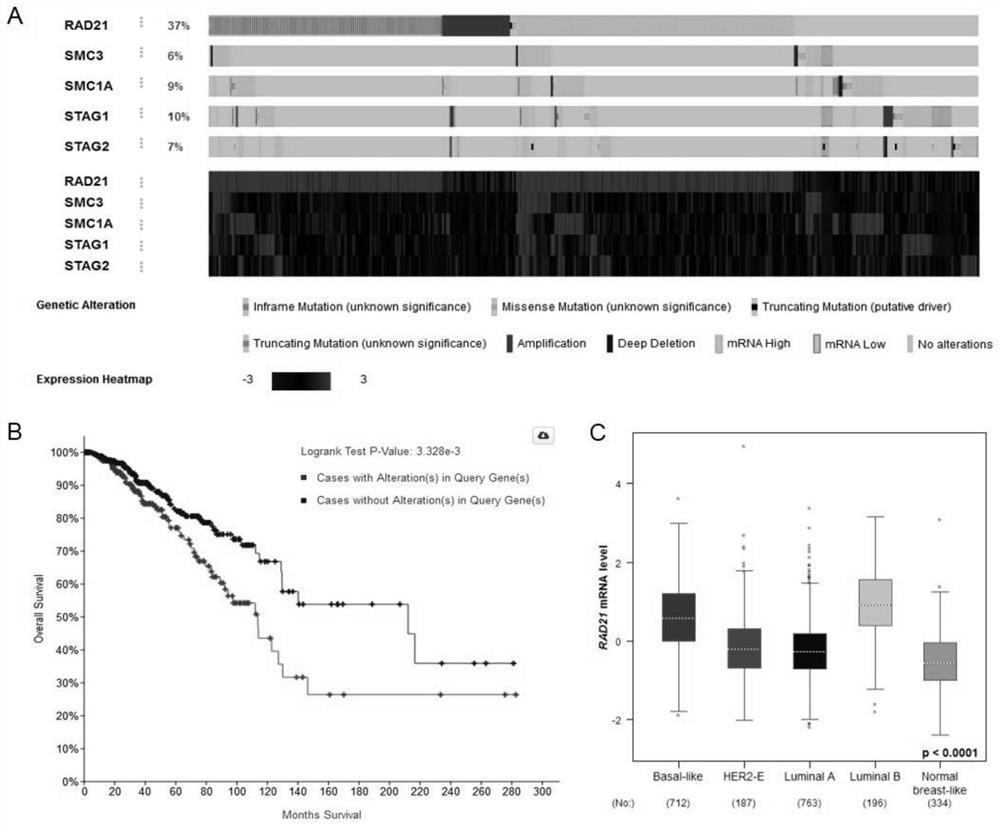
Figure 1 
Figure 2 
Figure 3
Abstract
Description
technical field
[0001] The invention relates to the field of biomedicine, in particular to a marker for evaluating the sensitivity and / or prognosis of triple negative breast cancer to neoadjuvant chemotherapy drugs and its application. Background technique
[0002] The information disclosed in this background section is only intended to increase the understanding of the general background of the present invention, and is not necessarily taken as an acknowledgment or any form of suggestion that the information constitutes the prior art already known to those skilled in the art.
[0003] Breast cancer ranks first in the incidence of malignant tumors in women, and accounts for the fifth in the death rate of malignant tumors in Chinese women, seriously threatening women's health. About 90% of breast cancer deaths are from breast cancer metastasis. Breast cancer is a highly heterogeneous malignant tumor, which can be divided into four categories according to the status of hormon...
Examples
Embodiment
[0032] Example 1 To clarify the role of RAD21 in the occurrence and development of breast cancer
[0033] In this example, 817 cases of invasive breast cancer and normal samples (Breast Invasive Carcinoma, TCGA, Cell 2015) in the TCGA (The Cancer Genome Atlas) database were first included in the analysis of this study. Among them, 817 samples had complete exome sequencing (Whole-exome sequencing) results with corresponding clinicopathological information; 817 samples had complete RNA-sequencing sequencing results; 816 samples had complete copy number Mutation CNV (copy-number alterations) detection results. Using cBioPortal online database, analyze the expression of RAD21 gene in 817 cases of invasive breast cancer samples (TCGA, Cell 2015), and further conduct the overall survival analysis of RAD21 gene high expression group and low expression group in invasive breast cancer samples . The UALCAN online database was used to analyze the expression of RAD21 gene in the TCGA ...
Embodiment 2
[0036] Example 2 RAD21 low expression and overexpression plasmid construction, siRNAs targeting RAD21 gene
[0037] (1) RAD21 low expression plasmid
[0038] Two RAD21 low-expression plasmids Tet-on ShRAD21#1 and #2 were purchased from Jinan Boshang Biotechnology Co., Ltd., and the plasmid was pZIP-TRE3G-ZsGreen-Puro(V125U). The sequence is as follows:
[0039] Tet-on ShRAD21#1: 5'-GCCATTACTTTACCTGAAGAAT-3'
[0040] Tet-on ShRAD21#2: 5'-CCAAATACCTTCTTGCAGACTG-3'
[0041] (2) RAD21 overexpression vector construction
[0042] The full-length cDNA clone of RAD21 (pEnter shuttle vector) was purchased from Weizhen Biotechnology Co., Ltd., the article number is CH886982. Firstly, the full-length cDNA fragment of RAD21 gene was amplified, and then ligated into the lentiviral vector pCMV-MIR by double digestion with BamHI and XhoI.
[0043] (3) Small interfering RNAs sequences (both purchased from Shanghai Gemma Co., Ltd.) are as follows:
[0044] RAD21-5798 5'-CCAAAUACCUUCUU...
Embodiment 3
[0047] Example 3 Biological role of RAD21 in breast cancer chemoresistance
[0048] (1) Lentiviral packaging
[0049] Add 4μg pMD2.G, 8μg psPAX2, and 8μg target DNA to 1.6ml serum-free medium, add 1.6ml serum-free medium 36μl Lip2000 to another 15ml centrifuge tube, mix well, and let stand at room temperature for 5min; Mix the liquids in the mixture together, mix evenly, and incubate at room temperature for 20 minutes; add the mixed liquid to 293T cells with a confluence of about 80%, cultivate them in an incubator, and discard the liquid after 6 hours and add them to the culture medium; collect 5ml of virus liquid after culturing for 24 hours , Store at 4°C, make up to 6ml, and collect all the virus liquid within 48 hours; filter the virus liquid with a 0.22 μm filter, add polyprene according to the volume, and store at -80°C.
[0050] (2) Construction of cell lines
[0051] Place the cells to be infected in a 6-well plate, add 2ml of virus solution to each well when the...