
Method for synthesizing thioether from thiophenol and aryl halide
A halogenated aromatic hydrocarbon and thiophenol technology, applied in the fields of organic chemistry and photocatalysis, can solve the problems of high synthesis cost, restrict large-scale production, etc., and achieve the effects of low production cost, improved conversion rate and no metal residues
Patent Information
- Authority / Receiving Office
- CN · China
- Current Assignee / Owner
- Publication Date
- 2021-12-03
Smart Images
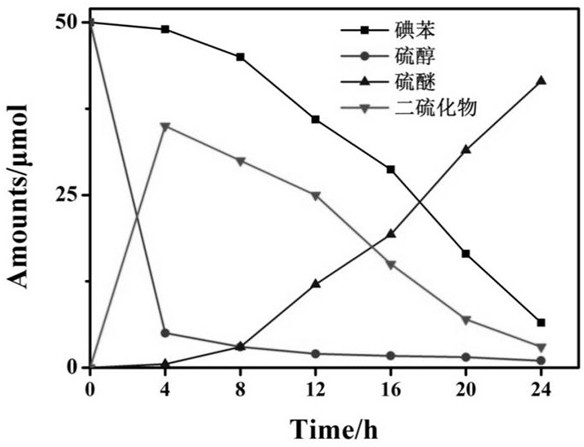
Figure 1 
Figure 2 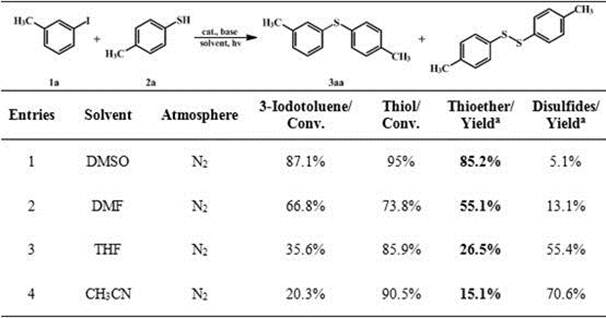
Figure 3
Abstract
Description
technical field
[0001] The invention belongs to the fields of organic chemistry and photocatalysis, and particularly relates to a method for synthesizing thioethers from thiophenols and halogenated aromatic hydrocarbons. Background technique
[0002] Aromatic thioethers are widely found in a variety of biologically active natural products and drugs, including nolatrexide, axitinib, and nelfinavir, among others. In addition, aromatic sulfides are also valuable in drug development, organic material applications, and polymer preparation. Therefore, it is of great significance to explore environmentally friendly and economical methods to synthesize thioethers, especially for the fields of small molecule synthesis and material applications. As far as the traditional method is concerned, the use of transition metal catalysts to catalyze the cross-coupling reaction of thiols and aryl halides is an effective method to realize the construction of C-S bonds to synthesize sulfides. T...
Examples
Embodiment 1
[0025] Using p-toluenethiophenol and 3-methyliodobenzene as substrates, Pd / ZnIn 2 S 4 is a photocatalyst, in N2 Under the atmosphere, dimethyl sulfoxide (DMSO), dimethylformamide (DMF), tetrahydrofuran (THF) and acetonitrile (CH 3 CN) as a solvent, KOH was added, and the reaction was carried out at room temperature and under visible light, and the specific reaction conditions were as described above. The reaction results are shown in the following table, wherein when DMSO is used as the solvent, the conversion rate and thioether yield are significantly higher than other solvents.
[0026] Table 1 Solvent to Pd / ZnIn 2 S 4 Influence of Photocatalytic Coupling Reaction of Thiophenols with Halogenated Iodobenzenes
[0027]
Embodiment 2
[0029] Using p-toluenethiophenol and 3-methyliodobenzene as substrates, Pd / ZnIn 2 S 4 is a photocatalyst, in N 2 Under the atmosphere, dimethyl sulfoxide was used as solvent, KOH was added, and the specific reaction conditions were as described above, and the time distribution diagram of the substrate and different products was made, such as figure 1 shown. The conversion rate of iodobenzene and the yield of target product aryl sulfide increased with time, and the thiol was almost completely converted into disulfide or thiophenol anion at the beginning of the reaction. The yield of disulfides decreased with time, indicating that disulfides would further participate in the reaction, resulting in the formation of sulfide products.
Embodiment 3
[0031] in N 2 Under the atmosphere, using dimethyl sulfoxide as a solvent, under the conditions of room temperature, light and alkali, the halogenated aromatic hydrocarbon is 3-iodotoluene, the reaction substrate thiophenol is explored, and the specific reaction conditions are as described above. The experimental results show that thiophenols with electron-withdrawing group EWG and electron-donating group EDG attached to the benzene ring can react with 3-iodotoluene, but the electronic effect and steric effect have certain influence on the yield of the target product.
[0032] Table 2 Substrate expansion reactions of thiophenols with different substituents
[0033]