
Continuous process for production of scrambled eggs
a technology of continuous process and scrambled eggs, which is applied in the directions of meat/fish preservation by drying, application, transportation and packaging, etc., can solve the problems of uneven cooking of eggs, watery or mushy egg products, and egg products that are not evenly cooked, so as to avoid thermal shock, increase pressure, and uniform firmness
Patent Information
- Authority / Receiving Office
- US · United States
- Patent Type
- Applications(United States)
- Current Assignee / Owner
- Publication Date
- 2004-04-22
- Estimated Expiration
- Not applicable · inactive patent
Smart Images
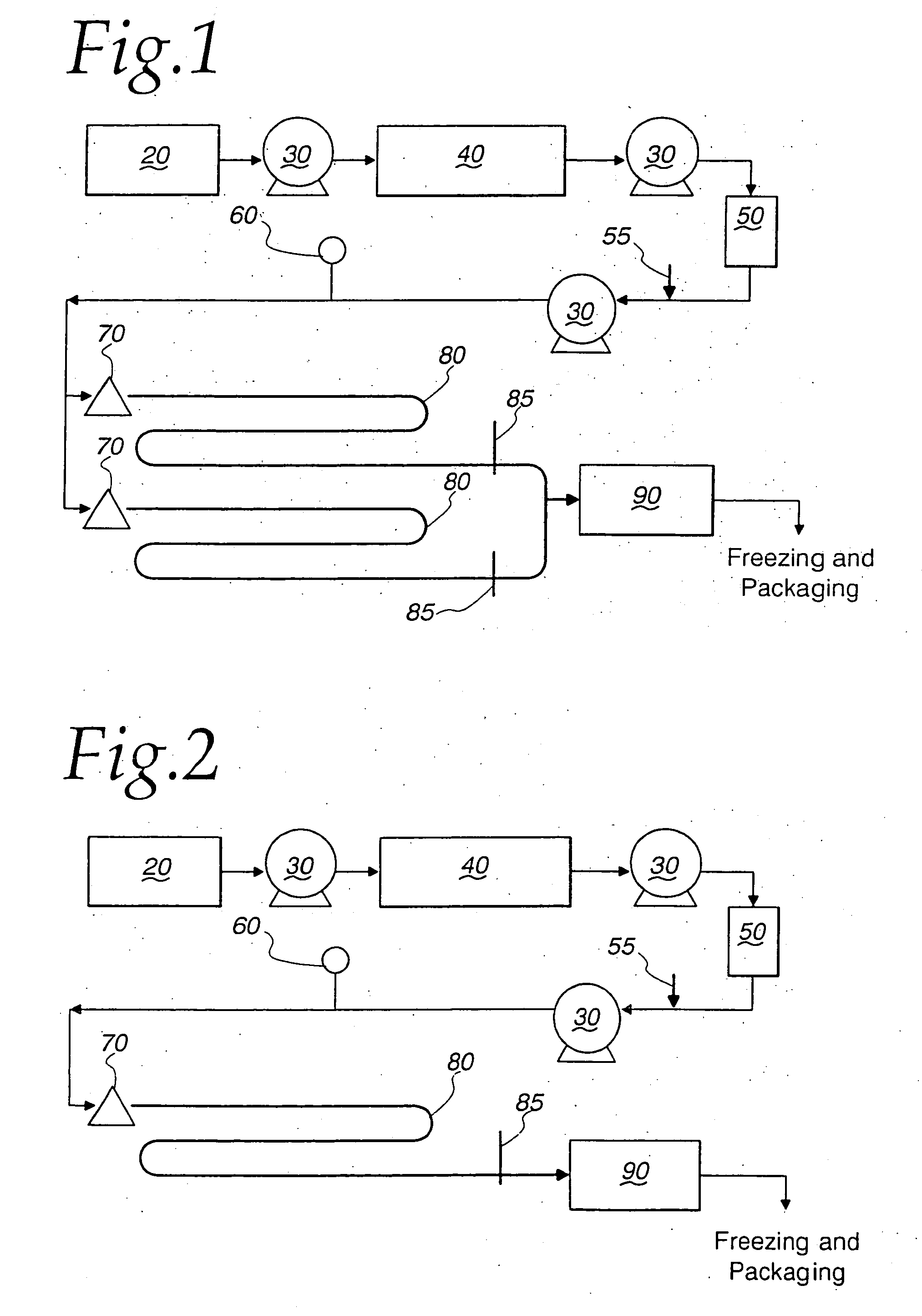
Figure 1 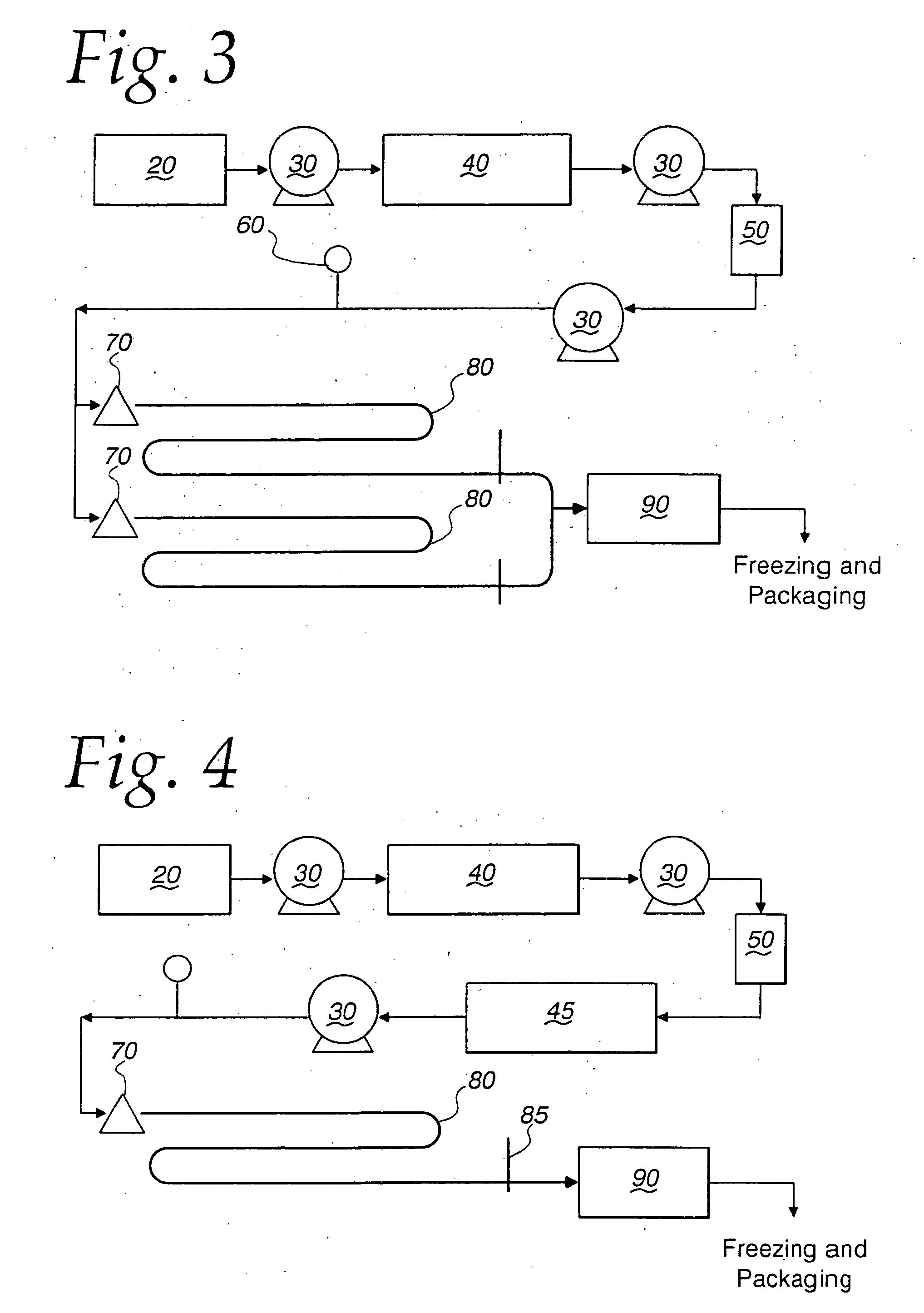
Figure 2 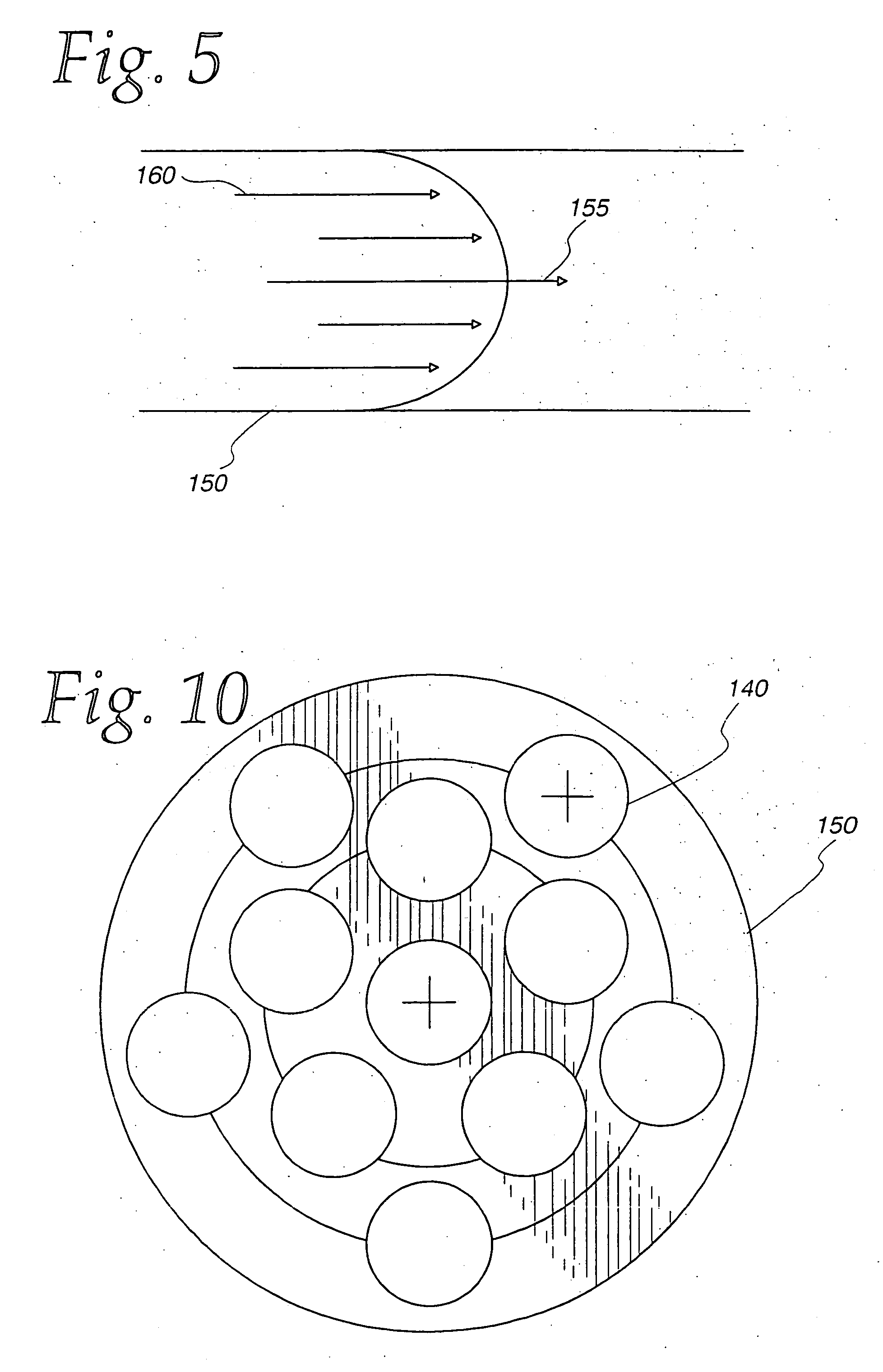
Figure 3
Abstract
Description
[0001] This invention is directed to a process and a system for the production of scrambled eggs. More particularly, process and the system of the invention are directed to producing homogeneous scrambled eggs with a homogenous firmness while minimizing channeling and fouling of holding tubes used to cook the egg product.
[0002] Producing scrambled eggs having a homogeneous firmness at high volumes without channeling or fouling cooking equipment or damaging heating equipment as a result of the fouling has been a problem. During the initial heating of the eggs with a heat exchanger such as a scraped surface heat-exchanger, egg has fouled the heat exchanger even to the extent of breaking the heat exchanger blades.
[0003] Holding tubes where liquid egg is held at elevated temperatures to cook the eggs develop "channeling". This is where laminar flow develops, as egg thickens and / or coagulates at the outer boundaries of the holding tube but tends to stay liquid at the center. In this circ...
Examples
example 1
Scraped Surface Heat Exchanger with Discontinuous Flow
[0056] Liquid whole egg product at a temperature of 40.degree. F. was pumped by use of a positive displacement pump through a water-jacketed tube in tube pre-heater and brought to a temperature of 140.degree. F. The preheated liquid whole egg product was then pumped by means of a positive displacement pump into a scraped surface heat exchanger (SSHE). The dasher contained within the barrel was operated at 270 rpm. Hot water was circulated in the jacket of the SSHE barrel and heat was indirectly transferred to product contained within the barrel. As the liquid whole egg product exited the SSHE at a temperature of about 170.degree. F., it immediately entered one branch of the hold tube. After a period of about 5 minutes, a rotating valve opened to a second 100-foot branch of the holding tube and product was forced into this section of the hold tube. The proteins contained within the liquid whole egg product denatured and coagulatio...
example 2
Steam Injection with Discontinuous Flow
[0068] Liquid whole egg product at a temperature of 40.degree. F. was pumped through the use of a positive displacement pump through a water-jacketed tube in tube pre-heater and brought to a temperature of 140.degree. F. The pre-heated liquid whole egg product was then pumped to the site of steam injection. Forty pounds of steam was introduced into the stream of liquid whole egg product. The pre-heated liquid egg product was flowing at a rate of 2300 pounds per minutes. Immediately adjacent to the point of steam injection, sufficient turbulence was created to incorporate and disperse steam. The liquid whole egg product, at a temperature of about 170.degree. F., immediately entered one branch of the hold tube. After a period of 5 minutes, a rotating 3-way valve opened so that product flows into a second branch of the holding tube. The proteins contained within the liquid whole egg product denature and coagulation occurs within the hold tube. For...
example 3
Scraped Surface Heat Exchanger with Continuous Flow
[0069] Liquid whole egg product at a temperature of 40.degree. F. was pumped through the use of a positive displacement pump through a water-jacketed tube in tube pre-heater and brought to a temperature of 140.degree. F. The preheated liquid whole egg product was then pumped by means of a positive displacement pump into a scraped surface heat exchanger (SSHE). The dasher contained within the barrel was operated at 270 rpm. Hot water was circulated in the jacket of the SSHE barrel and heat was indirectly transferred to product contained within the barrel. As the liquid whole egg product exited the SSHE at a temperature of about 170.degree. F., it immediately entered a hold tube. The proteins contained within the liquid whole egg product denatured and coagulation occurred within the hold tube. At the exit of the hold tube, the fully cooked egg was forced through an extrusion plate. The egg pieces were immediately frozen, packaged in b...