
Liquid crystal display device and liquid crystal production method
Patent Information
- Authority / Receiving Office
- US · United States
- Current Assignee / Owner
- Publication Date
- 2004-06-24
- Estimated Expiration
- Not applicable · inactive patent
Smart Images
Figure 1 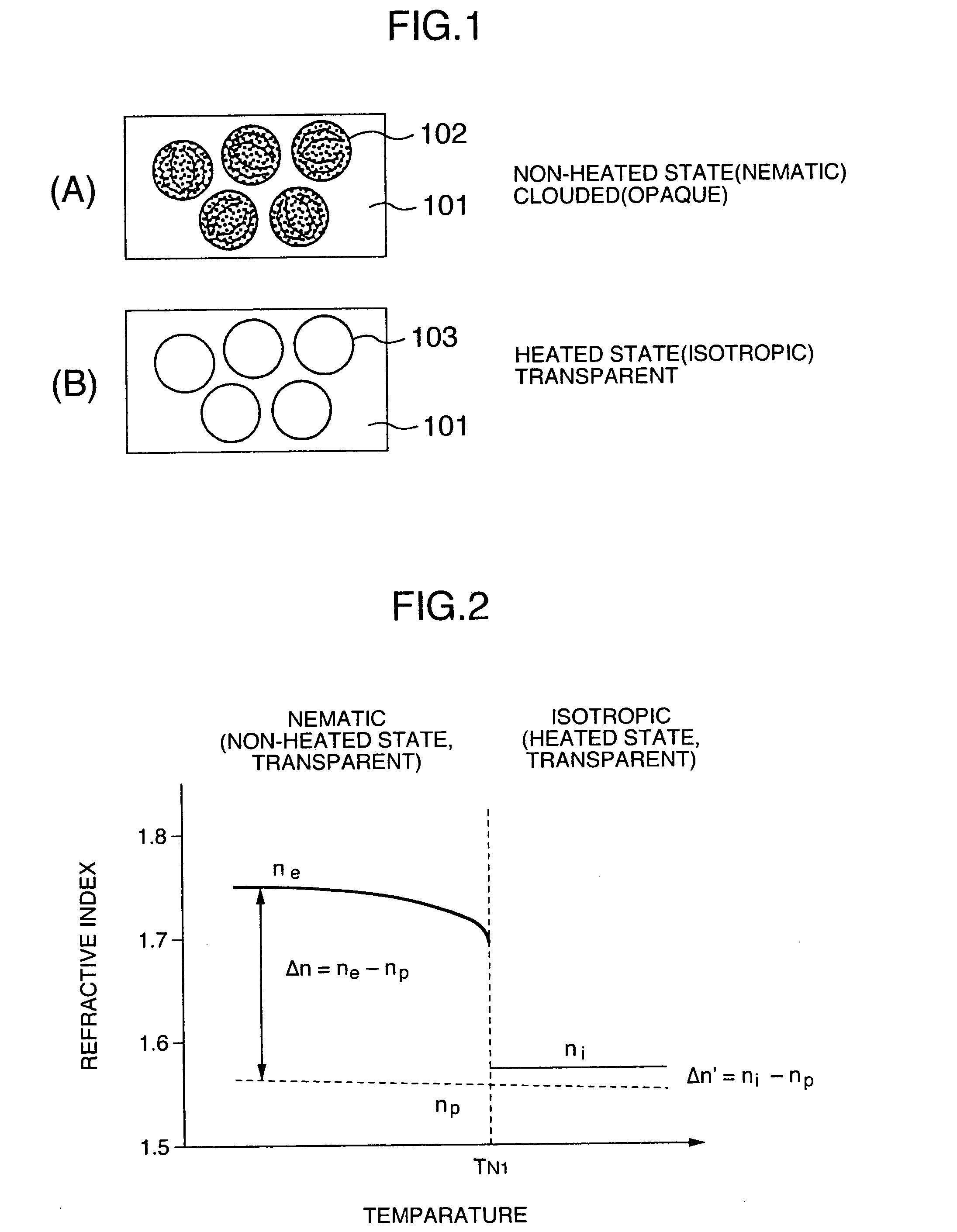
Figure 2 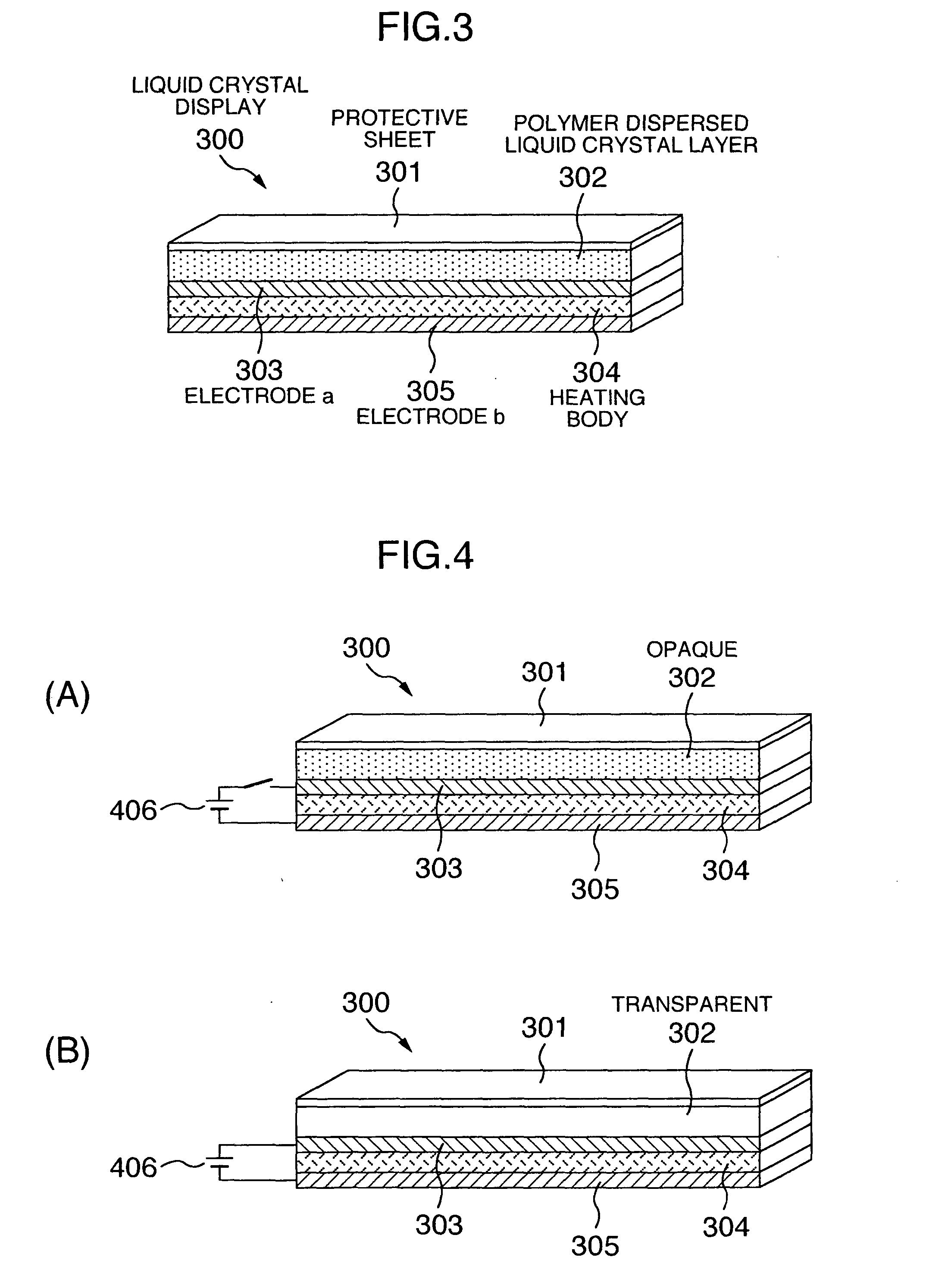
Figure 3
Abstract
Description
[0001] The present invention generally relates to liquid crystal displays, and particularly to a liquid crystal display formed of a polymer dispersed liquid crystal layer having thermooptic effect or thermal response characteristic that includes a liquid crystal material, and a heating unit for driving this polymer dispersed liquid crystal layer.PRIOR ART
[0002] Liquid crystal materials of which the optical characteristics are changed by temperature change have so far been used for the display of images. The liquid crystal materials for the display include smectic liquid crystal, nematic liquid crystal and cholesteric liquid crystal. It is known that these liquid crystal materials become transparent or opaque (clouded) or cause change of color when the molecular orientation of liquid crystal is changed by temperature change.
[0003] On the other hand, display devices using polymer dispersed liquid crystal have been developed. This type of devices have excellent characteristics such as ...
Examples
embodiment 1
[0108] To produce the liquid crystal display 300 of the structure of FIG. 3, polyvinyl butyral (T.sub.g=50.degree. C.) was used as the polymer, and nematic liquid crystal (T.sub.NI=72.degree. C., .DELTA.n=0.246) as the liquid crystal. The weight ratio of the polymer and liquid crystal was 1:1. Then, the same conditions and operations as in the embodiment 1 were used and performed to produce a liquid crystal cell C.
embodiment 3
[0115] Embodiment 3
[0116] The following materials were mixed and well stirred with a homogenizer at room temperature for 15 minutes to produce a polymer dispersed liquid crystal composition solution.
[0117] Polymer: polymethyl methacrylate . . . 5 weight part
[0118] Liquid crystal: cyanobiphenyl-based E-8
[0119] made by B.D.H. Corp . . . 5 weight part
[0120] Solvent: acetone . . . 90 weight part
[0121] This mixture solution was coated on a PET film by an applicator to form a polymer dispersed liquid crystal film 15 .mu.m thick. The thickness of the liquid crystal layer was increased by superimposing liquid crystal films according to the lamination method of the invention. The lamination of liquid crystal films was made by compression bonding at 80.degree. C. for one minute on the apparatus, TOLAMI-DX-350 that came onto the market from Tokyo Laminex Corp. Various different samples were prepared by changing the number of laminated liquid crystal films, and the transmission factors of those...