
Tetracarboxylic acid diester compound, polyimide precursor polymer and method for producing the same, negative photosensitive resin composition, positive photosensitive resin composition, patterning process, and method for forming cured film
Patent Information
- Authority / Receiving Office
- US · United States
- Current Assignee / Owner
- Publication Date
- 2017-10-19
Smart Images
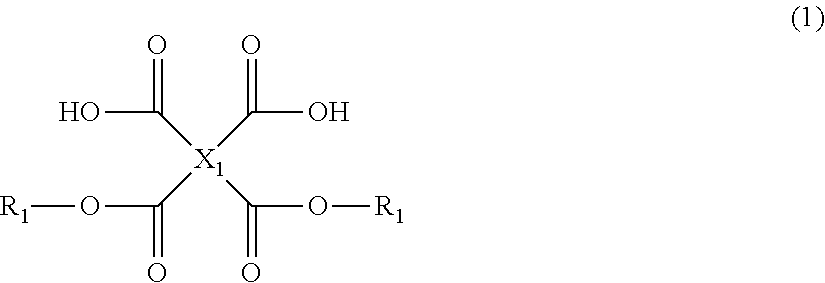
Figure 1 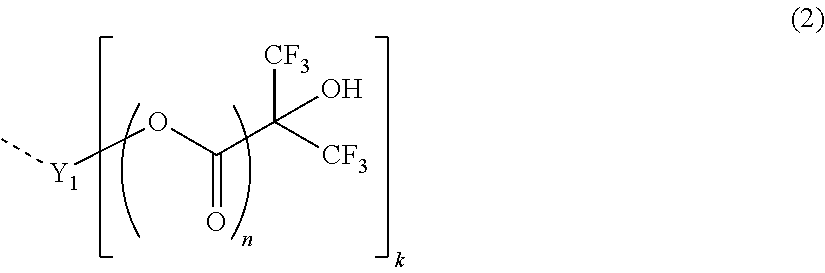
Figure 2 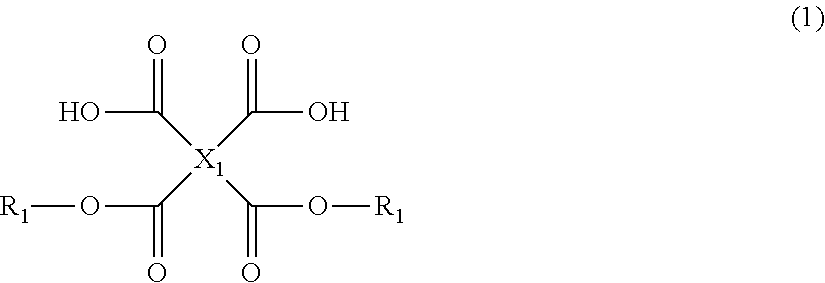
Figure 3
Abstract
Description
BACKGROUND OF THE INVENTIONField of the Invention
[0001] The present invention relates to a tetracarboxylic acid diester compound useful as a structural unit of a polyimide precursor polymer, a polyimide precursor polymer obtained by using the tetracarboxylic acid diester compound, a method for producing the same, a negative photosensitive resin composition and a positive photosensitive resin composition using the polyimide precursor polymer as their base resin, a patterning process using the negative photosensitive resin composition or the positive photosensitive resin composition, and a method for forming a cured film.Description of the Related Art
[0002] As various electronic devices including a personal computer, a digital camera, and a mobile phone progress toward downsizing and higher performance, requirements are rapidly increasing for further downsizing, thinning, and densifying in semiconductor devices. It is thus desired to develop a photosensitive insulating material that can...
Examples
examples
[0279]Hereinafter, the present invention will be specifically described with reference to synthesis examples, comparative synthesis examples, examples, and comparative examples, but the present invention is not limited to the following examples.
I. Synthesis of Polyimide Precursor Polymer Having Hexafluoroisopropanol Group
[0280]Chemical structural formulae of compounds used in the following synthesis examples are shown below.
[Synthesis Example 1] Synthesis of Tetracarboxylic Acid Diester Compound
[0281]A 3 L flask equipped with a stirrer and a thermometer was charged with 100 g (322 mmol) of 3,3′,4,4′-oxydiphthalic dianhydride (s-ODPA), 127.6 g (644 mmol) of a compound having a hexafluoroisopropanol, group (HF-1), and 400 g of γ-butyrolactone. To this solution was added 2.5 g (16 mmol) of 1,8-diazabicycloundecene under stirring at room temperature, and the solution was further stirred at room temperature for 24 hours. Then, 5.8 g of 10% hydrochloric acid aqueous solution was added dro...
synthesis example 2
[Synthesis Example 2] Synthesis of Polyimide Precursor Polymer (A-1)
[0284]In a similar manner, a 3 L flask equipped with a stirrer and a thermometer was charged with 100 g (322 mmol) of 3,3′,4,4′-oxydiphthalic dianhydride (s-ODPA), 127.6 g (644 mmol) of a compound having a hexafluoroisopropanol group (IF-1), and 400 g of γ-butyrolactone. To this solution was added 2.5 g (16 mmol) of 1,8-diazabicycloundecene under stirring at room temperature, and the solution was further stirred at room temperature for 24 hours. Then, 78.5 g (660 mmol) of thionyl chloride was added dropwise to the resulting solution under ice-cooling while maintaining the reaction solution temperature at 10° C. or less. After dropwise addition, the solution was stirred for 2 hours under ice-cooling. Then, a solution in which 58 g (290 mmol) of 4,4′-diaminodiphenyl ether (ODA), 1.8 g (16 mol) of 4-aminophenol (AP), and 104.4 g (1,320 mmol) of pyridine have been dissolved in 239 g of γ-butyrolactone was added dropwise...
synthesis example 3
[Synthesis Example 3] Synthesis of Polyimide Precursor Polymer (A-2)
[0286]The following polyimide precursor polymer (A-2) was obtained in the same manner as in Synthesis Example 2 except that 3,3′,4,4′-oxydiphthalic dianhydride (s-ODPA) was changed to 100 g (322 mol) of 2,3,3′,4′-oxydiphthalic dianhydride (a-ODPA). When the molecular weight of this polymer was measured by GPC, the weight average molecular weight was 16,200 in terms of polystyrene.
[0287]In the obtained polymer (A-2), the introduction amount of the hexafluoroisopropanol group was 0.23 mol with respect to 1.00 g of the polymer.