
User selectable hardware zoom in a video display system
a video display system and user-selected technology, applied in static indicating devices, instruments, cathode-ray tube indicators, etc., can solve the problem that the hardware zoom does not provide for a user-defined magnification ratio to be used
Patent Information
- Authority / Receiving Office
- US · United States
- Patent Type
- Applications(United States)
- Current Assignee / Owner
- Publication Date
- 2006-03-09
- Estimated Expiration
- Not applicable · inactive patent
Smart Images
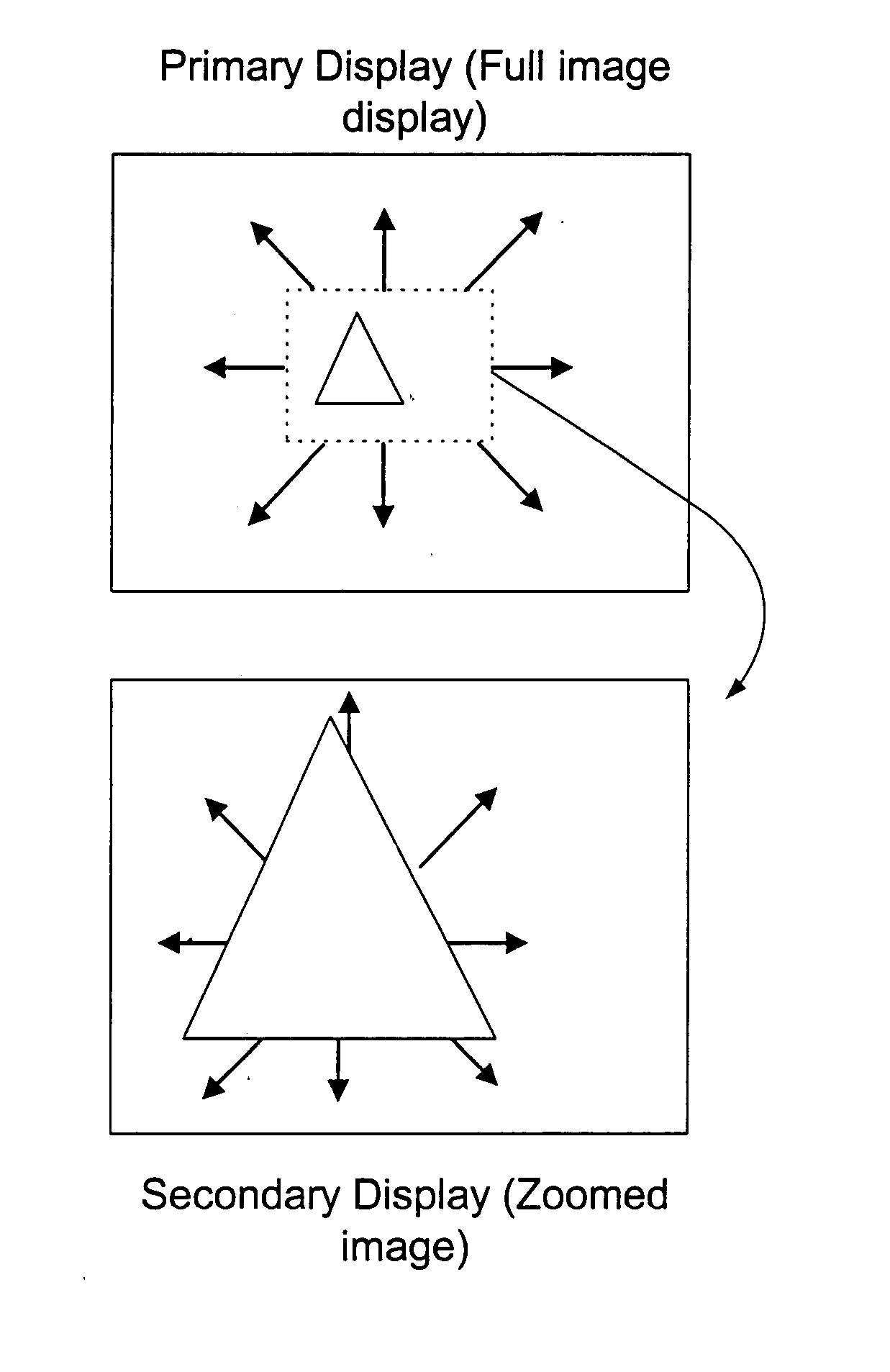
Figure 1 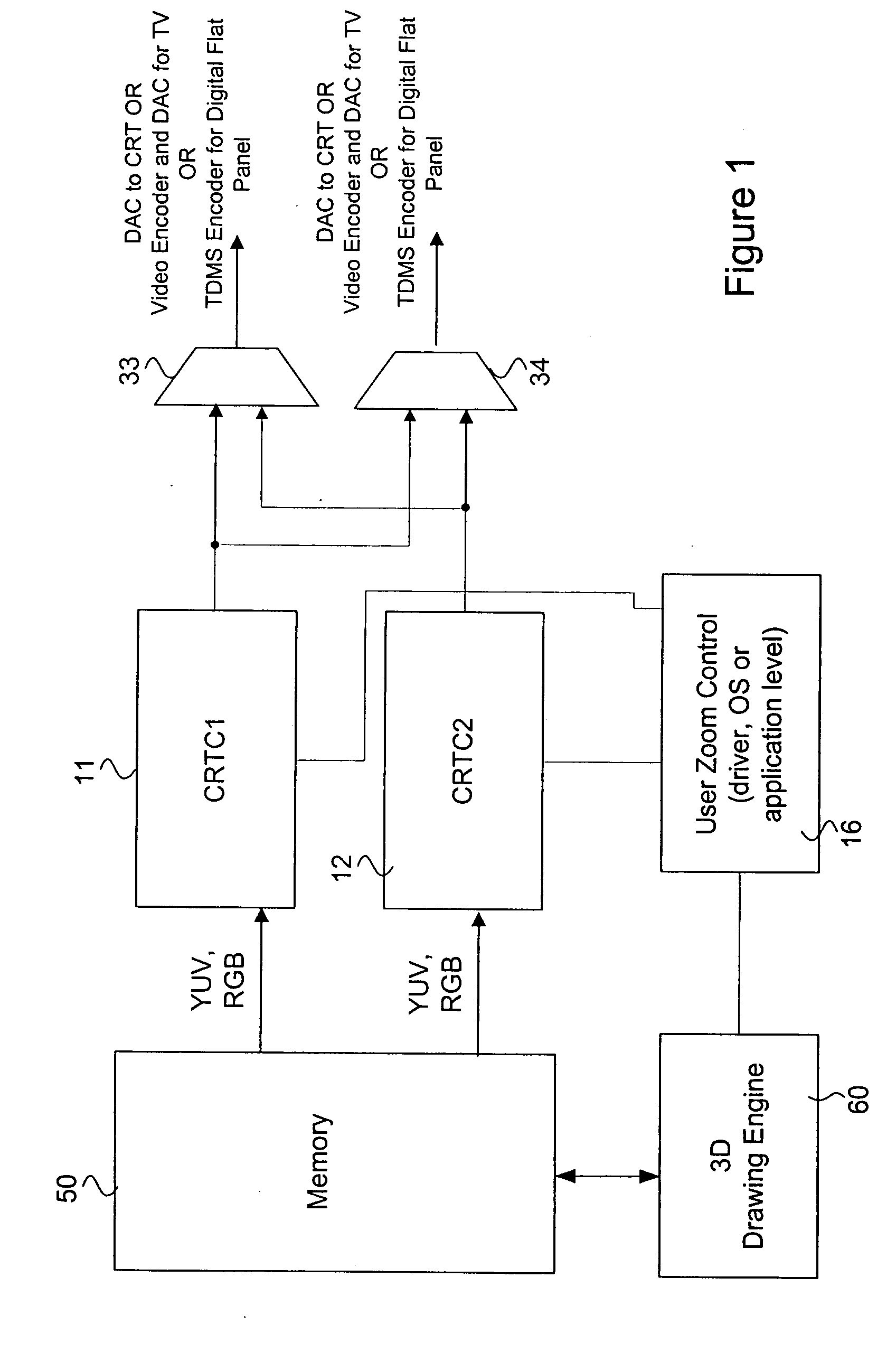
Figure 2 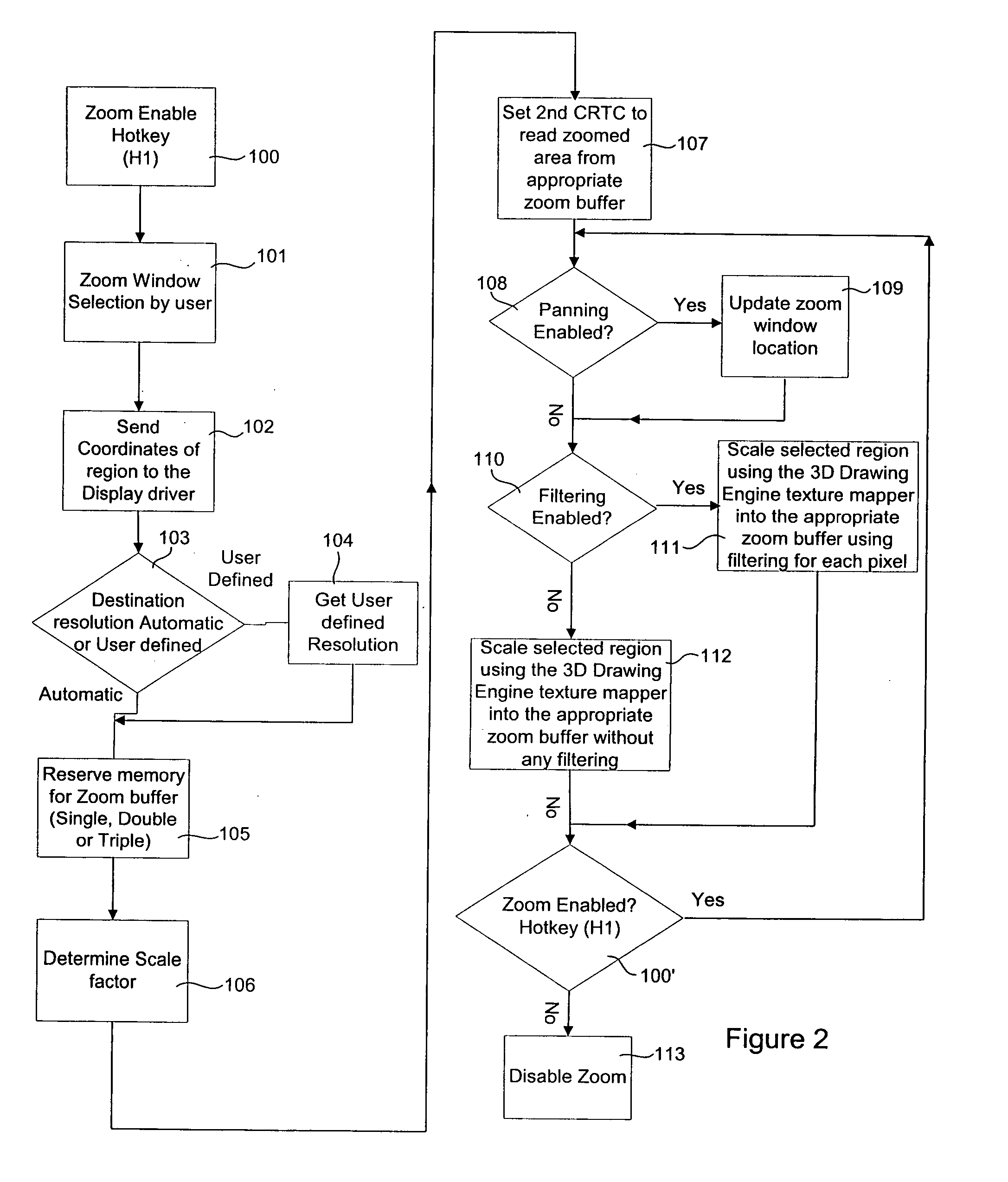
Figure 3
Abstract
Description
CROSS-REFERENCE TO RELATED APPLICATIONS
[0001] The present application is a continuation of U.S. patent application Ser. No. 09 / 526,441, filed on Mar. 16, 2000, the contents of which are hereby incorporated by reference.FIELD OF THE INVENTION
[0002] The present invention relates to a method and associated apparatus for providing a user selectable hardware zoom in a video display system. BACKGROUND OF THE INVENTION
[0003] Computers are important tools in today's society, and the computer display is an essential component of one's workspace. The importance of computer displays for the efficiency of work is demonstrated by the presence of larger displays and multiple displays when the display “real estate” becomes important to one's work. In some cases, larger displays allow for more “real estate” to be displayed. Dual displays are usually driven by independent display controllers, and the operating system (e.g. Windows 98™) is informed that the “desktop” or display surface is to be di...
Examples
Embodiment Construction
[0028] In the first preferred embodiment, two independent display controllers (a primary display and a secondary display controller) are each able to generate a stream of pixel data and associated synchronization signals (syncs) from pixel data contained in a display memory (surfaces). The two display controllers can drive a variety of output ports including any combination of RGB D / A converters, video encoder, and TDMS Panel Link or LCD interface. This permits many display combinations such as but not limited to two RGB monitors, two TV monitors, two flat panel displays or any mix of them.
[0029]FIG. 1 shows a high level block diagram of the preferred embodiment. Two CRTC's 11 and 12 are capable of fetching one or more display surfaces from a single frame buffer memory (50) which can be SGRAM, SDRAM, or any other type of Random Access Memory (RAM). Each CRTC may also contain one or more backend scalers that allows the input surfaces to be re-scaled. While, within the context of the...