
Therapeutic compositions for intranasal administration of ketorolac
a technology of intranasal administration and therapeutic compositions, which is applied in the direction of drug compositions, biocide, heterocyclic compound active ingredients, etc., can solve the problems of stinging or irritation, eye watering, stinging, etc., and achieve the effect of reducing the risk of recurrence, and improving the effect of recurren
Patent Information
- Authority / Receiving Office
- US · United States
- Patent Type
- Applications(United States)
- Current Assignee / Owner
- Publication Date
- 2009-02-12
- Estimated Expiration
- Not applicable · inactive patent
Smart Images
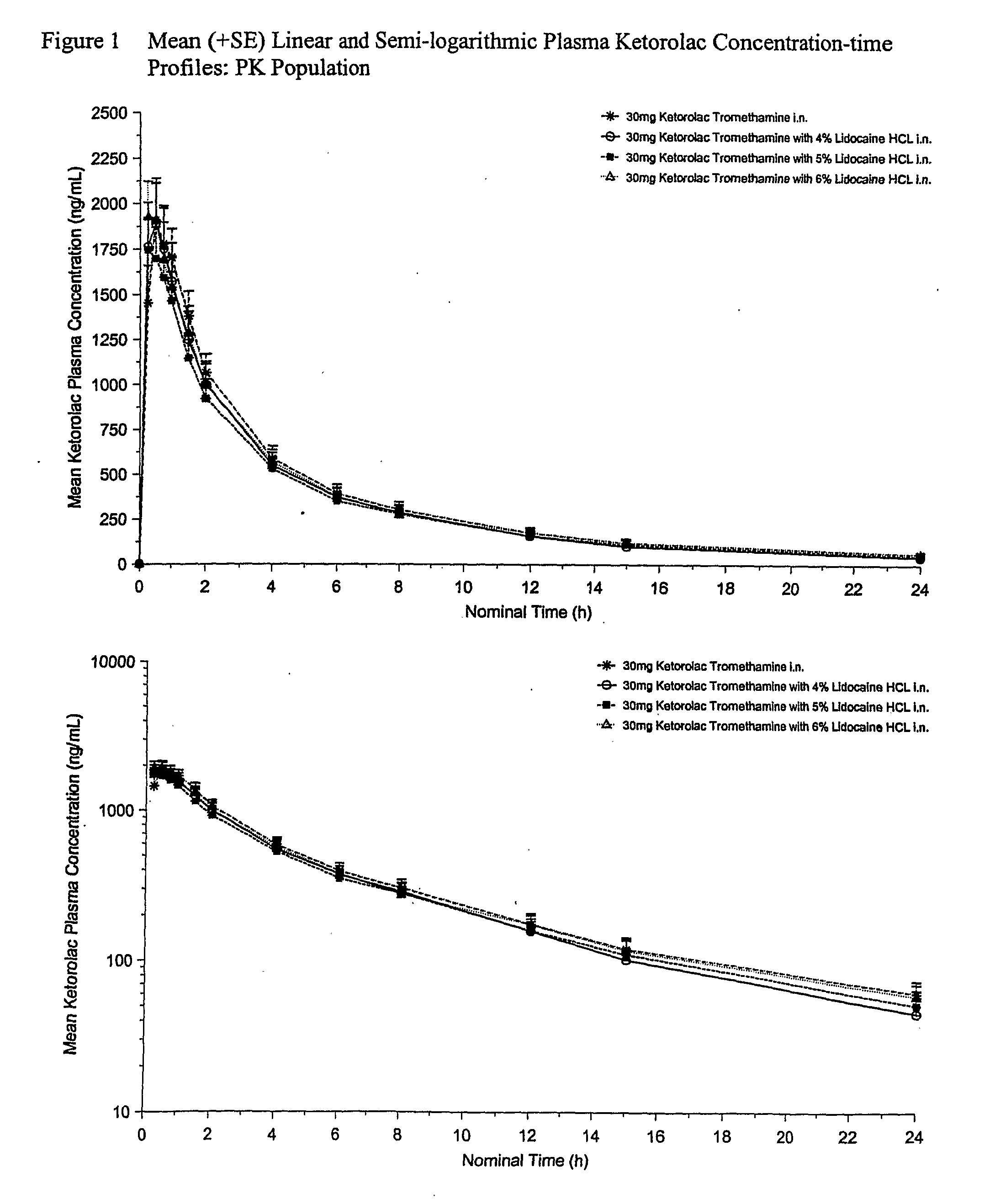
Figure 1 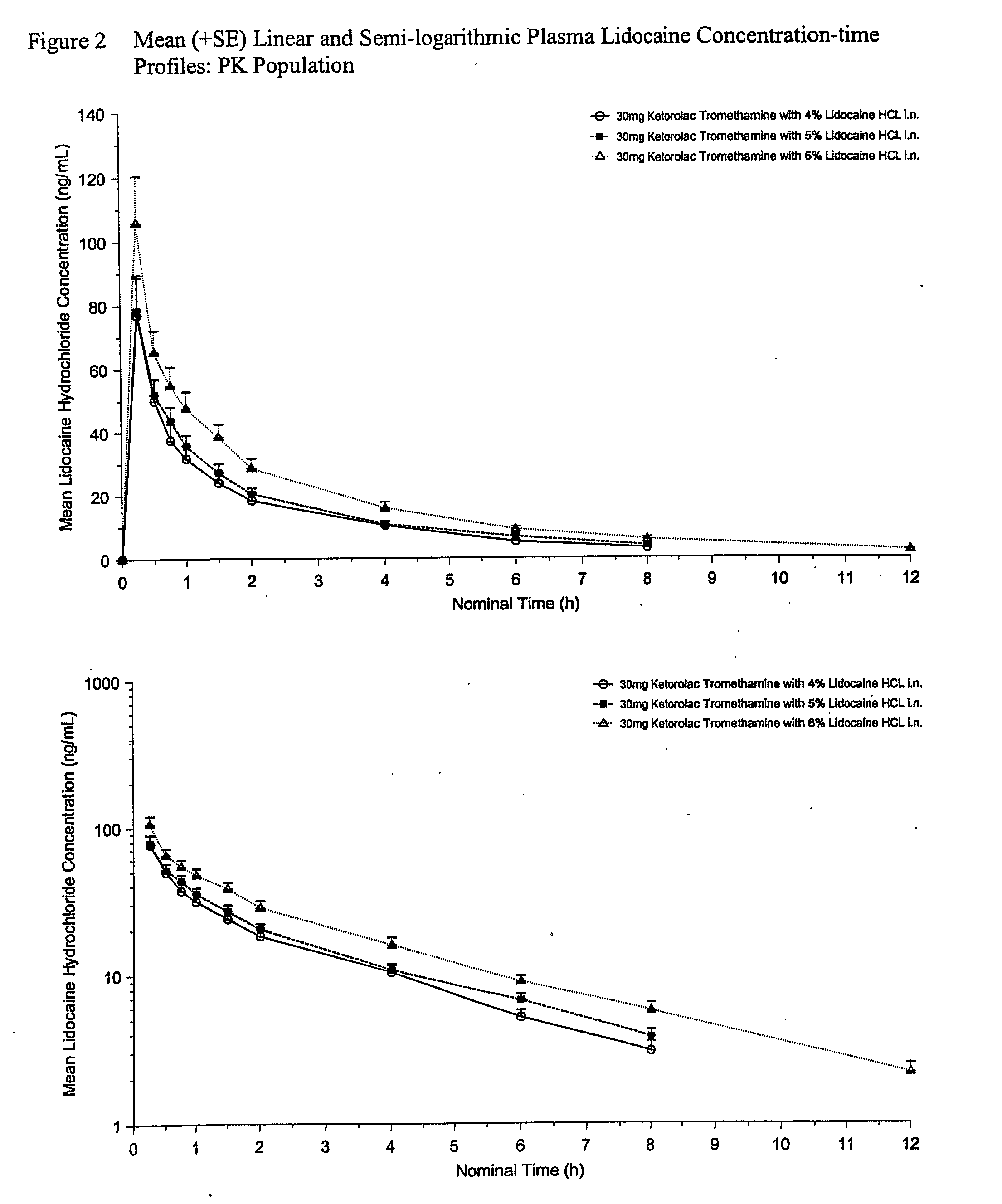
Figure 2 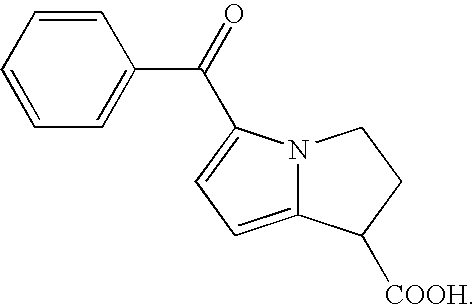
Figure 3
Abstract
Description
FIELD OF THE INVENTION
[0001] This invention relates to therapeutic compositions with analgesic and anti-inflammatory activity, suitable for intranasal administration, which include ketorolac or its pharmaceutically acceptable salts as the active ingredient and a local anesthetic to reduce the sensation of stinging and to improve efficacy. This invention also relates to a therapeutic method that provides for the nasal administration of the composition to a subject to treat pain, wherein the subject has a reduced sensation of stinging and the efficacy is improved compared to a known composition.BACKGROUND OF THE INVENTION
[0002] Ketorolac or 5-benzoyl-2,3-dihydro-1H-pyrrolizine-1-carboxylic acid has the following formula (I):It has been known for several years (U.S. Pat. No. 4,089,969) and is used in human therapy as an analgesic and an anti-inflammatory as the tromethamine salt. U.S. Pat. No. 4,089,969 is incorporated herein by reference.
[0003] Both the racemic form and each of the dextr...
Examples
example 1
[0066]This example provides a description for making compositions for nasal administration in accordance with the invention. A solution was prepared in accordance with the proportions shown in Table 1. Lidocaine hydrochloride was added to the solution to give the compositions of the invention shown in Table 2.
TABLE 1Ketorolac tromethamine, USP 15%Sodium EDTA, NF0.02%Potassium phosphate, NF(q.s. to pH 7.2)Water for Injection USP (q.s.)100 g
TABLE 2IngredientsIIIIIIKetorolac tromethamine, USP 15% 15% 15%Sodium EDTA, NF0.02%0.02%0.02%Potassium phosphate, NF (q.s. to pH 7.2)Lidocaine hydrochloride 4% 5% 6%Water for Injection USP (q.s.)100 g100 g100 6
example 2
[0067]This example provides a description of a phase I clinical study (a double-blind, randomized 4-way crossover) carried out to determine, i.a., if the presence of lidocaine hydrochloride in nasally administered formulations of ketorolac has any adverse effect on the PK profile of ketorolac. The results show that the PK characteristics are improved in the preferred formulations (5-6% w / v) by the presence of the anesthetic lidocaine hydrochloride, and otherwise not adversely affected. In addition, the safety and tolerability data for the formulations were evaluated.
[0068]The clinical study included 16 healthy volunteers who were recruited for the study in which each volunteer received 4 nasally administered spray formulations, three of which are compositions that represent an aspect of the invention. There was a wash-out period of 3-7 days between each dose. The four aqueous spray compositions were prepared as follows:
KT(1)L(2)NaEDTA(3)KPO4(4)Water(5)A:15%0 0.02%pH 7.2100 gB:15%4%0...
example 3
[0073]This example describes a study for postoperative patients to compare the safety, tolerability, and pharmacokinetics (PK) of 3 formulations of intranasal (IN) ketorolac tromethamine.
[0074]The study is a double-blind, parallel study in postoperative patients. Subjects receive 1 of 3 formulations of IN ketorolac tromethamine 30 mg or placebo. Two of the formulations are preferred formulations according to this inventions. The study includes enrolling fifteen subjects in each group for a total of 60 subjects. Each formulation is administered to each subject IN (one spray into each nostril).
[0075]Postoperative patients suitable for the study include patients age 18 through 60 years, with body weight within 20% of ideal body weight as per the MetLife height and weight tables for men and women (version 1999).
[0076]Subjects are randomly assigned to receive either:[0077]Treatment A (a composition known in the art)—single IN dose of 30 mg ketorolac tromethamine (one spray into each nost...