
Method and apparatus for pyrolysis-induced cleavage in peptides and proteins
Patent Information
- Authority / Receiving Office
- US · United States
- Current Assignee / Owner
- Publication Date
- 2011-04-14
Smart Images
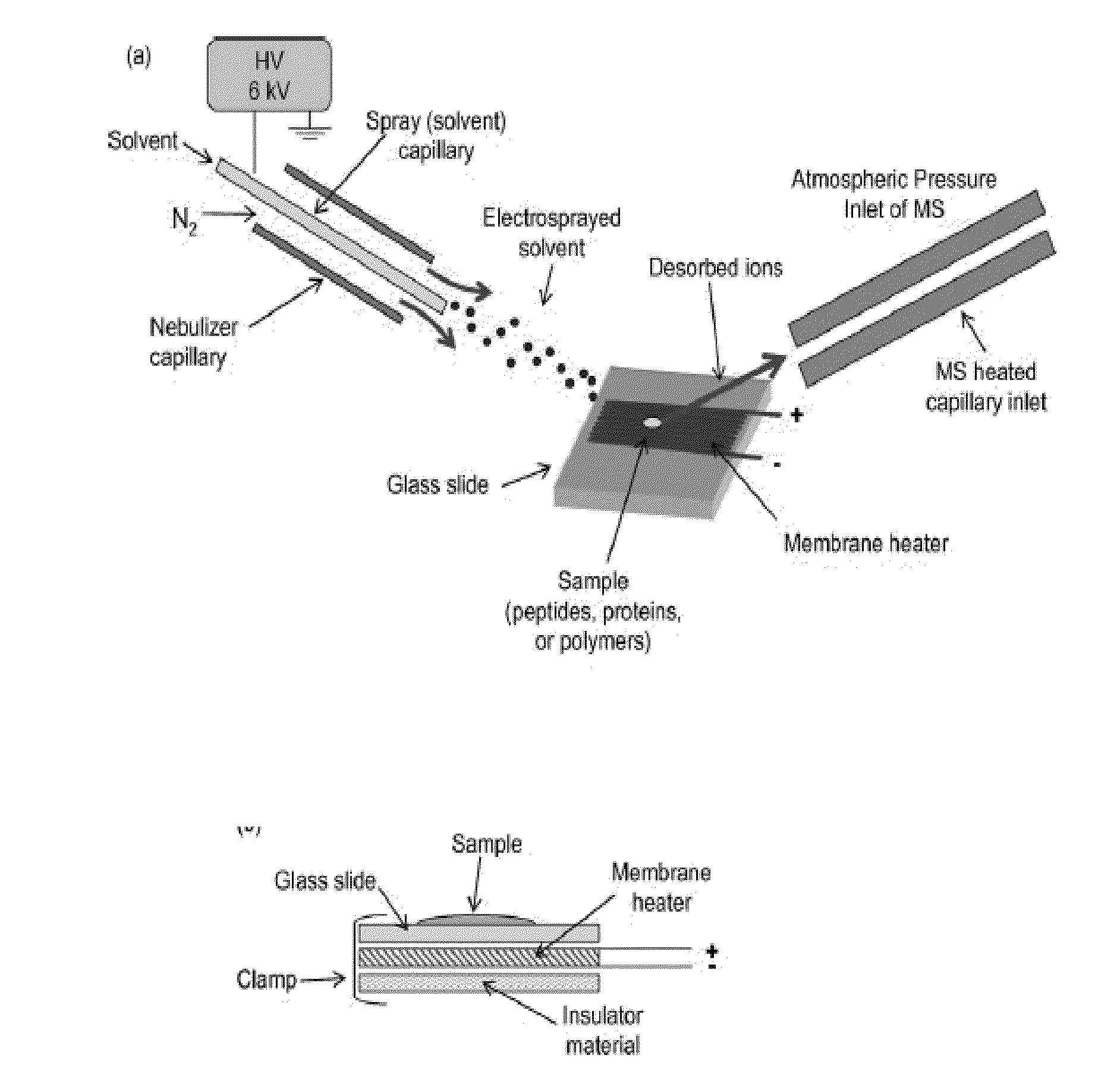
Figure 1 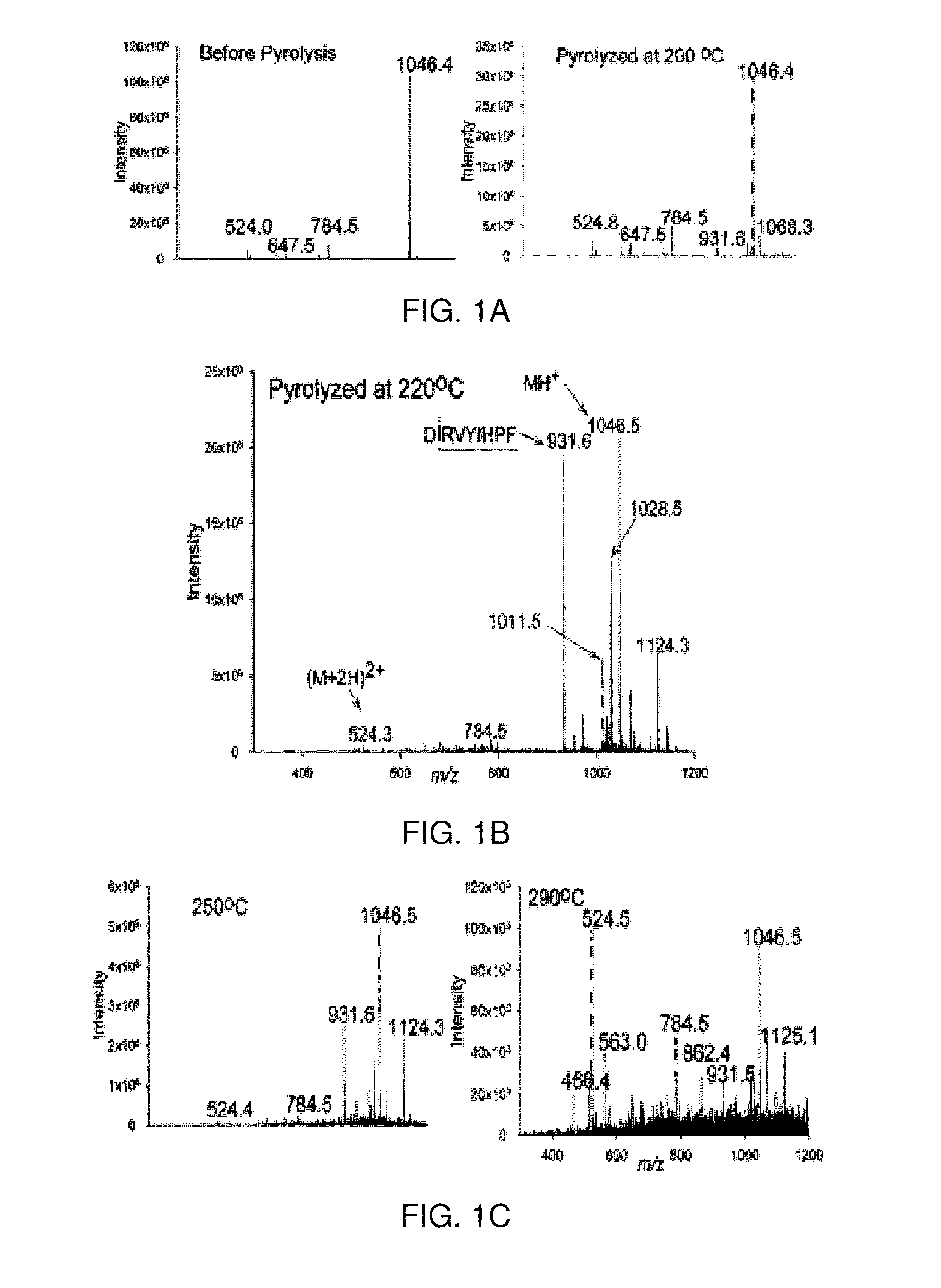
Figure 2 
Figure 3
Abstract
Description
[0001] This application is a continuation-in-part of U.S. patent application Ser. No. 12 / 307,538, filed Jan. 5, 2009.
[0002] The United States Government has rights in this invention under National Institutes of Health—National Center for Research Resource (R15-RR020354-01A1) and United States Department of Agriculture (USDA Grant #448800).BACKGROUND OF THE INVENTION
[0003] The invention relates generally to pyrolysis-induced cleavage of peptides and proteins and, more specifically, to a simple and site-specific nonenzymatic method based on pyrolysis has been developed to cleave peptides and proteins.
[0004] Pyrolytic cleavage is found to be specific and rapid as it induced a cleavage at the C-terminal side of aspartic acid, at the N-terminal side of csyeine and at disulfide bonds in the temperature range of 220-250° C. in 10 s. Electrospray ionization (ESI) mass spectrometry (MS) and tandem-MS (MS / MS) were used to characterize and identify pyrolysis cleavage products, confirming that sequ...
Examples
example 1
Pyrolysis-Induced Cleavage at Aspartic Acid Residue in Peptides and Proteins
[0047]Chemicals. Peptides used were: (A) Angiotensin II, human, DRVYIHPF (SEQ ID NO. 1); (B) VIP (1-12) peptide, HSDAVFTDNYTR (SEQ ID NO. 2); and (C) VSV-G peptide, YTDIEMNRLGK (SEQ ID NO. 3) (all from AnaSpec, San Jose, Calif.). Lysozyme protein (from Sigma-Aldrich, St. Louis, Mo.) was used without further purification. All solvents used for sample preparation and MS measurements were HPLC grade (Burdick & Jackson, Muskegon, Mich.), and the formic acid (96%) was ACS Reagent grade (Aldrich, St. Louis, Mo.).
[0048]Pyrolyzer Design and Pyrolysis Procedure. Approximately a 1 mg solid sample of peptide or protein was pyrolyzed under ambient conditions. Samples were placed in a glass tube (length 31 mm and internal diameter 4 mm; Agilent, Santa Clara, Calif., Part #5180-0841) and heated using a resistance heating wire (Omega, Stamford, Conn., nickel-chromium wire, part #NI60-015-50, length 20 cm) enwound around th...
example 2
Pyrolysis Device and Procedures
[0059]A diagram of the on-probe pyrolyzer interfaced to the DESI source is shown in FIG. 6A. A homebuilt DESI source was interfaced with a quadrupole ion trap MS (LCQ Classic, Thermo Electron, San Jose, Calif.) and was operated in the positive ion mode. The on-probe pyrolyzer consisted of a membrane heater (Model #HM6815, Minco, Minneapolis, Minn.) placed underneath a removable glass slide held tightly together with a clamp (FIG. 6B). The sample to be pyrolyzed was placed directly on the center of the glass slide. The membrane heater was powered by alternating current (AC) from a transformer (Model #3PN116C, Superior Electric, Farmington, Conn.) and heating and final pyrolysis temperature were controlled by adjusting the voltage of the transformer and the heating time. For our current setup, a voltage of 20 V applied for 11 s resulted in a final pyrolysis temperature of 220° C. These values for pyrolysis temperature and time were used for all biologica...
example 3
On-Probe Pyrolysis DESI-MS Analysis of Biomolecules
[0064]As described in Example 1, the site-specific pyrolysis-induced cleavage at the amino acid aspartic acid (letter symbol “D”) in both peptides and proteins has been achieved by heating samples to a temperature of 220-250° C. for 10 s under atmospheric pressure conditions. Peptides and proteins in this previous study were pyrolyzed in an open-ended tube furnace, extracted with a suitable solvent and analyzed by ESI-MS and MS / MS to characterize and identify non-volatile pyrolysis cleavage products. In this Example, the same samples were pyrolyzed on-probe and products were analyzed in situ by DESI-MS, bypassing the sample extraction, transfer, and ESIinfusion steps. In the ESI-MS study and the DESI-MS study here described, pyrolysis of peptides and proteins above 300° C. produced complete charring of the polypeptide backbone.
[0065]Pyrolysis induced site-specific cleavage at aspartic acid has was observed mostly at low temperature ...