
Metal-sulfur electrode for lithium-sulfur battery and preparing method thereof
Patent Information
- Authority / Receiving Office
- US · United States
- Current Assignee / Owner
- Publication Date
- 2013-05-23
Smart Images
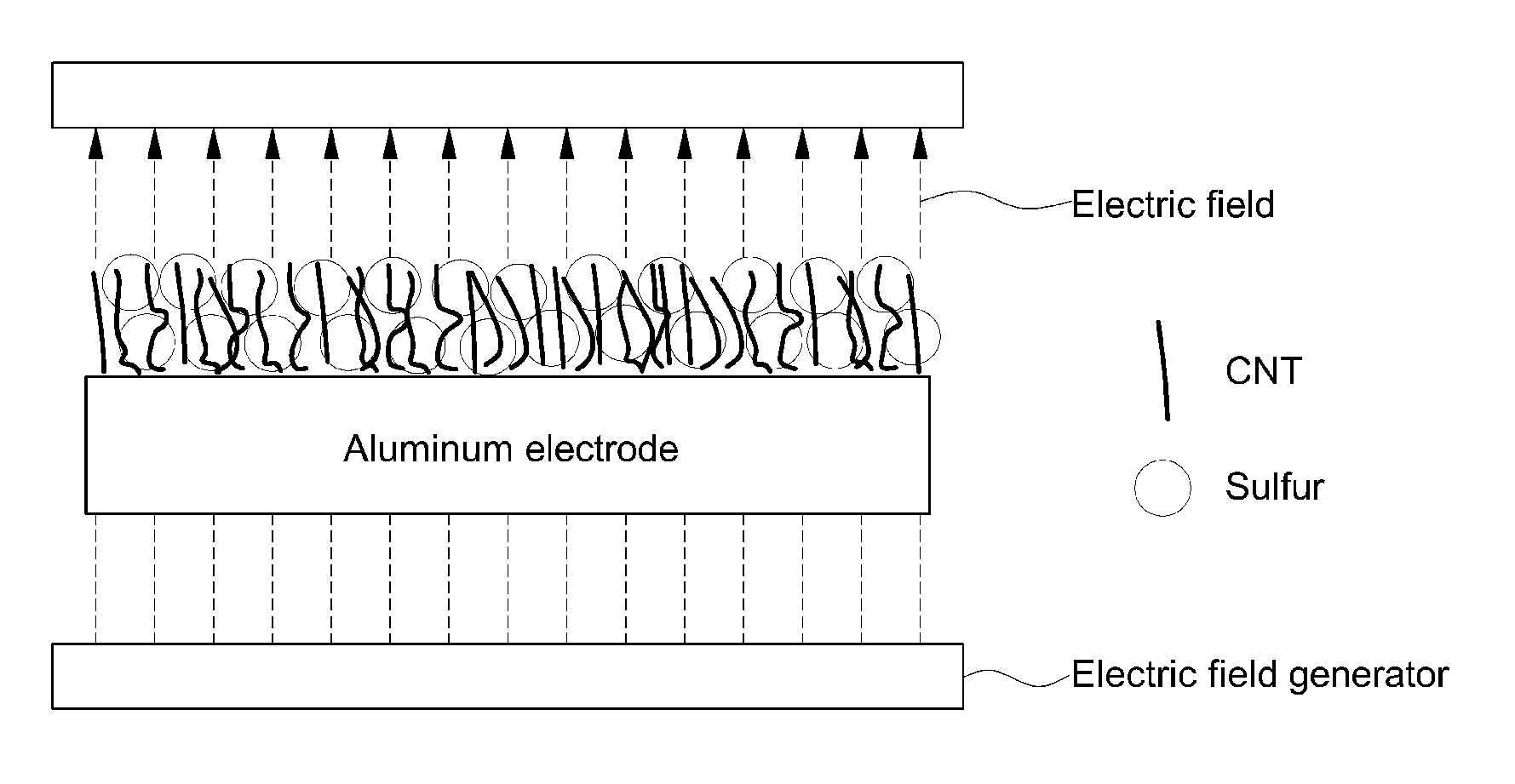
Figure 1 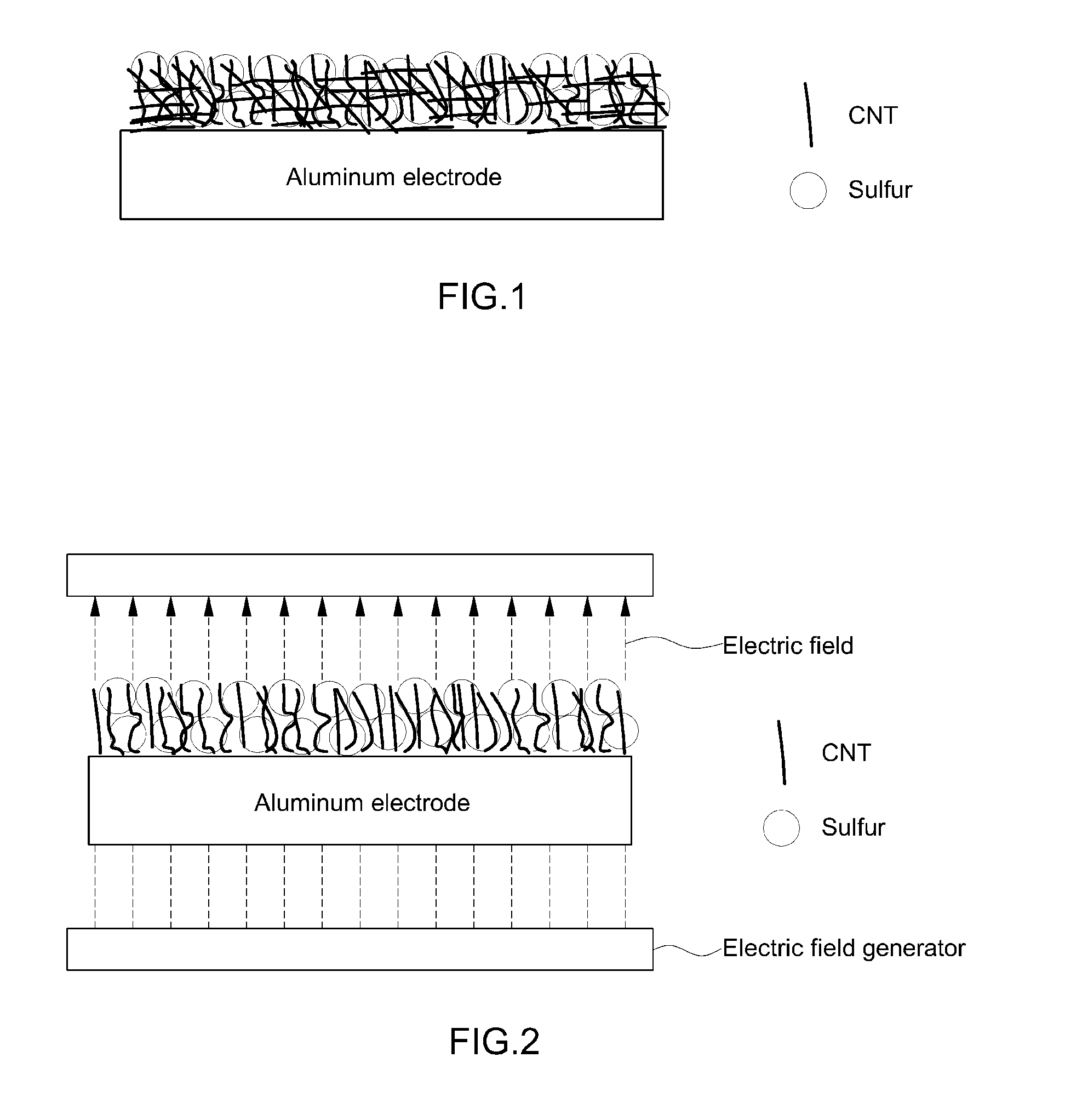
Figure 2
Abstract
Description
CROSS-REFERENCE TO RELATED APPLICATIONS
[0001] This application claims priority under 35 U.S.C. §119 to Korean Patent Application No. 10-2011-0122478, filed on Nov. 22, 2011, in the Korean Intellectual Property Office, the disclosure of which is incorporated herein by reference in its entirety.BACKGROUND
[0002] (a) Technical Field
[0003] The present invention relates to a metal-sulfur electrode for a lithium-sulfur battery and a method for preparing the same. More particularly, it relates to a metal-sulfur electrode for a lithium-sulfur battery prepared by coating a slurry mixture including sulfur, a conductive material and a binder as an electrode active material on a metal electrode and drying the same while applying an electric field so that the conductive material is aligned adequately so as to provide maximized efficiency during repetitive charging and discharging when used in the anode of the lithium-sulfur battery.
[0004] (b) Background Art
[0005] Metal-sulfur electrodes are typically ...
Examples
examples
[0036]The example and test example will now be described. The following examples are for illustrative purposes only and not intended to limit the scope of this invention.
example
[0037]To prepare an anode with controlled directionality of a conductive material, 80% of sulfur (100 mesh, Aldrich), 10% of carbon nanotube (Hanwha Chemical) and 10% of a binder (PVdF, Kynar) were mixed in a solvent (NMP, Aldrich) and milled at 600 rpm for 12 hours using a planetary mill to prepare a slurry, which was coated on an aluminum electrode to about 50 μm thickness using a doctor blade and dried for 12 hours while applying an electric field using an electric field generator. The drying was performed slowly at room temperature under a strong electric field. Subsequently, the slurry was further dried in an oven at 50-80° C. to evaporate the remaining solvent. A unit cell was prepared by disposing a porous separator (Celgard 2325, Celgard) between the resulting anode with controlled directionality of the conductive material and a lithium cathode and coating an electrolyte [1M LiCF3SO3 / 0.5M LiTFSI+DME (1,2-dimethoxyethane, anhydrous, 99.5%), Aldrich] over the entire structure....