

Flexible Metal Polymer Composites
a technology of metal polymer and composites, applied in the field of flexible composites, can solve the problems of overly burdensome techniques for creating fine details, heavy or too expensive objects to make of solid metal,
Patent Information
- Authority / Receiving Office
- US · United States
- Patent Type
- Applications(United States)
- Current Assignee / Owner
- Publication Date
- 2018-01-11
Smart Images
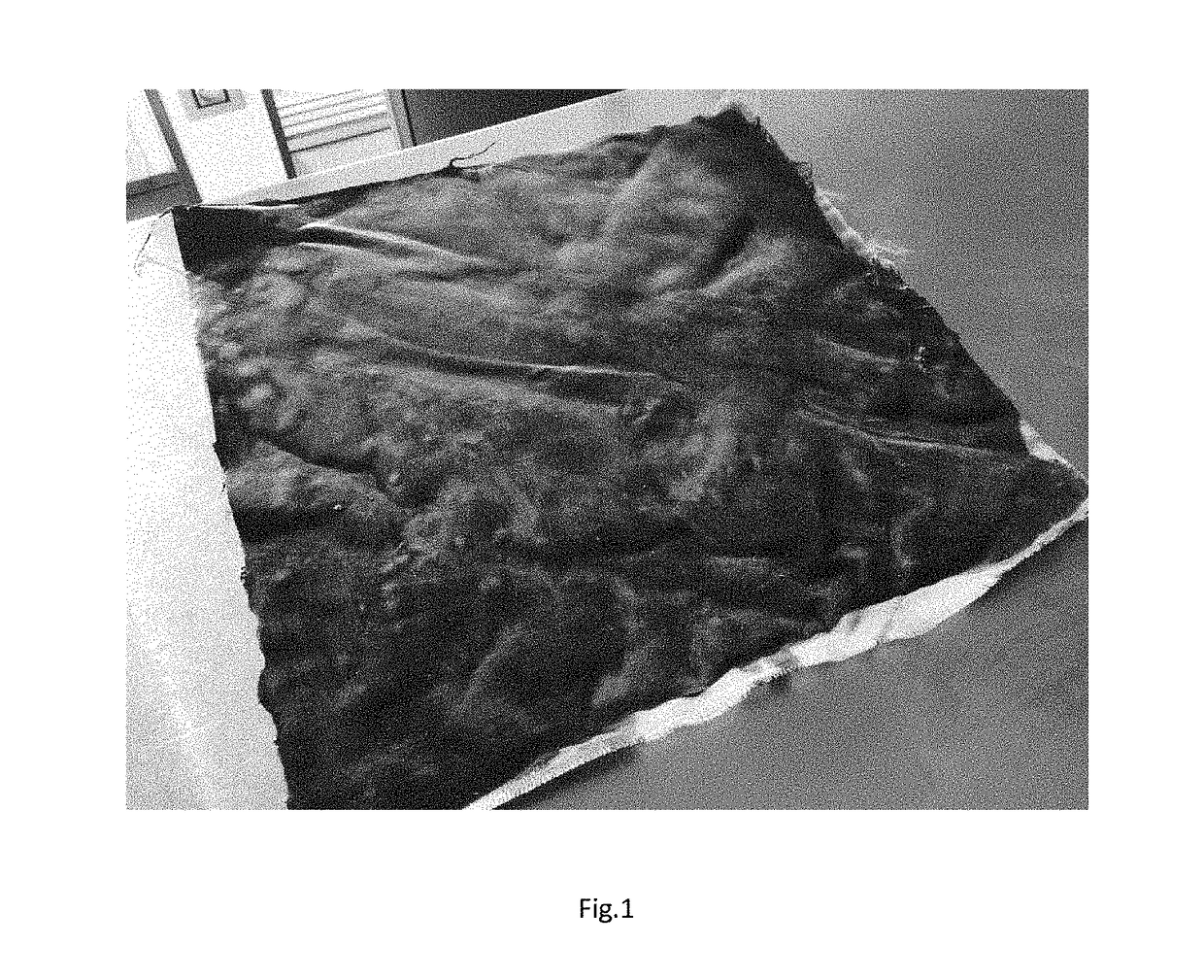
Figure 1
Abstract
Description
[0001] The present invention concerns a flexible composite containing a metal powder, preferably copper, which may further comprise a woven or nonwoven web; the use of such composites in various objects or textiles such as curtains or bags; and the method for producing same.INTRODUCTION
[0002] At the dawn of the 1980s, a novel technique appeared which revolutionized the way in which the world works metal.
[0003] This technique, which consists schematically in combining metal and binder, makes it possible to quickly coat almost any support, whatever the form or nature (laminates, melamines, wood, plastics, plaster, glass fiber, ceramics, concrete, foams, porcelain, glass and metal), while following surface details perfectly.
[0004] This true composite material is available today in several varieties, thus solving the numerous problems associated with the use of solid metal.
[0005] Thus, objects that would be too heavy or too expensive to make of solid metal, or would involve overly burdensome...
Examples
examples
[0209]In order to illustrate the present invention, the following examples were prepared. In no case is the object of the present invention limited to these examples alone.
[0210]1. CuP8-Based Powders
[0211]CuP8 powder, the particle size of which is not controlled, is known to be used in brazing.
[0212]Conventionally, it has the following characteristics:[0213]Nominal composition (% mass): Cu: 92[0214]P: 8[0215]Melting point: 710-750° C.[0216]Density: 8 g / cm3 [0217]Protocol for fabricating the copper-phosphorus powder according to the invention
[0218]According to the present invention, the copper-phosphorus alloy containing a percentage of phosphorus between 2% and 16%, preferably 8%, is introduced into the melt bath. This alloy is then atomized with water under conditions such that the particle size results must be between 8 and 150 μm (D50); the oxygen content is between 0.3% and 5% by weight.[0219]The following powder was thus obtained:
TABLE 1Particle size, cumulative % retained (ISO...