
Impact modified carbonate polymer composition having improved resistance to degradation and improved thermal stability
a technology of thermoplastics and carbonates, applied in the field of impact modified thermoplastic aromatic carbonate polymer compositions, can solve the problems of rubbery modifiers, especially troublesome alkali metal carboxylates, etc., and achieve the effects of reducing residual surfactant levels, allowing flexibility in preparation, and improving stabilization to degradation or transesterification
Patent Information
- Authority / Receiving Office
- US · United States
- Patent Type
- Patents(United States)
- Current Assignee / Owner
- Publication Date
- 2008-07-01
- Estimated Expiration
- Not applicable · inactive patent
Smart Images

Figure 1 
Figure 2 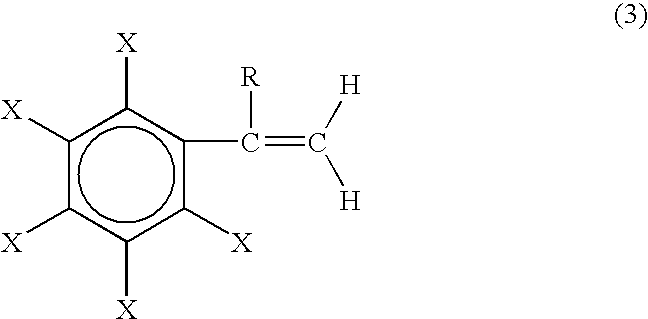
Figure 3
Abstract
Description
[0001] This is a continuation of application serial no. 08 / 923,650 filed on Sep. 4, 1997 now U.S. Pat. No. 6,545,089, which is incorporated herein by reference.FIELD OF THE INVENTION
[0002] The present invention is directed to an impact modified thermoplastic aromatic carbonate polymer composition having improved resistance to transesterification or degradation and improved thermal stability. More specifically the composition of this invention comprises in combination an aromatic polycarbonate resin and an impact modifier that essentially does not catalyze transesterification or degradation of an aromatic carbonate polymer composition.BACKGROUND OF THE INVENTION
[0003] Addition of rubbery impact modifiers is commonly used to improve the toughness of aromatic carbonate polymer compositions. In comparing the effectiveness of various rubbery modifiers large differences in melt stability are often observed. In aromatic carbonate polymer compositions, the polycarbonate portion of the composit...
Examples
example 1
[0060]Polycarbonate resin having an intrinsic viscosity of about 0.43 dl / g (deciliter per gram) as measured in methylene chloride at about 20° C. was extruded using a 130 mm W-P twin screw extruder with additives as set forth in TABLE 1 below. The extrudate was pelletized and dried at about 120° C. for about 2 hours. The dried pellets were then injection molded into test specimens wherein the barrel temperature of the injection molding machine varied from about 285° C. to about 300° C. Formulation A is a comparative formulation and Formulation 1 is a formulation of this invention. The test results obtained are in TABLE 1 as follows.
[0061]
TABLE 1A1FORMULATIONPolycarbonate100100Stabilizer (hindered phenol - aryl0.390.39phosphite)Mold Release (pentaerythritol tetra00.1stearate) (PETS)Impact Modifier 14—Impact Modifier 2—4PROPERTIESTensile Elongation (%)3354MVI @ 6 mins. 300° C. (ml / 10 mins.)16.816.7MVI 18 mins. @ 300° C. (ml / 10 mins.)21.518.8MVI Shift, (18-6 mins.) %28 (%)13 (%)Impact ...
example 2
[0063]Example 1 was repeated except that the formulations employed herein were as set forth in TABLE 2. Formulation B and C are comparative examples and Formulation 2 and 3 were formulations of this invention.
[0064]
TABLE 2B2C3FORMULATIONPolycarbonate100100100100Stabilizer0.60.60.60.6Mold Release (PETS)0.150.20.1Impact Modifier 144Impact Modifier 244PROPERTIESTensile Elongation (%)75997086MVI, 6 mins. @ 300° C.17.616.917.919.2(ml / 10 mins.)MVI, 18 mins. @ 300° C.18.91618.918.9(ml / 10 mins.)MVI Shift (18-6 mins) %7−56−2Impact modifiers 1 and 2 are the same as employed in Table 1.Same stabilizer and mold release as employed in Table 1 except stabilizer also contained a thioester.
example 3
[0065]Example 1 was repeated except that a polycarbonate had an IV of about 0.46 dl / g and a 30 mm twin screw extruder was employed herein. Formulation D, E, F, G, and H (Table 3) are comparative formulations. Formulations 4-8 (Table 4) are formulations of this invention.
[0066]
TABLE 3DEFGHFORMULATIONPolycarbonate100100100100100Stabilizer0.390.390.390.390.39Carbon Black phr1.01.01.01.01.0Impact Modifier 14.04.04.04.04.0Mold Release—0.10.2——(PETS)Polyalphaolefin———0.10.2Mold ReleasePROPERTIESMVI, 6 mins. @14.617.315.915.915.2300° C. (ml / 10mins.)MVI 18 mins.15.519.317.918.118.0Preheat @300° C. (ml / 10mins.)MVI Shift (18-6612131418mins.) %Same impact modifier 1 as employed in Table 1, Example A.Same stabilizer and mold release as employed in Table 1, Example 1.Carbon Black is 25% concentrate in a PC resin carrier.
[0067]
TABLE 445678FORMULATIONPolycarbonate IV-1001001001001000.45 dl / gStabilizer0.390.390.390.390.39Carbon Black1.01.01.01.01.0Impact Modifier 24.04.04.04.04.0PolyalphaolefinMold...