
High speed downlink packet access communication in a cellular communication system
A cellular communication system, downlink technology, applied in the field of support for remote stations, can solve problems such as high protocol complexity, and achieve the effects of low complexity, improved support, and improved performance
- Summary
- Abstract
- Description
- Claims
- Application Information
AI Technical Summary
Problems solved by technology
Method used
Image

Examples
Embodiment Construction
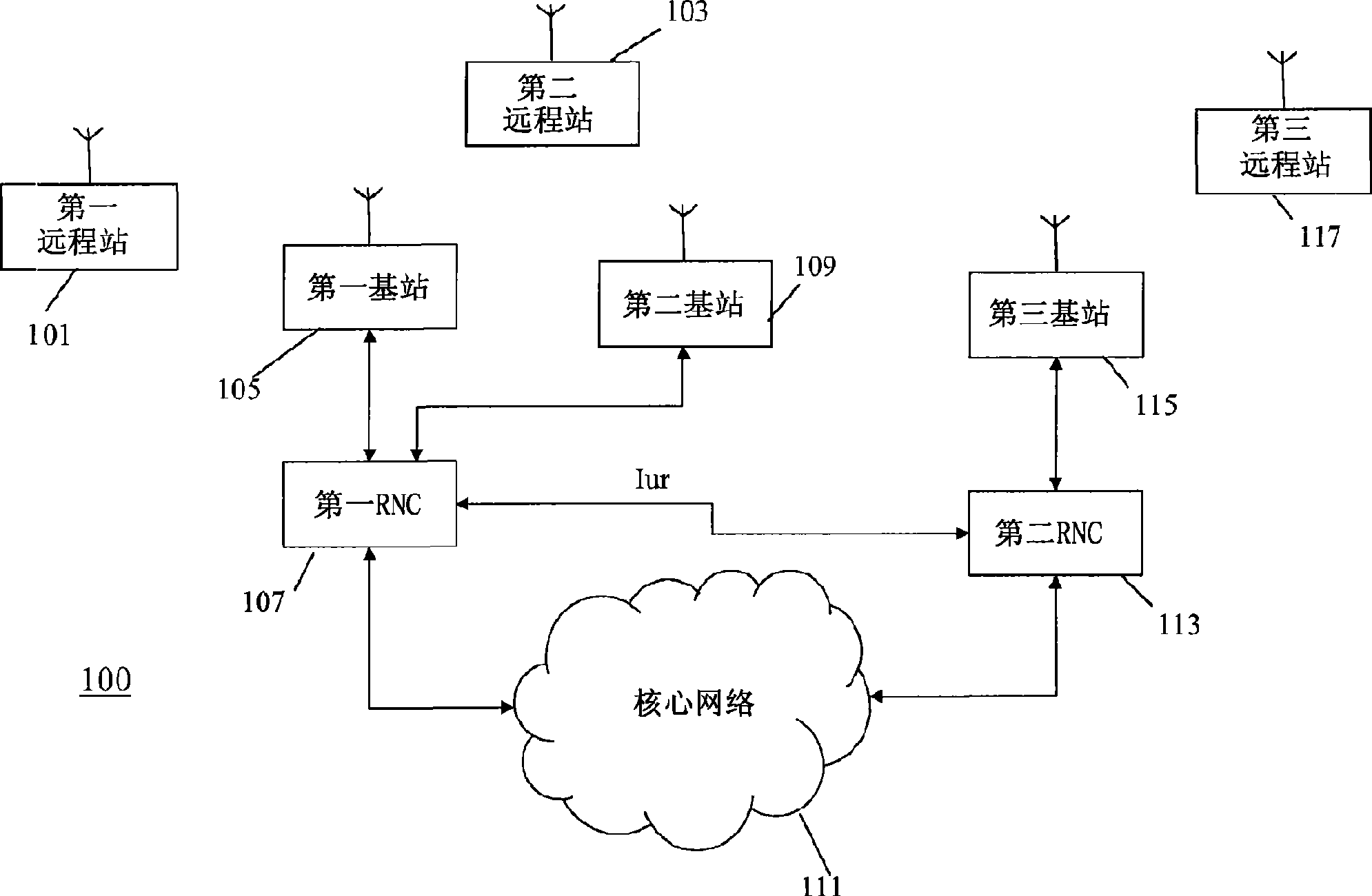
[0058] figure 1 An example of a UMTS cellular communication system according to some embodiments of the present invention is shown.
[0059] In a cellular communication system, a geographic area is divided into cells, each of which is served by a base station. The base stations are connected to each other by a fixed network that can communicate data between the base stations. A remote station, such as a user equipment (UE) or mobile station, is served via a wireless communication link by the base station of the cell within which the remote station is located.
[0060] exist figure 1 In the example, the first remote station 101 and the second remote station 103 are in a first cell supported by the first base station 105 .
[0061] The first base station 105 is coupled to a first RNC 107 which is further coupled to a second base station 109 . The RNC performs various control functions related to the air interface, including radio resource management and data routing to and f...
PUM
 Login to View More
 Abstract
Description
Claims
Application Information
 Login to View More