
Target quaternary ammonium salt cationic polymer lipid gene carrier, preparation method and application thereof
A technology of quaternary ammonium salt cations and cationic lipids, which is applied in liposome delivery, non-active ingredients of polymer compounds, gene therapy, etc., can solve the problems of low transfection efficiency, poor pertinence, and high cost, and achieve simple preparation methods , less drug leakage, good stability
- Summary
- Abstract
- Description
- Claims
- Application Information
AI Technical Summary
Problems solved by technology
Method used
Image

Examples
Embodiment 1
[0050] This example discusses the effect of different ratios of polyethyleneimine tris(octadecyl)ammonium chloride (PQA) and cholesterol on the particle size of cationic polymer liposomes when the reverse evaporation method is adopted.
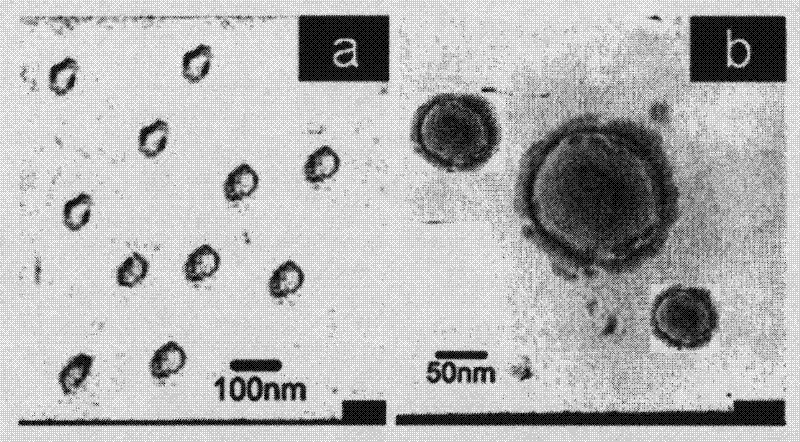
[0051] PQA (the weight-average molecular weight is 20,000) and cholesterol in different proportions are co-dissolved in dichloromethane, and mixed to obtain solution I; prepare deionized aqueous solution II, wherein the ratio of solution I and solution II is 1:2; After the two solutions were mixed, they were fully ultrasonically emulsified, and dichloromethane was distilled off under reduced pressure on a rotary evaporator to obtain a polymer liposome solution. As can be seen from Table 2, adjusting the mass ratio of PQA and cholesterol can obtain polymer liposomes with different particle sizes, and the particle size distribution of the cationic polymer liposomes in aqueous solution is also relatively uniform. in figure 1 It is a TEM photo of...
Embodiment 2
[0055] This example mainly provides an example of using other lipid components to prepare cationic polymer liposomes.
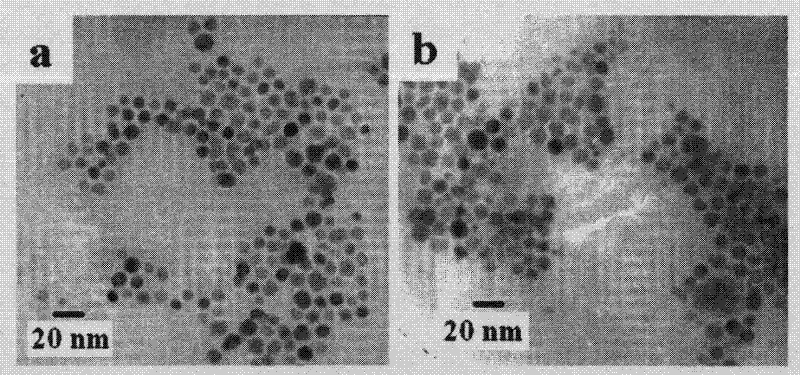
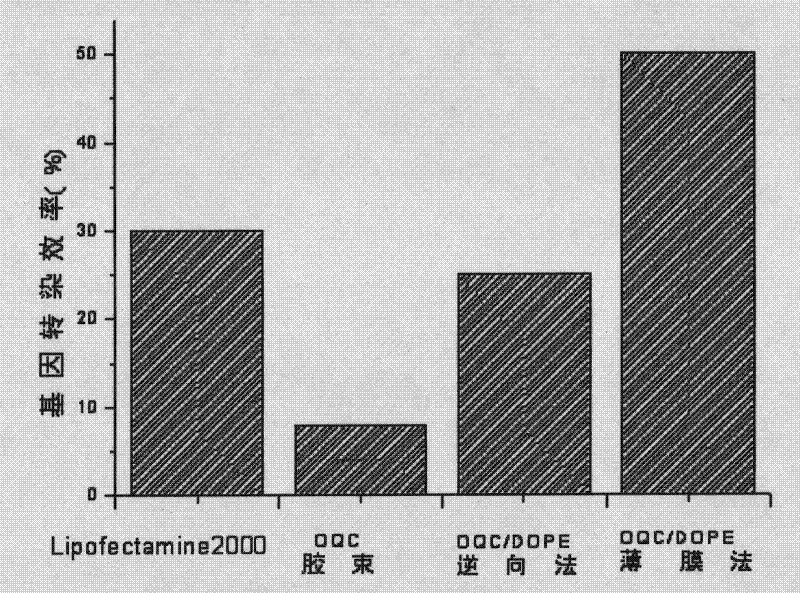
[0056] Weigh carboxymethyl chitosan-based tri(octadecyl)ammonium chloride (quaternary ammonium salt substitution degree is 90.0%, weight average molecular weight is 1000) 15.0mg, DOPE 12.0mg is dissolved in 3.0ml dichloromethane , oscillate evenly to obtain solution I, put it into an eggplant-shaped bottle, distill under reduced pressure on a rotary evaporator, and pass nitrogen gas from time to time until the dichloromethane is completely volatilized, then dry it in vacuum at room temperature for 24 hours, and then use 3.0 mg of water-soluble 5.0ml PBS (pH = 7.4) buffer solution II of magnetic particles was ultrasonically hydrated for 10min (thin film method); or the solution I solution II was blended and emulsified, ultrasonically 10min, after forming a stable emulsion, put it into an eggplant-shaped bottle, and Distill under reduced pressure on a rotary ev...
Embodiment 3
[0059] This example is a method for preparing PEG-modified cationic polymer liposomes. PEG-modified positive
[0060] This example is a method for preparing folic acid-modified cationic polymer liposomes. Take folic acid-modified cationic polymer liposome FA-PQA (folate-modified polylysine-based tri(octadecyl)ammonium chloride) / PQA / cholesterol as an example: first prepare FA-PQA, Then assemble, the specific experimental process is as follows:
[0061] (1) Preparation of FA-PQA:
[0062] Dissolve 2.5g of folic acid FA in 50mL of DMSO solution, add 1.5ml of triethylamine to it, dissolve 1.3g of NHS with a certain amount of DMSO, add it to the above reaction system and react in the dark for more than 12 hours. The product was filtered to obtain the NHS-FA active as a yellow solid. Take 1.0 g of NHS-FA active substance and dissolve it in 25 mL of DMSO, and add a certain amount of PQA. use Na 2 HPO 4 Adjust the pH of the reaction system to 10 with NaOH buffer solution, and r...
PUM
 Login to View More
 Abstract
Description
Claims
Application Information
 Login to View More